
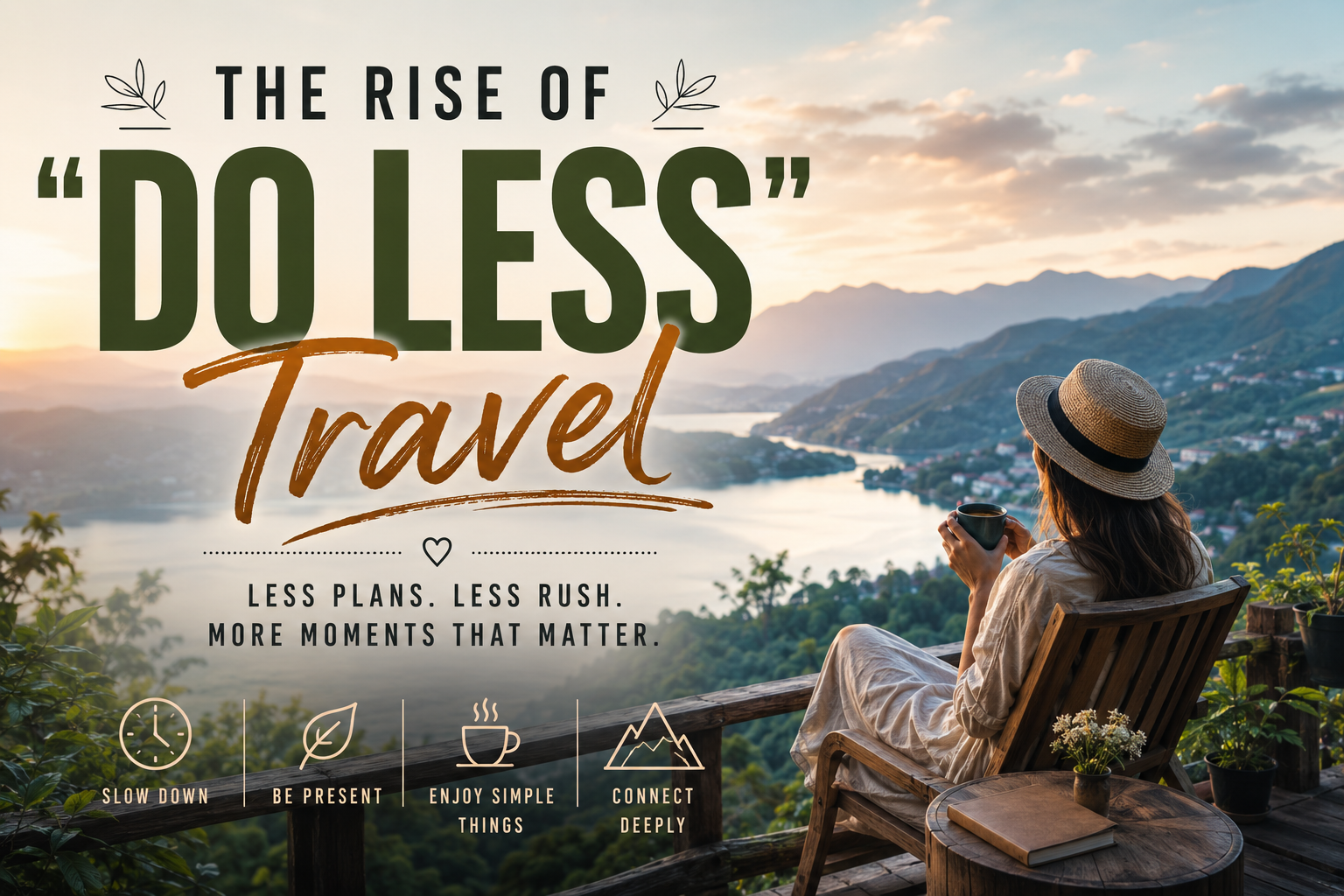
For years, travel was treated like a checklist.
Wake up early.
Visit five places in one day.
Take the photos.
Try every famous café.
Cover every attraction.
Move fast.
Do more.
Come back exhausted.
Somewhere along the way, travel started feeling less like escape and more like performance.
And now, travelers are quietly pushing back.
A new kind of travel is rising.
One that asks a very different question:
What if the best trip isn’t the one where you do more—but the one where you do less?
The Era of Overpacked Travel
Modern travel often became strangely intense.
A three-day trip somehow needed:
- sunrise viewpoints
- tourist attractions
- shopping
- food hopping
- hidden gems
- nightlife
- “must-see” experiences
By the end of the trip, people needed recovery from the vacation itself.
The irony is obvious.
Travel was supposed to refresh us.
Instead, many trips became exhausting.
Social Media Made It Worse
A big reason?
Comparison.
Travel stopped being just about personal experiences.
It became visual proof.
If someone visits Bali, we expect:
beach clubs, swings, waterfalls, cafés, drone shots, luxury breakfasts, sunsets.
If someone visits Europe:
landmarks, train rides, museums, shopping streets, perfect photos.
The pressure became subtle—but powerful.
People began traveling not just to experience places, but to “cover” them.
And covering a place is very different from actually being there.
Travelers Are Tired
Something changed.
People realized:
constant movement isn’t always enjoyable.
Packing and unpacking every day gets tiring.
Long itineraries create stress.
Trying to maximize every hour creates pressure.
The result?
Travel burnout.
And increasingly, travelers are rejecting that.
Enter “Do Less” Travel
This new mindset is simple:
Stay longer.
Rush less.
Plan fewer things.
Leave room for nothing.
Instead of trying to experience ten places in three days, travelers choose one.
Instead of strict itineraries, they choose flexibility.
Instead of running between attractions, they sit longer in cafés.
Walk unfamiliar streets.
Watch sunsets without checking time.
Sleep without alarms.
Travel becomes slower.
And strangely, richer.
The New Luxury Is Space
Luxury used to mean expensive hotels.
Now, for many people, luxury means something else:
time.
Silence.
No schedule.
No rush.
No pressure to optimize every hour.
The freedom to wake up and decide nothing.
That kind of travel feels deeply different.
Because real rest doesn’t come from beautiful locations alone.
It comes from mental space.
Doing Less Creates Better Memories
Interestingly, the trips people remember most are rarely the most efficient ones.
They remember:
unexpected conversations
quiet walks
slow breakfasts
rainy afternoons in unknown cafés
doing absolutely nothing with someone they care about
The most meaningful moments often happen when there’s room for them.
Overplanning leaves no room.
Slow Travel Is Becoming Aspirational
What once looked “lazy” now looks intentional.
Travelers increasingly want:
fewer destinations
deeper experiences
less rushing
more presence
less content creation
more real memories
And honestly, it makes sense.
Because not every trip needs to be productive.
Final Thought
Travel was never meant to become another performance metric.
Not every destination needs to be conquered.
Not every day needs a checklist.
Sometimes the most beautiful part of travel is having nowhere urgent to be.
Because maybe the best journeys are the ones where we finally stop trying to do everything.