
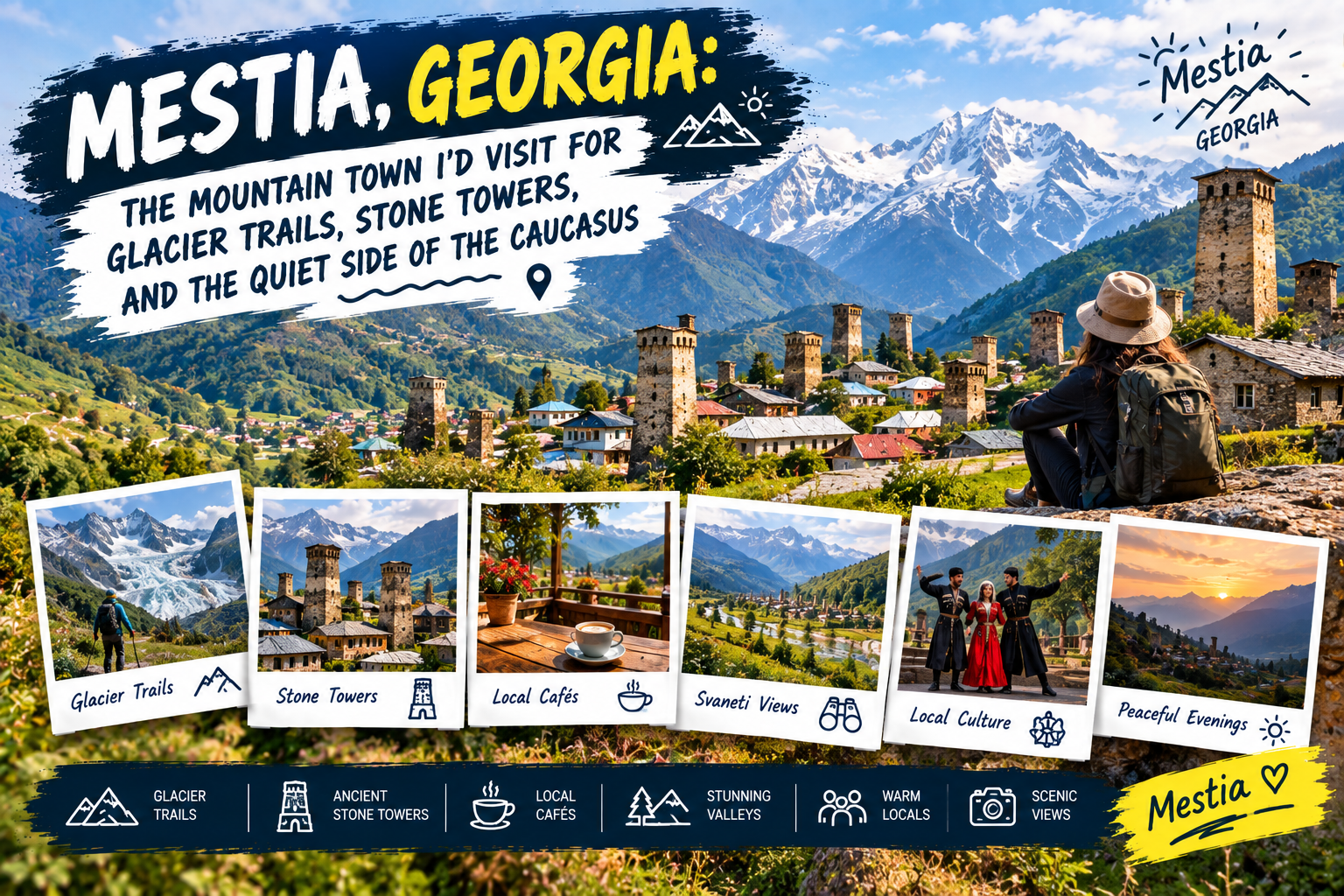
There is a version of Georgia that many travelers never reach – Mestia.
They land in Tbilisi, spend a few days wandering the old town, perhaps head toward Kakheti for wine, and leave feeling like they have experienced the country.
They have not seen Mestia.
I had not either until I finally made the journey into Svaneti.
Mestia sits at around 1,500 metres in northwestern Georgia, surrounded by some of the most dramatic mountains of the Caucasus. Stone towers rise above traditional houses, hiking trails disappear into pine forests, and glaciers sit beyond the town like reminders that the mountains here still set the pace.
Getting there takes effort.
That is part of what makes Mestia so memorable.
Where Is Mestia, Georgia, and Why Is It Special?
Mestia is the main town of Upper Svaneti, a historic mountain region in northwestern Georgia. The settlement sits in a valley surrounded by the Greater Caucasus, with peaks such as Ushba dominating the landscape.
Svaneti developed in relative isolation for centuries.
That isolation shaped everything from architecture and food to local traditions and defensive structures. The region’s distinctive stone towers were built as fortified homes and places of refuge, creating a landscape unlike almost anywhere else in Georgia.
Upper Svaneti is also recognised by UNESCO for its exceptional medieval mountain landscape and traditional architecture.
Mestia today is the practical base for exploring this region.
It has guesthouses, restaurants, hiking routes, museums, transport connections, and tour operators, but it still feels small enough that the surrounding mountains remain the main attraction.
Mestia and the Caucasus Mountains
The first thing that struck me was not a particular building.
It was the scale of the landscape.
Mestia feels small when you look toward the mountains. Roads, houses, and towers occupy a narrow part of the valley while enormous peaks rise beyond them.
The contrast is what makes the town so memorable.
One moment you are drinking coffee in the centre of Mestia.
A few minutes later, you are looking at snow-covered mountains.
Svan Towers in Mestia: The Architecture That Defines Svaneti
The stone towers are impossible to miss.
They rise beside homes and appear throughout the surrounding villages, creating a skyline that feels more like a medieval fortress settlement than a modern mountain town.
Many of these structures date from the medieval period and were connected to the defensive traditions of Svan communities.
Why Are Mestia’s Svan Towers Important?
The towers were not built as monuments for tourists.
They served practical defensive purposes and formed part of the traditional settlement pattern of Svaneti.
Walking through Mestia, I kept noticing how naturally these structures fit into the town.
A tower might stand beside a family home.
Another would appear behind a garden.
Further along the road, another stone structure would rise against the mountains.
The result is a landscape where history is not separated from everyday life.
Svaneti Museum of History and Ethnography
For a deeper understanding of the region, the Svaneti Museum of History and Ethnography is worth adding to a Mestia itinerary.
The museum provides context about Svaneti’s history, culture, religious art, manuscripts, and traditional life.
I found that seeing the towers first and then learning about their history made the architecture much more meaningful.
Instead of simply photographing an old stone building, I could understand why it existed.
Mestia Hiking Trails: From Forest Walks to High Mountain Lakes
Hiking is one of the biggest reasons to visit Mestia.
The town works as a base for several trails, ranging from relatively accessible walks to demanding mountain routes.
Weather matters enormously here.
Mountain conditions can change quickly, and trail difficulty can be very different from what a route description initially suggests.
Chalaadi Glacier Hike Near Mestia
The Chalaadi Glacier trail was one of the experiences I had been looking forward to most.
The route takes you from the Mestia area toward the glacier through a landscape of forest, river, rock, and increasingly rugged mountain scenery.
As you approach the glacier, the environment changes.
Trees become less dominant.
The valley narrows.
Rock and ice begin to take over.
Eventually, you reach the glacier itself.
Standing there, with meltwater moving away from the ice and enormous rock walls surrounding the valley, made the journey feel worthwhile.
The exact hiking conditions and access can change with weather, so local advice is important before setting out.
Koruldi Lakes: The Higher View of Mestia
For a more demanding hiking day, Koruldi Lakes offers a completely different perspective.
The trail climbs above Mestia toward alpine terrain, with increasingly expansive views over the surrounding mountains.
On a clear day, Mount Ushba becomes one of the defining features of the panorama.
This is not the hike I would choose for a casual afternoon.
Start early, carry sufficient water, wear proper hiking footwear, and allow enough time to return before conditions deteriorate.
The higher you go, the more quickly weather can become a factor.
Ushguli From Mestia: A Journey Into Upper Svaneti
Ushguli is one of the most famous places to visit from Mestia.
The collection of villages sits at a much higher elevation and is known for its historic architecture, stone towers, dramatic mountain setting, and views toward Shkhara.
Ushguli is also part of the UNESCO-listed Upper Svaneti cultural landscape.
Why Visit Ushguli From Mestia?
The journey itself is part of the experience.
The road winds through the mountains, and the landscape gradually becomes more remote.
When you finally arrive, the combination of stone towers, traditional buildings, open valleys, and huge mountain peaks makes Ushguli feel dramatically different from Mestia.
Lamaria Church is one of the best-known landmarks in the area.
Its setting, with the mountains rising behind it, is almost impossible to photograph badly.
Mestia to Ushguli: Trek or Drive?
Travelers generally experience the route in one of two ways.
A multi-day trek is an option for hikers who want to experience the landscape on foot.
A vehicle journey works better for travelers with limited time or those who prefer not to undertake a multi-day mountain trek.
The road can be rough, and travel times depend on conditions.
Rather than treating the journey as a simple transfer, I would consider it part of the Svaneti experience.
What to Eat in Mestia: Discovering Svan Cuisine
The mountains influence more than just the landscape.
Svaneti has its own culinary traditions, and eating local food is one of the easiest ways to understand the region.
Guesthouses can be particularly rewarding because family-run stays often serve homemade meals.
Svan Food to Try in Mestia
Look for traditional dishes such as kubdari, a meat-filled pastry associated with Svaneti, as well as regional cheeses, breads, potatoes, and dishes seasoned with the distinctive Svan salt blend.
And yes, there is khachapuri too.
Georgia has no shortage of excellent food, but eating a warm homemade meal after a day outside feels particularly satisfying in Mestia.
When Is the Best Time to Visit Mestia?
The best time to visit Mestia depends heavily on what you want to do.
For hiking, the warmer months are generally more practical, although conditions vary significantly by altitude and route.
Summer can bring better access to mountain trails, while spring and autumn can offer changing landscapes and fewer visitors.
Mestia in Summer
June through September is the main hiking period for many visitors.
Higher trails can still have snow early in the season, so conditions should always be checked locally.
July and August are popular because of generally better access to mountain routes, but they can also bring more visitors.
Mestia’s in Autumn
Autumn changes the character of Svaneti.
The forests become colourful, the air turns cooler, and the mountains begin transitioning toward winter.
September can be particularly appealing for travelers who want hiking conditions combined with early autumn scenery.
By later autumn, some mountain routes can become significantly more difficult.
Mestia’s in Winter
Winter creates a completely different version of the town.
Snow transforms the valley, and the region becomes relevant for winter activities and skiing.
However, the hiking experiences described in this article should not simply be assumed to remain accessible during winter.
Always check current road, trail, weather, and transport conditions before travelling.
How to Get to Mestia From Tbilisi
Mestia’s remote location means getting there takes planning.
That journey is one reason the town feels different from Georgia’s more accessible destinations.
Tbilisi to Mestia’s by Train and Marshrutka
One common option is to travel from Tbilisi toward Zugdidi and then continue by road to Mestia.
Marshrutkas and other road transport connect Zugdidi with Mestia, although schedules can change seasonally.
Another option is to arrange road transport directly, depending on your itinerary.
Flying to Mestia’s
Georgia also has domestic air connections serving the region, although flights can be affected by mountain weather.
That is important to remember before building a tightly scheduled itinerary around a flight.
If weather matters, leave some flexibility in your schedule.
Why the Journey to Mestia Is Part of the Experience
Mestia is not somewhere you accidentally end up while passing through Georgia.
The journey takes planning.
You cross from cities and lower valleys into increasingly mountainous terrain until the landscape completely changes.
By the time you arrive, the mountains have already become part of the trip.
Where to Stay in Mestia
Mestia has a range of accommodation, from guesthouses and family-run stays to more conventional hotels.
I would seriously consider staying at a local guesthouse.
The experience is not only about having a bed for the night.
It can also mean homemade food, conversations with hosts, and a closer connection to everyday life in Svaneti.
What to Look for in a Mestia Guesthouse
Before booking, check:
- Location within Mestia
- Heating availability during cooler months
- Breakfast and dinner options
- Wi-Fi availability
- Transport assistance
- Recent guest reviews
- Whether luggage storage is available for multi-day treks
A central location is convenient, while a property slightly outside the busiest area can offer better mountain views and a quieter atmosphere.
Practical Tips for Hiking in Mestia
Mestia is beautiful, but the mountains deserve respect.
Wear Proper Hiking Shoes
Some trails involve uneven ground, mud, loose rock, and steep sections.
Regular sneakers may not be enough for longer or more demanding routes.
Start Mountain Hikes Early
Starting early gives you more daylight and can help you avoid some afternoon weather changes.
That matters particularly for longer hikes such as Koruldi Lakes.
Check Local Trail Conditions
Trail conditions can change after rain, snowfall, landslides, or other weather events.
Ask your accommodation host, local guides, or tourism professionals about current conditions before leaving.
Carry Cash and Essentials
Cards may not work everywhere, especially away from larger businesses.
Carry enough cash along with water, snacks, sun protection, a rain layer, and a basic first-aid kit.
Mobile connectivity can also become limited once you leave town.
How Many Days Do You Need in Mestia?
Three to four days can provide a good introduction to Mestia.
That gives you enough time to explore the town, visit the museum, hike one major trail, and make a trip toward Ushguli.
If you want to complete the multi-day Mestia-to-Ushguli trek or add more mountain hikes, staying longer makes much more sense.
The biggest mistake would be trying to squeeze Svaneti into a single rushed day.
Mestia rewards time.
Why Mestia Stayed With Me
Georgia has no shortage of places that look beautiful in photographs.
Mestia felt different.
The towers were not built to become Instagram backgrounds.
The glacier was not waiting for tourists.
The mountains were not trying to impress anyone.
They were simply there.
That is what I liked most about Mestia.
The town does not feel arranged around visitors. Life continues around the towers, guesthouses, livestock, mountain roads, rivers, and trails.
There is noise, of course.
You hear rivers.
You hear wind.
You hear dogs and cowbells.
You hear conversations drifting from guesthouses.
But there is less of the constant pressure to consume an attraction and move on.
That is the quiet side of the Caucasus I was looking for.
Frequently Asked Questions About Mestia
What is Mestia, Georgia known for?
Mestia is known for its historic Svan towers, mountain landscape, Upper Svaneti cultural heritage, hiking trails, and access to destinations such as Chalaadi Glacier, Koruldi Lakes, and Ushguli.
Is Mestia worth visiting?
Mestia is particularly suited to travelers interested in mountain landscapes, hiking, history, traditional architecture, local food, and the culture of Svaneti.
How many days do you need in Mestia?
Three to four days is a useful starting point for exploring Mestia, hiking one or two trails, and visiting Ushguli. Longer stays are better for multi-day treks and additional mountain hikes.
Can you visit Mestia without hiking?
Yes. You can explore the town, see the Svan towers, visit the Svaneti Museum, experience local food, and travel to places such as Ushguli without completing a major trek.
What is the best time to visit Mestia?
For hiking, June through September is generally the most practical period, although mountain conditions vary. September can offer a combination of hiking opportunities and early autumn scenery.
How do you get from Tbilisi to Mestia?
Travelers can reach Mestia by combining rail or road travel toward Zugdidi with onward road transport, arrange a direct road journey, or consider a domestic flight when operating and weather conditions permit.
Is Mestia good for a Georgia mountain trip?
Mestia is one of the main bases for exploring Svaneti and the Georgian Caucasus. Its combination of historic architecture, hiking trails, mountain scenery, and access to villages such as Ushguli makes it a natural choice for a mountain-focused Georgia itinerary.
Final Thoughts
I went to Mestia for the mountains.
I stayed for the feeling of being somewhere that still moves at its own pace.
The stone towers, glacier trails, forest paths, homemade food, and enormous Caucasus peaks were everything I had hoped to find.
But the thing I remember most is how small everything felt against the mountains.
Mestia does not need to convince you that it is special.
You arrive, look up, and understand.
Internal Links
- The World’s Most Breathtaking Cliffside Villages You Need to See Once in Your Lifetime
- Hidden Gems: Why Offbeat Travel Creates the Best Memories
- The Rise of Do-Less Travel
- The Joy of Getting Lost: Why Unplanned Travel Adventures Are the Most Rewarding
- The Future of Sustainable Travel: How to Explore Without Leaving a Trace
- The Hidden Mental Health Benefits of Travel
- Experience-Led Travel 2026: Okinawa, Marrakech, Swiss Alps