
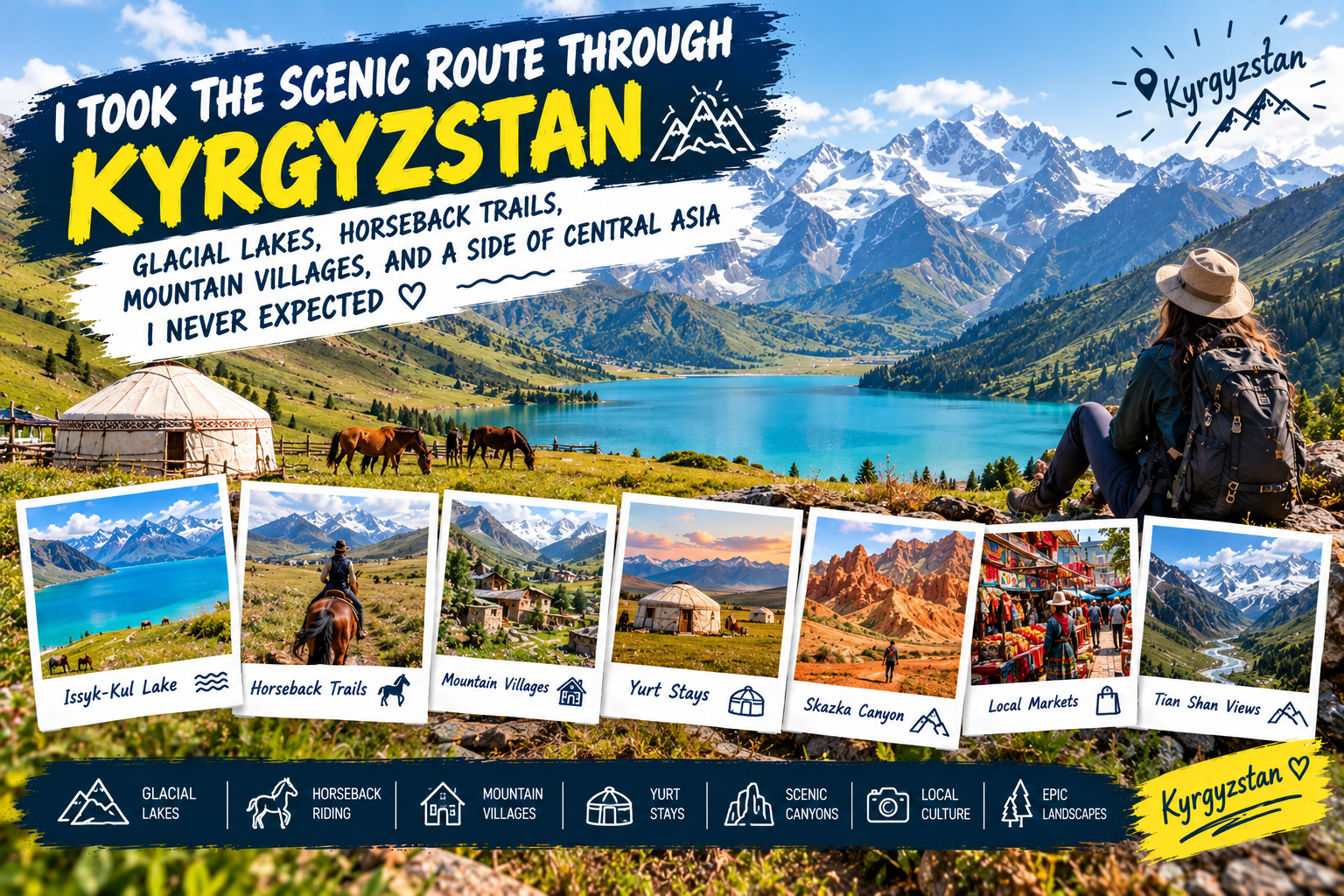
Kyrgyzstan travel was never part of my original plan. It was supposed to be a stopover, a country I’d cross on my way to somewhere else, somewhere with a bigger name and a longer Wikipedia page.
It was supposed to be a stopover. I thought I would cross the country on my way to somewhere else, somewhere with a bigger name and a longer Wikipedia page.
Three weeks later, I was sitting outside a yurt at nearly 3,000 meters. I was drinking salty milk tea I had not asked for and did not quite want.
Nearby, a shepherd moved his flock down a ridge the color of rust. At that moment, I understood that I was no longer in a stopover.
I was somewhere that had quietly rearranged my idea of what a trip through Central Asia could be.
This is the long way of saying: skip the highlights reel.
Kyrgyzstan travel is not about rushing from one famous attraction to another. It is about taking the long road, sleeping beside alpine lakes, riding through mountain valleys, and spending time in villages that most travelers never reach.
Here is the actual route, the actual dust, and the actual reasons Kyrgyzstan travel keeps pulling people back.
Exploring the dramatic mountain landscapes that define Kyrgyzstan travel.
Why Kyrgyzstan Travel Does Not Get the Credit It Deserves
Ask most people to point to Kyrgyzstan on a map and you will probably get a shrug.
The country sits between Kazakhstan, Uzbekistan, Tajikistan, and China. It is landlocked and mountainous, with roughly ninety percent of the country sitting above 1,500 meters.
The Tian Shan peaks fill the eastern half of the country like a wall someone forgot to mention.
There is no ocean. There are no famous ruins. There is also no single postcard image that appears on every traveler’s feed.
And that, it turns out, is exactly the appeal.
A Different Kind of Central Asia Travel
Kyrgyzstan never had to build a tourism industry around convincing you that it was worth seeing.
It simply is.
The Silk Road passed through here for a reason. The caravanserais and trade routes still show it.
Today, you can rent a horse instead of a camel. In addition, you can find a homestay with a wood stove waiting at the end of many valleys.
That combination makes Kyrgyzstan travel feel different from the more familiar routes through Central Asia.
If you want a broader route through the region, you can also explore our Central Asia travel routes.
Bishkek: The Starting Point for Kyrgyzstan Travel
I landed in Bishkek expecting a functional and forgettable capital city.
Instead, I found wide Soviet-era boulevards lined with poplar trees. Old men played chess in Panfilov Park.
Then there was Osh Bazaar.
Do not confuse it with the city of Osh. This Bishkek market sells everything from dried apricots to secondhand car parts within the same fifty meters.
Bishkek is not so much a destination as a decompression chamber.
You land and buy a SIM card. After that, you eat plov and manti until you are uncomfortable.
Finally, you head for the hills.
The hills are the actual point.
How Long to Spend in Bishkek
I would give Bishkek a day, maybe two.
That is enough time to visit Ala-Too Square and wander through the State History Museum. You can also get a feel for how young this country still is as an independent state.
After that, get out.
For travelers building their itinerary around Kyrgyzstan travel, Bishkek works well as a starting point before heading into the mountains.
Song-Kul Lake: Sleeping Above the Clouds
The road to Song-Kul climbs through a pass that makes your ears pop twice.
Then the land simply opens up.
Song-Kul sits at about 3,016 meters. The high alpine lake is surrounded by grazing land where herders bring their livestock during the summer months.
There are no permanent buildings out here. Instead, yurt camps appear in June and disappear by October.
Life Around Song-Kul
I stayed with a family that had followed the same seasonal migration for three generations.
The daughter was maybe nineteen. She spoke better English than my guidebook and better Russian than either of us.
She also taught me to make kymyz, the fermented mare’s milk that Kyrgyz herders have been drinking for centuries.
I will not pretend that I loved the taste.
Still, turning it down would have been the wrong move entirely.
Nights Beside the Lake
At night, the temperature drops hard, even in July.
You sleep under more stars than you knew existed. A felt blanket keeps you warm, and someone’s grandmother probably made it.
In the morning, horses graze right against the yurt walls.
Meanwhile, the lake turns the color of hammered pewter before the sun clears the ridgeline.
That is one of those moments that makes Kyrgyzstan travel difficult to forget.
Horseback Trails and Kyrgyzstan Travel in Jyrgalan
If Song-Kul is where you learn to slow down, Jyrgalan Valley is where you learn to ride.
This eastern valley lies not far from Karakol. It has become the unofficial home of community-based horseback trekking in Kyrgyzstan.
For good reason, too.
The trails wind through larch forests and cross alpine passes. They also pass herding camps where dogs the size of small bears watch you with total indifference.
Learning to Ride in Jyrgalan
I had ridden horses exactly twice before this trip.
Both times were on a beach. Each ride followed a straight line at a walk.
Jyrgalan was completely different.
The route included narrow switchbacks and river crossings. My horse clearly knew the route better than I did.
Every so often, it reminded me of that fact by stopping to eat while I tugged uselessly at the reins.
My guide, a local man named Nurlan, laughed more than once.
He never laughed unkindly.
By day three, I trusted the horse more than I trusted myself.
That was probably the correct order of operations out there.
For anyone interested in Kyrgyzstan travel, Jyrgalan offers a chance to experience the country’s mountain landscapes on horseback.
Multi-Day Horseback Trekking
The multi-day horseback trekking routes through Jyrgalan can last anywhere from two nights to a full week.
Some routes connect to Karakol. Others loop back through smaller villages.
You sleep in guesthouses or homestays. You eat whatever the family is eating.
By the end, your legs ache in places you did not know had muscles.
If you have a separate Karakol trekking guide, this is a natural place to link to it.
Ala-Kul Lake: The Turquoise Payoff
No conversation about Kyrgyzstan hiking gets far without someone mentioning Ala-Kul Lake.
The mentions are earned.
The trek to Ala-Kul usually takes two or three days. Many hikers follow a loop from Karakol or the Altyn-Arashan hot springs.
The trail climbs to a pass just over 3,860 meters.
Then you drop into a bowl holding a lake so turquoise that it looks corrected in an editing app.
It is not.
That color comes from glacial silt suspended in the water. No filter is doing you any favors. The lake does the work itself.
Reaching the Ala-Kul Pass
The climb to the Ala-Kul pass is the hardest part of the trip.
The air gets thin. The scree becomes loose.
Meanwhile, the wind seems personally offended by your presence.
Then you crest the ridge.
The lake is suddenly there, glowing below you.
Every complaint you had on the way up seems to disappear.
I sat on a boulder for close to an hour. I did not take a single photo during the first twenty minutes.
That tells you something because I am not usually a person who resists that urge.
The trek is one of the experiences that makes Kyrgyzstan travel so memorable.
Ending the Trek at Altyn-Arashan
Afterward, most trekkers descend to Altyn-Arashan.
The valley has natural hot springs where you can soak your sore legs in mineral water.
Snow-capped peaks sit directly overhead.
As a result, the hot springs make a memorable ending to a difficult multi-day trek.
Kyrgyzstan Travel Through the Mountain Villages
Somewhere in the middle of the country, tucked into a red-rock canyon along the Kokemeren River, sits Kyzyl-Oi.
Most itineraries pass straight through on the way to somewhere with a bigger name attached.
That is a mistake.
The canyon walls here are a deep rust-red. The river runs bright green with glacial melt.
The village itself has maybe a few hundred residents. People still farm, herd, and host travelers in spare rooms.
Getting Stuck in Kyzyl-Oi
I stayed two nights longer than planned because a landslide closed the road.
Fortunately, I have never minded being stuck somewhere less.
An older woman named Aigul fed me more bread and jam than I could reasonably eat. Twice, she refused to let me help with the dishes.
Her grandson took me up the canyon on foot to a spot where eagles nest.
We did not share more than thirty words of a common language during the entire walk.
It did not matter.
Hospitality in Kyrgyz Mountain Villages
Small Kyrgyz mountain villages such as Kyzyl-Oi, Kochkor, and Arslanbob show the country’s hospitality culture particularly well.
That culture comes from centuries of nomadic tradition.
There is a word, kunak asy, that roughly means the guest’s meal.
The idea describes an obligation that many Kyrgyz families still take seriously.
A guest is fed first. A guest is fed best. The guest is rarely allowed to pay for it.
These villages reveal another side of Kyrgyzstan travel, far from the country’s better-known trekking routes.
Tash Rabat: A Caravanserai on the Silk Road
Near the Chinese border, at more than 3,500 meters, sits Tash Rabat.
It is a stone caravanserai built into a hillside. Its exact date varies depending on which historian you ask, with estimates ranging from the 10th to the 15th century.
Merchants once stopped here to rest and shelter from the cold. They travelled along the route between Kashgar and points west.
Today, Tash Rabat is mostly empty.
A domed stone building sits beside a handful of yurt camps. Most days, there are almost no other visitors.
Inside Tash Rabat
Standing inside the cold stone corridors, I thought about how many people had passed through this exact spot.
They carried silk, spices, and news from places that no longer exist under the same names.
Tash Rabat does not get crowded.
It does not try to sell you anything.
Instead, it simply sits there, doing what it has done for close to a thousand years.
If your site has a separate article about Silk Road history in Central Asia, Tash Rabat is a natural place to connect the two.
Osh and the Ferghana Valley
The south of the country feels like a different place entirely.
Osh, one of the oldest cities in Central Asia, sits in the Ferghana Valley.
The city has a Silk Road bazaar that has traded continuously, by most accounts, for more than two thousand years.
Osh also has a different rhythm from the north.
There is more Uzbek influence. The food is different. You hear a wider mix of languages on the street.
Sulaiman-Too at Sunset
I climbed Sulaiman-Too, the sacred mountain that rises from the middle of the city, at sunset.
The call to prayer rolled across the valley.
In the distance, the Pamir-Alay range sat blue against the horizon.
It is a strange feeling to stand on a mountain that pilgrims have climbed for more than a thousand years.
It is even stranger to do it in a city that many people outside the region have never heard of.
What Nobody Tells You Before Kyrgyzstan Travel
A few honest notes, gathered the hard way.
Roads and Travel Times
Roads in Kyrgyzstan are rough.
Travel times on a map are also almost always optimistic. Therefore, budget more hours than you think you need.
A journey that looks short on a map can take much longer in reality.
Cash and ATMs
ATMs are common in Bishkek and Osh.
They become much harder to find elsewhere.
For this reason, carry cash when you leave the larger cities.
Community Based Tourism
CBT, the Community Based Tourism network, supports much of the homestay and trekking infrastructure in smaller towns.
Using it puts money directly into the villages you are passing through.
It can also make it easier to arrange local stays and trekking experiences.
Altitude and Acclimatization
Altitude sickness is a real concern above 3,000 meters.
No amount of gym fitness replaces proper acclimatization.
For that reason, give yourself a few days to adjust before pushing higher into the mountains.
The Hospitality
Then there is the hospitality.
You will receive constant offers of tea, bread, and a place to sit.
It is not a performance for tourists.
Instead, it is simply how people live here. That hospitality will be extended to you whether you are ready for it or not.
These practical details can make Kyrgyzstan travel much easier, especially when you leave the larger cities.
The Country I Did Not Expect
I went to Kyrgyzstan for the mountains.
In the end, I left thinking about the people.
The glacial lakes are extraordinary. The horseback trails through valleys like Jyrgalan are some of the most memorable parts of Central Asia travel.
The mountain villages also hold onto a way of life that is disappearing in many other places.
But it is the small moments that I keep returning to.
A cup of tea I did not ask for.
A grandmother refusing to let me do the dishes.
A nineteen-year-old teaching me to make fermented mare’s milk with more patience than I deserved.
Those are the memories that stayed with me.
Kyrgyzstan does not need to be anyone’s stopover.
Give it the time it is asking for.
It may rearrange a few things you thought you knew about travel and about this stretch of the world.
It does so without ever raising its voice.
If you are planning Kyrgyzstan travel, take the long road when you can. Leave room for the mountain villages, the unexpected detours, and the conversations that were never part of the itinerary.
That is where much of the trip happens