
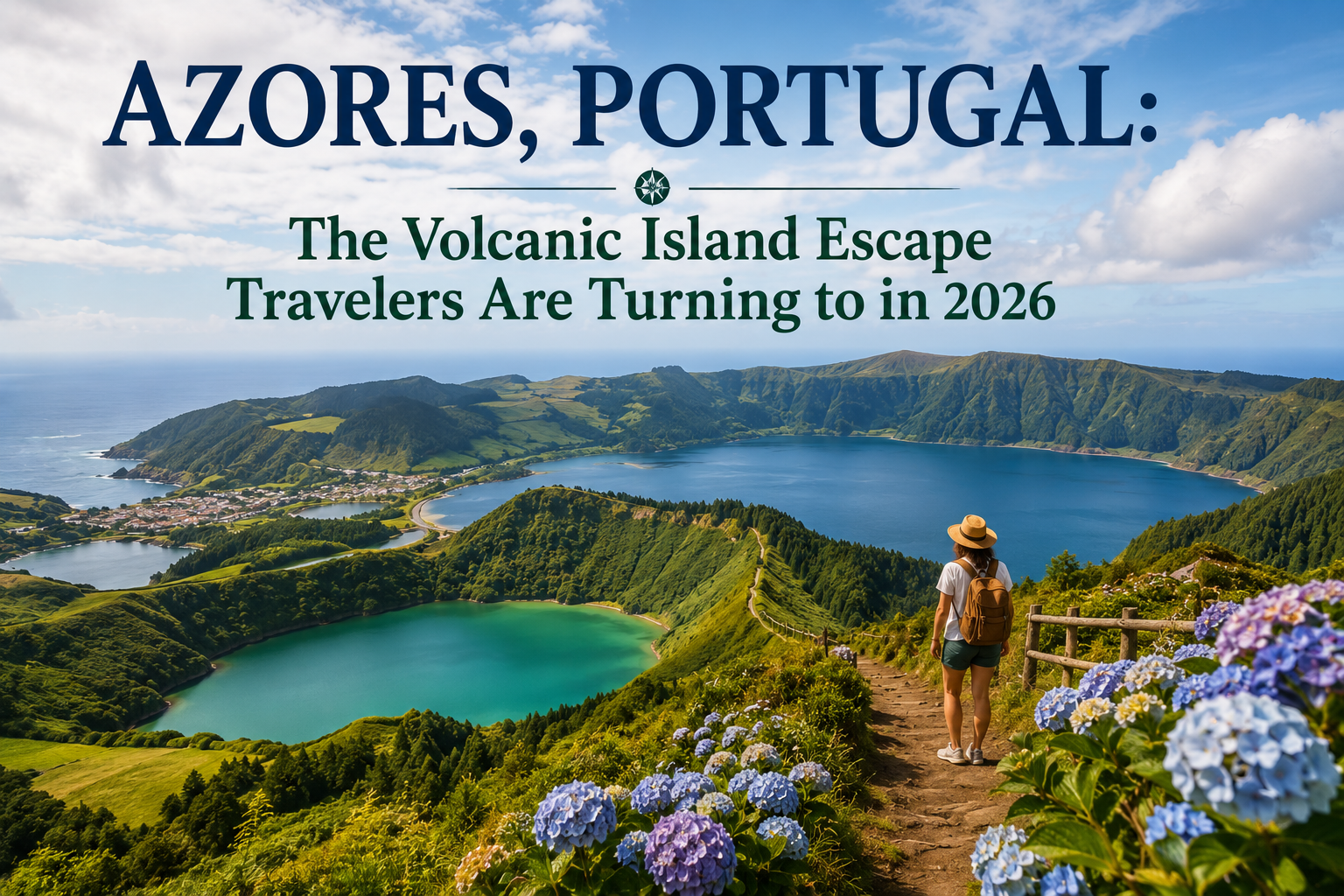
Far out in the North Atlantic, the Azores, Portugal offer a landscape unlike almost anywhere else in Europe. Green hills are divided by hydrangea-lined roads, volcanic craters hold brilliant lakes, and cattle graze on pastures surrounded by ocean.
The Azores are an autonomous region of Portugal made up of nine volcanic islands. For years, they were considered one of Europe’s quieter destinations. In 2026, however, more travelers are discovering their combination of dramatic nature, outdoor adventure, local culture, and slower-paced island life.
If you are looking for a European destination away from crowded city centers, the Azores deserve a place on your travel list.
Where Are the Azores?
The Azores are an archipelago in the North Atlantic Ocean, roughly 1,400 kilometers west of mainland Portugal. Although politically part of Portugal, the islands have a landscape and atmosphere very different from Lisbon, Porto, or the Algarve.
The nine islands are divided into three geographical groups:
- Eastern Group: São Miguel and Santa Maria
- Central Group: Terceira, Graciosa, São Jorge, Pico, and Faial
- Western Group: Flores and Corvo
Each island has its own character.
São Miguel is the largest island and the main gateway for many international visitors. Pico is dominated by Mount Pico, Portugal’s highest mountain. Terceira combines volcanic scenery with historic architecture, while Faial is famous for its marina, hydrangeas, and volcanic landscapes.
Why the Azores Are Becoming Popular in 2026
The growing interest in the Azores reflects several broader travel trends.
Nature-Focused Travel
The islands offer a strong alternative to Europe’s crowded urban destinations. Instead of museums and busy shopping streets, travelers come for crater lakes, volcanic trails, forests, waterfalls, thermal pools, and ocean views.
Sustainable Tourism
The Azores have increasingly positioned themselves as a destination for nature-based and lower-impact tourism. This approach appeals to travelers who want outdoor experiences while being more conscious of the environmental impact of their trips.
Easier Connections
Air connections through mainland Portugal and other international gateways have made the islands more accessible than they once were. São Miguel is generally the easiest starting point for first-time visitors.
Remote Work and Longer Stays
Ponta Delgada has also attracted remote workers looking to combine work with hiking, nature, and island living. Reliable connectivity in populated areas makes longer stays more practical, although coverage can become less consistent in remote areas.
Together, these trends have helped move the Azores from an obscure destination to one of Europe’s increasingly popular nature escapes.
São Miguel: The Best Starting Point for an Azores Trip
For first-time visitors, São Miguel is often the easiest island to explore.
One of its most famous attractions is Sete Cidades, a volcanic caldera containing two striking lakes. The contrasting colors of Lagoa Verde and Lagoa Azul create one of the Azores’ most recognizable landscapes.
Then there is Furnas, a geothermal valley where volcanic activity shapes both the landscape and local cuisine.
The traditional cozido das Furnas is prepared by placing a pot containing meat and vegetables into the naturally heated volcanic ground, allowing geothermal heat to cook the meal slowly.
São Miguel is also home to several thermal bathing experiences. Terra Nostra Park and Poça da Dona Beija are among the best-known places to experience the island’s geothermal waters.
In the capital, Ponta Delgada, visitors can explore cobbled streets, historic buildings, restaurants, cafés, and the waterfront.
Pico, Terceira, and Faial
If you have more than a week, consider adding another island.
Pico Island
Pico is dominated by Mount Pico, Portugal’s highest mountain at 2,351 meters.
The island is also known for its distinctive vineyards. Vines are cultivated in black volcanic soil and protected by intricate stone walls. The Landscape of the Pico Island Vineyard Culture is recognized as a UNESCO World Heritage site.
Terceira
Terceira combines volcanic scenery with centuries of history.
Its main city, Angra do Heroísmo, is a UNESCO World Heritage site and offers colorful architecture, historic streets, churches, and a strong local cultural identity.
Faial
Faial is known for its blue hydrangeas and the Capelinhos volcanic landscape, created by an eruption in the late 1950s.
The island’s main town, Horta, is also famous among sailors crossing the Atlantic and has one of the region’s most recognizable marinas.
Inter-island flights and ferries make island-hopping possible, but schedules can vary by season. Planning connections in advance is important, especially outside summer.
Whale Watching in the Azores
Whale watching is one of the standout experiences in the Azores.
The waters surrounding the islands attract a wide range of marine life, including sperm whales, dolphins, fin whales, and migrating blue whales.
Sperm whales can be seen throughout much of the year, while spring can provide opportunities to spot migrating baleen whales.
Popular departure points include:
- Ponta Delgada on São Miguel
- Horta on Faial
- Lajes do Pico on Pico
Because marine wildlife is unpredictable, sightings can never be guaranteed. Choosing a responsible operator that follows wildlife-watching guidelines can help reduce the impact on marine animals.
Hiking in the Azores
For outdoor enthusiasts, hiking is one of the main reasons to visit.
Trails cross volcanic craters, forests, valleys, coastlines, and mountain landscapes.
On São Miguel, popular hiking areas include Sete Cidades and Lagoa do Fogo.
Flores is especially attractive to hikers because of its waterfalls, cliffs, lakes, and dramatic western landscapes.
For experienced hikers, climbing Mount Pico is one of the Azores’ most challenging and rewarding adventures. The route involves a substantial elevation gain and should be attempted with appropriate preparation and current local guidance.
Weather can change quickly, so hikers should check trail conditions before setting out.
Hot Springs, Crater Lakes, and Volcanoes
Volcanic activity is central to the identity of the Azores.
Across the islands, travelers can discover:
- Volcanic craters
- Geothermal springs
- Lava formations
- Crater lakes
- Volcanic hiking trails
- Coastal cliffs
Furnas on São Miguel is particularly famous for its geothermal activity.
The islands also experience occasional seismic activity. This is part of living in an active volcanic region, and local authorities monitor volcanic and seismic conditions.
Visitors should follow official safety guidance when exploring geothermal areas or volcanic landscapes.
Best Time to Visit the Azores
The best time to visit the Azores depends on what you want to do.
June to September
Summer generally offers the most favorable conditions for hiking and outdoor activities. It is also the busiest period, so accommodation and rental cars can be more expensive.
April to May
Spring brings lush landscapes and can be a particularly good period for whale watching. Visitor numbers are generally lower than during the summer peak.
October
October can still offer relatively mild conditions, making it attractive for travelers who want fewer crowds.
November to March
Winter is quieter and can be less expensive, but rainfall and changing weather are more common. Some seasonal boat excursions may also operate less frequently.
Because the Azores have a maritime climate, weather can change quickly at any time of year. A flexible itinerary is useful.
How to Get to the Azores
Most international visitors arrive through Ponta Delgada Airport on São Miguel.
Connections are available through mainland Portugal, particularly Lisbon, as well as selected international destinations.
Travelers planning to visit multiple islands can use inter-island flights and ferries, although schedules vary.
Once on an island, renting a car is often the most convenient way to reach hiking trails, viewpoints, villages, and natural attractions.
Roads can be narrow and winding, so driving slowly and allowing extra travel time is recommended.
How Many Days Do You Need in the Azores?
For a first visit, five to seven days on São Miguel provides enough time to explore major attractions without rushing.
With 10 to 14 days, travelers can consider combining São Miguel with Pico, Faial, Terceira, or another island.
Trying to visit too many islands during a short trip can make the journey feel rushed because inter-island transportation depends on schedules and weather.
A slower itinerary usually works better in the Azores.
Should You Visit the Azores in 2026?
If you are looking for a European destination built around nature rather than crowds, the answer is yes.
The Azores combine volcanic landscapes, crater lakes, hiking trails, thermal pools, whale watching, local food, and distinctive island cultures.
They are no longer completely unknown, but they still offer a very different experience from Europe’s busiest destinations.
For travelers who want to trade crowded city streets for volcanic trails, ocean horizons, and quiet island mornings, 2026 could be an excellent time to discover the Azores.
Frequently Asked Questions About the Azores
What are the Azores known for?
The Azores are known for volcanic landscapes, crater lakes, thermal springs, hiking, whale watching, lush scenery, and distinctive island culture.
Which Azores island is best for first-time visitors?
São Miguel is generally the easiest choice for first-time visitors because it is the largest island and offers a wide variety of attractions, including Sete Cidades, Furnas, Lagoa do Fogo, and Ponta Delgada.
What is the best time to visit the Azores?
Late spring through early autumn generally offers favorable conditions for outdoor activities. Spring can be particularly appealing for whale watching, while summer is best suited to travelers prioritizing hiking and more stable weather.
Can you visit the Azores without a car?
Yes, particularly if you stay in Ponta Delgada or another main town. However, renting a car is usually more convenient for exploring remote viewpoints, hiking trails, villages, and natural attractions.
Are the Azores expensive?
Costs vary depending on the island, season, accommodation, and activities. Traveling outside the summer peak can help reduce accommodation and rental-car costs.
How many islands are there in the Azores?
There are nine main islands, divided into Eastern, Central, and Western island groups.
Internal Link
- Portugal Travel Guide – Enigma Jaunt
- Hidden Gem Destinations in Europe – Enigma Jaunt
- European Travel Guides – Enigma Jaunt