
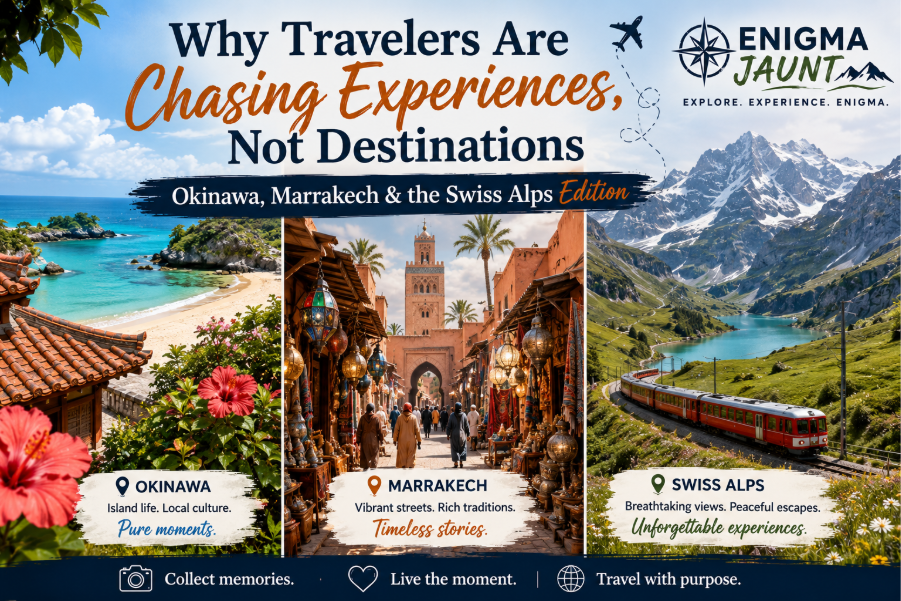
There was a time when a good trip meant a good list. See the tower, see the museum, snap the photo, go home. That list is losing its grip. Ask travelers today what they remember most from a trip, and few of them mention a monument. They mention a meal cooked by a stranger, a hike that left their legs sore for a week, a market where nobody spoke their language and it didn’t matter. This is what the travel industry now calls experience-led travel, and it is reshaping where people go and why.
Three places sit at the center of this shift in 2026: Okinawa in Japan, Marrakech in Morocco, and the Swiss Alps. None of them are new discoveries. What’s new is the reason people are booking flights there.
What “Experience-Led Travel” Actually Means
The phrase gets thrown around a lot, so it’s worth being precise about it. Experience-led travel is not about checking off famous sights. It is about choosing a destination because of what you’ll do there, who you’ll meet, and how the place will change your week, not just your photo album.
Industry data backs this up. Search interest in slow travel has hit an all-time high this year, and searches for “slow travel Italy” alone climbed 100% in a single month. Meanwhile, American Express’s 2026 Global Travel Trends Report found that a large majority of younger travelers now seek out local workshops and hands-on activities wherever they land, from a tortilla-making class in Mexico City to a fragrance workshop in Paris. People aren’t just visiting a place anymore. They want to leave with a skill, a story, or a scar.
That appetite is exactly why Okinawa, Marrakech, and the Swiss Alps are having their moment.
Okinawa: Japan’s Quiet Answer to Tokyo Fatigue
Tokyo and Osaka still dominate Japan’s tourism headlines, but a growing number of travelers are skipping the neon for something slower. Okinawa, a chain of subtropical islands south of the Japanese mainland, has seen global search volume surge by more than 70% in the past year, according to travel data from Expedia.
Part of the draw is pace. Okinawa moves differently from the rest of Japan. Its castles, some standing since the 1300s, are now UNESCO World Heritage Sites, and its waters rank among the best diving spots in the world, home to sea turtles, coral reefs, and quiet coves that never made it into a guidebook. The food tells its own story too. Okinawan cuisine blends Chinese and Japanese influence into dishes built around longevity and simplicity, a fitting menu for an island long studied for how long its people live.
For travelers chasing something authentic rather than crowded, Okinawa offers exactly that trade: fewer lines, more meaning. If you’re mapping out a longer Japan trip, it pairs well with the kind of unhurried itinerary we cover in our guide on planning the perfect summer getaway.
Marrakech: A City Built for Getting Lost
Marrakech has always had a pull, but the way people travel there has changed. It’s no longer just a stopover for a souk photo. Travelers are staying longer, booking riads instead of hotel chains, and treating the city as a base for deeper detours: a night in the Sahara, a cooking class tucked behind an unmarked door, a walk through the Majorelle Gardens with no set plan for the afternoon.
The city’s maze-like medina, its mix of Amazigh, Arab, and French influence, and its markets that seem to sell everything and nothing at once make it hard to experience Marrakech passively. You end up participating whether you meant to or not, and that’s precisely the kind of immersion today’s travelers are searching for. Nearby Fez is starting to draw some of that same crowd, offering a quieter, less-touristed version of the same cultural depth.
Before a trip like this, it pays to get your paperwork sorted early. Our visa and documentation guide is a good place to start, and our notes on staying safe and aware in unfamiliar environments are worth a read before wandering into any medina.
The Swiss Alps: From Ski Season to Every Season
For decades, the Alps meant one thing: winter sports. That’s no longer the whole story. As European summers grow hotter, travelers are heading up in altitude to escape the heat, and mountain regions like Savoie in the French Alps have seen booking searches jump more than 50% year over year. Switzerland’s own alpine towns are following the same pattern, drawing hikers, cyclists, and wild swimmers who used to save the mountains for December.
What makes the Alps fit the experience-led mold so well is the range of things to actually do once you’re there. Hiking trails wind through wildflower meadows. Glacial lakes offer cold-water swimming for those brave enough. Small villages serve food built for after a long day outdoors, not for a rushed lunch between sights. Wellness travel plays a role here too, with more travelers swapping five-star spa resorts for lakeside saunas and long walks that clear the head rather than pamper the body.
Trains also make the Alps an easy fit for slow travel. Many routes are only reachable by rail, which turns the journey itself into part of the experience rather than a means to an end. If you’re planning a trip built around trains and unhurried stops, our post on budget-friendly ways to explore without overspending can help you stretch the trip further.
Why This Shift Is Happening Now
A few things are driving this change at once, and none of them are going away soon.
Travelers want stories, not souvenirs. Nearly 8 in 10 global respondents in Amex’s 2026 survey said the skills and memories from a trip last longer than anything they could buy. A cooking lesson beats a fridge magnet.
Overcrowding has a cost. Popular capitals are pricier and more crowded than ever, pushing travelers toward destinations that offer space to breathe. Okinawa, Marrakech, and the Alps all give people room to slow down without giving up culture or comfort.
Social media has shifted from showing off to showing up. Where travel photos once centered on famous backdrops, more posts today document activities: a market stall, a trail, a shared meal. That shift in content naturally points people toward places built for doing, not just seeing.
AI-assisted planning is making niche trips easier to book. Search interest in AI travel assistants grew 350% over the past year, and that convenience is letting more people build custom, experience-first itineraries instead of settling for a packaged tour.
Planning Your Own Experience-Led Trip
If Okinawa, Marrakech, or the Swiss Alps have caught your interest, the biggest shift in mindset is this: stop planning around sights and start planning around activities. Book fewer stops and give each one more days. Look for a cooking class before you look for a museum. Choose a riad or a mountain inn over a big hotel chain if you want the stay itself to feel like part of the trip.
None of this requires an unlimited budget. It requires a different set of questions when you plan. What will I actually spend my days doing here? Who will I meet? What will I be able to do that I can’t do at home? Once you start asking those questions, the destination almost picks itself.
Whichever of these three you choose first, pack light, leave room in the schedule for the unplanned, and let the place set the pace. Our packing essentials guide can help you get the basics right before you go.