
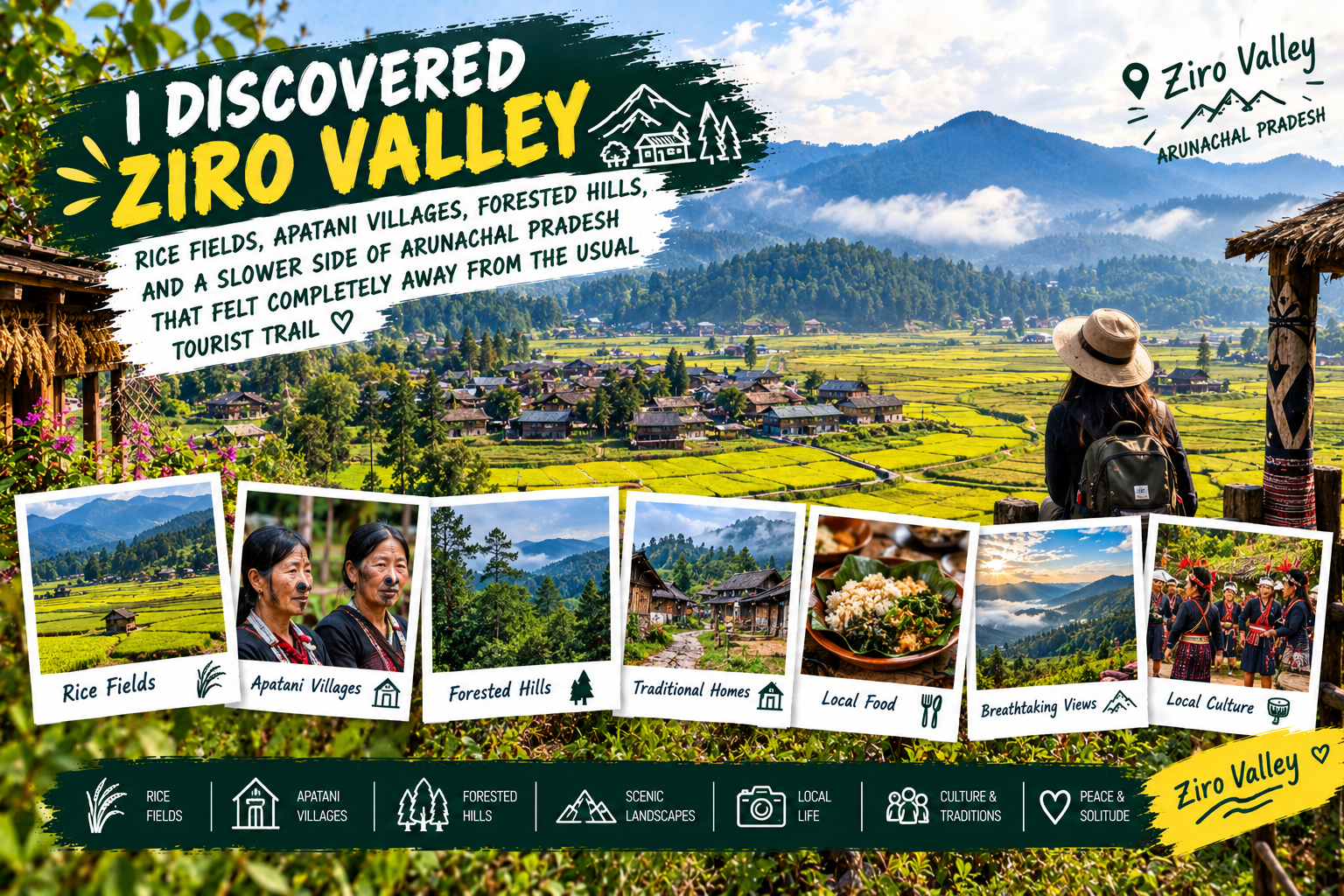
There is a particular kind of quiet that settles over a place once you are far enough from a highway. I noticed it first somewhere past Kimin, when the road narrowed, the trucks thinned out, and the hills on either side turned a deeper, wetter green – Ziro Valley.
By the time the car climbed into Ziro Valley, that quiet had become the whole point of the trip. Rice fields stretched across the valley floor, pine-covered hills surrounded the landscape, and traditional Apatani villages appeared between patches of forest.
I had first heard of Ziro through photographs. A valley divided into neat rice fields, forested hills standing guard around it, and traditional houses belonging to the Apatani community can make for an irresistible image.
What those photographs cannot fully capture is how Ziro Valley actually feels once you arrive. The pace is unhurried, the landscape feels lived-in, and the usual signs of mass tourism are noticeably absent.
There are no endless souvenir stalls or crowds competing for viewpoints. Instead, you find rice fields, quiet villages, bamboo structures and hills that seem to have been left alone for generations.
That atmosphere is what stayed with me long after leaving Ziro Valley.
Where Is Ziro Valley?
Ziro Valley is located in the Lower Subansiri district of Arunachal Pradesh, around 115 kilometres from Itanagar, the state capital.
At approximately 1,500 metres above sea level, the valley enjoys a cooler climate without feeling like an extreme high-altitude destination. Its relative distance from India’s major tourist circuits has helped preserve a slower pace of travel.
Arunachal Pradesh itself has never been marketed on the same scale as destinations such as Himachal Pradesh or Uttarakhand. Reaching the region requires more planning, and that effort naturally limits mass tourism.
The valley is also home to the Apatani people, whose culture is closely connected with the landscape. Traditional houses, bamboo structures, rice fields, agricultural practices and village life all form part of the cultural experience.
The Apatani cultural landscape has been placed on UNESCO’s Tentative List of World Heritage Sites, highlighting its cultural and agricultural significance.
How I Reached Ziro Valley
There is no airport in Ziro Valley, so reaching the destination involves combining air or rail travel with a road journey.
I flew into Guwahati and travelled onward from there. Many travellers choose an overnight bus from Guwahati, while another option is to take a train to Naharlagun and continue by road.
The journey from Naharlagun to Ziro takes several hours through forested hill roads. Far from being just a transfer, the drive becomes part of the experience as the scenery gradually changes.
Itanagar and North Lakhimpur can also serve as access points. Bus services operated by the Arunachal Pradesh State Road Transport Corporation connect the region with Guwahati on selected days, although schedules should be confirmed before travelling.
Permits for Ziro Valley
Travel to Arunachal Pradesh requires advance planning because of its permit regulations.
Indian citizens require an Inner Line Permit (ILP), while foreign nationals require a Protected Area Permit. These permissions should be arranged before the journey rather than left until arrival in Ziro.
The Rice Fields That Define Ziro Valley
The first thing that struck me after reaching the valley floor was the extraordinary order of the agricultural landscape.
Unlike scattered fields, the rice paddies of Ziro Valley are arranged in an intricate network of plots and raised embankments. Narrow paths run between the fields, allowing farmers to move through the landscape.
Early mornings are particularly beautiful. Mist often hangs low over the paddy fields, while the surrounding hills slowly emerge from the haze.
Walking along one of those narrow paths felt almost meditative after the long journey into Arunachal Pradesh.
The Apatani Paddy-Cum-Fish Cultivation System
One of the most remarkable features of Ziro Valley is the traditional paddy-cum-fish cultivation system practised by the Apatani community.
Rice and fish are raised together in the same flooded fields. The system has evolved over generations and represents a low-impact agricultural practice closely adapted to the local environment.
I stopped near Hong village at a working field where a farmer was checking a shallow irrigation channel. He explained how water is directed from the hills into the fields and later released as part of the agricultural cycle.
Nothing about the scene felt staged for visitors.
It was simply everyday life, continuing in much the same way it has for generations.
Exploring the Apatani Villages of Ziro
Several Apatani villages spread across Ziro Valley, including Hong, Hija, Bamin, Dutta and Hari.
Each settlement offers a slightly different glimpse into local life. Traditional houses, bamboo granaries, village platforms and narrow lanes create an atmosphere that feels very different from conventional tourist destinations.
Hong is often described as one of the larger Apatani villages. Walking through its lanes, I found myself slowing down without consciously deciding to.
Traditional houses are built using wood and bamboo, with raised structures and sloping roofs. The narrow lanes often encourage visitors to walk slowly, making simple encounters with residents feel natural rather than staged.
Meeting the Apatani Community
Some of my strongest memories from Ziro Valley came from conversations with older members of the community.
A few senior Apatani women I encountered still carried traditional facial tattoos and nose plugs associated with an older cultural practice. The tradition was officially discontinued in the 1970s and is now primarily seen among older generations.
Rather than treating these traditions as photographic curiosities, I found it important to approach people respectfully and ask before taking photographs.
One woman near Hija shared an oral-history explanation for the practice after I asked about it. Her story connected the tradition to attempts to make women less attractive to raiders from neighbouring communities.
That conversation reminded me that cultural travel is most meaningful when the people who live in a destination remain at the centre of the experience.
Festivals of Ziro Valley
Two important festivals are closely associated with the Apatani calendar: Dree and Myoko.
Dree Festival
Dree takes place in July and is associated with agriculture, prayers for a good harvest, traditional celebrations, feasting and dance.
For visitors, witnessing Dree can offer an opportunity to experience Apatani culture during an important community occasion.
Myoko Festival
Myoko is held in March and focuses on friendship, social relationships and alliances between clans.
Unlike commercial cultural shows, these festivals are community events. Visitors should therefore approach them with respect and follow local guidance.
Pine-Covered Hills Around Ziro Valley
The rice fields are only one part of the landscape.
Forested hills surround Ziro Valley, giving the destination a sheltered and enclosed character. Pine-covered slopes create a striking contrast with the geometric patterns of the agricultural fields below.
Kile Pakho Viewpoint
Kile Pakho is a ridge close to the main town and offers a sweeping view across the valley.
The climb is relatively short rather than a demanding trek, making it accessible to travellers who want a panoramic view without committing to a full-day hike.
I visited in the late afternoon and found the ridge almost completely quiet. Apart from a couple of local boys taking cattle home, there was little movement around the viewpoint.
That solitude made the view even more memorable.
Talley Valley Wildlife Sanctuary
Travellers who want to explore the wilder side of the region can consider Talley Valley Wildlife Sanctuary.
Located a short drive from the main valley, the sanctuary protects temperate and subtropical forests containing diverse flora and birdlife. Orchids are among the region’s notable natural features, while elusive mammals are also reported in the wider landscape.
This is not a conventional safari destination.
There are no jeep safaris designed for easy wildlife viewing. Instead, the sanctuary appeals to travellers interested in forests, biodiversity, birdwatching and the quieter side of Arunachal Pradesh.
The additional effort required to reach the area is part of its appeal.
A Natural Rock Formation Near Ziro
Another small attraction near Ziro Valley is a natural rock formation locally regarded as a Shiva lingam.
The site attracts a modest number of pilgrims and curious visitors.
Although it is not a major tourist attraction, the location illustrates how natural features across the valley can become connected with local belief, spirituality and everyday life.
Ziro Festival of Music
In recent years, Ziro Valley has become increasingly known for the Ziro Festival of Music.
Held every September, the outdoor festival attracts independent musicians and music lovers from across India and abroad. Its growing popularity has introduced Ziro to a new generation of travellers.
However, my visit took place outside the festival period.
For anyone specifically looking for the slower side of Ziro Valley, travelling outside the festival dates can be rewarding. Without the additional crowds, the valley returns to its everyday rhythm of farming, village life, changing weather and quiet roads.
Where to Stay in Ziro Valley
Accommodation in Ziro Valley leans heavily toward homestays.
For me, that is part of the attraction rather than a limitation. Staying with an Apatani family offers a much closer look at everyday life than a conventional hotel experience.
Meals may include rice, bamboo shoot, pork, local greens and fish associated with the valley’s agricultural system. Evening conversations can also become an important part of the stay.
Travellers seeking greater privacy can find small hotels and guesthouses in Ziro town and Hapoli, the administrative headquarters of the valley.
However, a homestay is worth considering if your goal is to understand the destination rather than simply use it as a base for sightseeing.
What to Eat in Ziro Valley
Food in Ziro Valley is generally simple, seasonal and closely connected to the local environment.
Bamboo shoot features prominently in many dishes, appearing in both fresh and fermented forms.
Rice naturally forms an important part of meals, while fish from local paddy fields can also feature in traditional cooking.
After a full day walking through villages and rice fields, these uncomplicated meals can feel particularly satisfying.
The food may not be elaborate, but it reflects the landscape and the community that lives there.
Best Time to Visit Ziro Valley
The best time to visit Ziro Valley depends on whether you prefer festivals, lush agricultural landscapes, mild weather or winter solitude.
Generally, March to October offers the most comfortable conditions for exploring the valley.
Spring brings fresh greenery and the Myoko festival. July coincides with Dree, while September combines pleasant travel conditions with the Ziro Festival of Music.
Autumn can bring golden rice fields as the agricultural cycle moves toward harvest.
Winter, from November through February, is colder and can bring misty conditions. The landscape becomes quieter and more muted, which may appeal to travellers who prefer solitude over bright seasonal colours.
Practical Tips for Visiting Ziro Valley
Arrange Your Permit in Advance
Indian citizens need an Inner Line Permit for Arunachal Pradesh, while foreign nationals require a Protected Area Permit.
Do not leave permit arrangements until the last minute.
Carry Enough Cash
Mobile connectivity and ATM access can be patchy in parts of the valley.
Carrying sufficient cash is therefore a sensible precaution.
Plan Local Transport
Many villages are close enough to explore on foot, while local taxis can help with longer distances.
Two-wheelers may also be available in Hapoli, although road and weather conditions should be considered before choosing this option.
Respect Local Customs
Always ask before photographing residents, particularly older people with traditional tattoos or other cultural features.
During festivals, visitors should also follow local guidance and avoid treating community celebrations as staged tourist performances.
Slow Down
The biggest mistake you can make in Ziro Valley is trying to rush through it.
Give yourself time to walk through the villages, sit beside the rice fields, talk to local residents and simply watch the weather change across the hills.
Places to Visit in Ziro Valley
For a first trip, these are some of the most worthwhile places and experiences to include:
- Hong Village – Explore traditional Apatani houses and village lanes.
- Hija Village – Experience another side of Apatani village life.
- Bamin and Dutta Villages – Walk through traditional settlements and agricultural landscapes.
- Rice Fields – See the distinctive paddy-cum-fish cultivation system.
- Kile Pakho – Enjoy panoramic views across the valley.
- Talley Valley Wildlife Sanctuary – Explore forests and biodiversity beyond the main valley.
- Ziro Festival of Music – Visit in September if you want to experience the famous music festival.
- Local Homestays – Experience Apatani food and everyday life.
- Traditional Village Platforms – Observe community spaces and local architecture.
- Misty Valley Landscapes – Take time to photograph the changing scenery around Ziro.
A Suggested Ziro Valley Itinerary
Day 1: Arrive and Explore
Reach Ziro Valley and settle into your homestay or accommodation.
Spend the evening walking around the nearby area and watching the hills change colour as the sun goes down.
Day 2: Apatani Villages and Rice Fields
Begin with Hong and nearby villages.
Walk through the agricultural landscape and learn about the traditional paddy-cum-fish cultivation system.
Use the afternoon to explore Hija, Bamin or Dutta, depending on local access and your interests.
Day 3: Kile Pakho and the Forests
Head toward Kile Pakho for a panoramic view over Ziro Valley.
If time and local conditions allow, continue toward Talley Valley Wildlife Sanctuary for a deeper look at the surrounding forests.
Return to your accommodation for another quiet evening in the valley.
Day 4: Slow Travel and Departure
Keep the final morning flexible.
Enjoy a local breakfast, spend some time with your hosts, take a final walk through the nearby fields and begin the journey onward.
A slower final day is often more rewarding than trying to squeeze another long excursion into the schedule.
Frequently Asked Questions About Ziro Valley
Where is Ziro Valley located?
Ziro Valley is located in the Lower Subansiri district of Arunachal Pradesh, approximately 115 kilometres from Itanagar and around 1,500 metres above sea level.
What is Ziro Valley famous for?
Ziro Valley is best known for its Apatani culture, traditional villages, rice fields, paddy-cum-fish cultivation, pine-covered hills and the Ziro Festival of Music.
How do I reach Ziro Valley?
The nearest railway station is Naharlagun. Travellers can also approach the region from Itanagar or North Lakhimpur, while many visitors travel from Guwahati by road or combine rail and road travel.
Do I need a permit to visit Ziro Valley?
Yes. Indian citizens require an Inner Line Permit for Arunachal Pradesh. Foreign nationals require a Protected Area Permit.
Which Apatani villages should I visit in Ziro?
Hong, Hija, Bamin, Dutta and Hari are among the principal Apatani villages in the valley.
What is the best time to visit Ziro Valley?
March to October is generally a comfortable period for visiting. March is associated with Myoko, July with Dree, and September with the Ziro Festival of Music.
Is Ziro Valley good for slow travel?
Yes. The combination of quiet villages, rice fields, homestays, forested hills and limited mass tourism makes Ziro Valley particularly well suited to slow travel.
Final Thoughts: Why Ziro Valley Stayed With Me
I have travelled to places that announce themselves loudly—monuments with their own gift shops and viewpoints with their own parking fees.
Ziro Valley does none of that.
Instead, the valley simply exists in its own rhythm, with rice growing in the fields, fish moving through the paddies and people going about their daily lives.
What stayed with me was not one particular viewpoint or photograph.
It was the feeling of walking through a village without being surrounded by crowds. It was the mist above the rice fields, the sound of conversation around a homestay and the green hills enclosing the valley.
For anyone searching for Arunachal Pradesh at its most unhurried, Ziro Valley offers something increasingly rare: the feeling that you have discovered a place rather than simply arrived at another destination.
Sometimes, the most memorable journeys are the ones that ask you to slow down.
Ziro was one of those journeys for me.
Internal Links
- Munnar, India: Why This Lush Hill Station Is Becoming One of India’s Hottest Monsoon Escapes in 2026
- I Spent 3 Days in Meghalaya This Monsoon—The Living Root Bridges, Rain, and Mist Made Me Want to Stay Longer
- The Rise of Do-Less Travel
- Hidden Gems: Why Offbeat Travel Creates the Best Memories
- The Future of Sustainable Travel: How to Explore Without Leaving a Trace
- Traveling Through the Seasons: Why Every Time of Year Offers a Unique Adventure
- The Joy of Getting Lost: Why Unplanned Travel Adventures Are the Most Rewarding
Outbound Links
- https://arunachaltourism.com/ziro-3/
- https://arunachalpradesh.gov.in
- https://www.incredibleindia.gov.in
- https://whc.unesco.org/en/tentativelists/5893/
- https://tourism.gov.in
- https://www.nationalgeographic.com/travel
- https://www.lonelyplanet.com
- https://www.cntraveler.com
- https://www.britannica.com
- https://www.iucn.org