
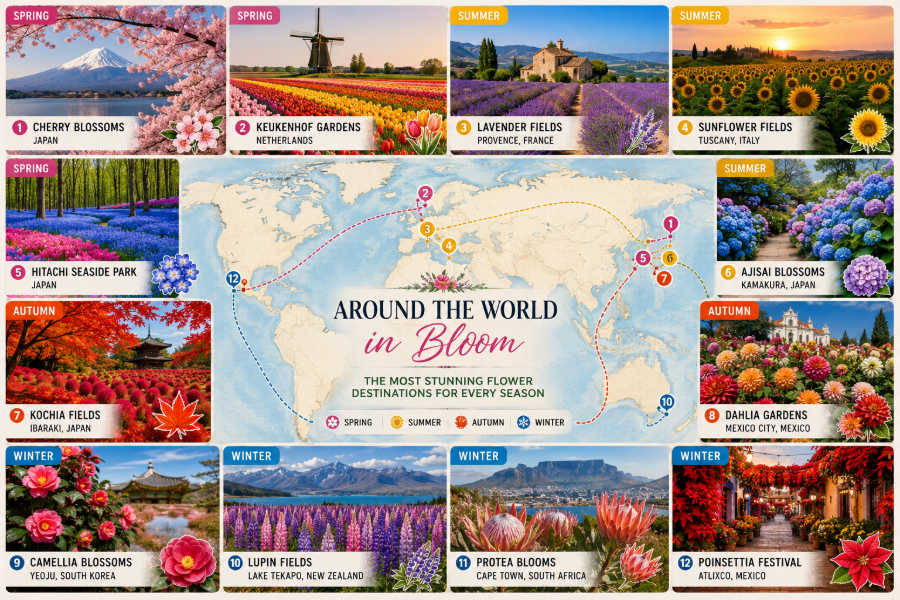
There is a particular kind of traveler who plans a whole trip around a single bloom. Not a beach, not a skyline, not a There’s a particular kind of traveler who plans an entire trip around a single bloom — not a beach, not a skyline, not a museum, but a flower that only opens for a few weeks a year. If you’ve ever rearranged your calendar for a tulip field, or booked a flight the moment cherry blossom forecasts came out, you already know the pull.
Flower tourism is one of the fastest-growing niches in travel, and it’s easy to see why: few sights match the scale, color, and quiet drama of an entire landscape in bloom.
This guide covers the best flower destinations in the world, organized by season, so you can start planning no matter when you like to travel. Some spots are famous gardens with ticketed entry and manicured paths. Others are wild valleys and hillsides where nature does all the work. Either way, timing is everything — a bloom window can last anywhere from a few days to a couple of months, and missing it by even a week can mean the difference between a field of color and a field of green.
Spring: Tulips, Cherry Blossoms, and the Season Everyone Waits For
Spring is peak flower tourism season, and the Northern Hemisphere puts on its biggest show.
Keukenhof Gardens, Netherlands The destination most people picture when they think of tulip season — and it earns the reputation. Roughly seven million bulbs are planted by hand each year, with tulips, hyacinths, and daffodils arranged in sweeping color blocks. The park typically opens mid-March and closes by mid-May. The surrounding Bollenstreek region, a short drive from Amsterdam, is worth a trip on its own for tulip fields that stretch to the horizon.
Japan’s cherry blossom season Sakura season remains one of the most anticipated travel events on the planet, drawing visitors to parks, temples, and riversides from Tokyo to Kyoto. Bloom typically arrives in late March or early April, though warmer springs in recent years have pushed the timing earlier and shortened the window in some regions. Spots like Chureito Pagoda near Mount Fuji draw huge crowds, so it’s worth researching quieter viewing locations or visiting on a weekday morning.
Washington, D.C., United States The Tidal Basin’s cherry trees, a gift from Tokyo more than a century ago, burst into pink and white bloom over just a few days, usually in late March or early April. Peak bloom is short and weather-dependent — plan around the National Park Service’s bloom forecast rather than a fixed date.
Valley of Flowers, Uttarakhand, India This UNESCO World Heritage Site sits inside the Nanda Devi Biosphere Reserve in the Himalayas and is best visited from June through September, bridging spring and summer travel depending on when the monsoon arrives. Its own micro-climate keeps it greener and more colorful than the surrounding alpine terrain, with the palette shifting every few weeks as different species come into flower.
Summer: Lavender Fields, Alpine Wildflowers, and Southern Hemisphere Blooms
Summer travel opens up a wider map, from the lavender hills of southern Europe to fields on the other side of the equator.
Provence, France The lavender fields of the Luberon and Valensole plateau reach peak color from late June through early August, when the rows turn a deep, saturated purple against old stone farmhouses. The scent alone is worth the trip, and many small towns hold lavender festivals timed to the harvest.
Furano, Hokkaido, Japan Less crowded than cherry blossom season, Furano’s lavender farms bloom through July, with rolling purple hills set against a mountain backdrop. Farm Tomita is the best-known spot and draws a steady but manageable stream of visitors.
Lake Tekapo, New Zealand Because the Southern Hemisphere runs on the opposite calendar, New Zealand’s Russell lupins bloom during its late spring and early summer — roughly mid-November into December. Fields of pink, blue, and purple lupins line the shores of the glacier-fed lake, with the small Church of the Good Shepherd offering one of the country’s most photographed views. Clear night skies in the area also make it a good stop for stargazing after a day of flower viewing.
Autumn: Chrysanthemums, Cosmos Fields, and a Quieter Kind of Bloom
Autumn flower travel tends to be overlooked, which is part of its appeal. Crowds thin out, and the blooms feel more like a reward for paying attention.
Chrysanthemum festivals, China and Japan Chrysanthemums have deep cultural roots across East Asia, and autumn festivals celebrating the flower run from late October through November. Elaborate displays — including flowers trained into shapes and figures — are common, particularly in Japan, where the chrysanthemum carries strong symbolic weight.
Cosmos fields, Japan As summer fades, fields of cosmos flowers open across the country, with Hitachi Seaside Park among the most photographed. Pink, white, and magenta blooms typically peak from late September through October — a softer, more delicate counterpoint to spring’s cherry blossoms.
Dahlia gardens, Netherlands While tulips get the spotlight in spring, dahlias take over Dutch gardens in September. Growers around Anna Paulowna cultivate dozens of varieties in bold, layered colors that hold up well into early autumn.
Winter: Wildflower Super Blooms and Festivals That Fight the Cold
Winter is the least obvious season for flower travel, but a handful of destinations make the case for planning a trip around it.
Namaqualand, South Africa When much of the Northern Hemisphere is buried in winter, South Africa’s Namaqualand region turns into one of the world’s great wildflower spectacles. Triggered by winter rains, the desert erupts into orange, purple, and white daisies from August into September — a phenomenon locals simply call “the flower season.”
Chiang Mai Flower Festival, Thailand Held every February, this festival transforms the city with parades of flower-covered floats, temporary garden displays, and stalls selling orchids and other tropical blooms. A good option for travelers who want warmth and color during the colder months elsewhere.
Plum blossoms, China and Japan Ahead of the cherry blossom rush, plum blossoms open in late January and February, often while snow is still on the ground. Gardens in cities like Nanjing and Tokyo draw smaller, quieter crowds than their spring counterparts — an appealing pick for travelers who want the bloom experience without the peak-season crush.
Planning Tips for Flower Tourism
- Bloom windows shift year to year. Weather and climate patterns affect timing, sometimes by two or three weeks. Check current-year bloom forecasts before booking flights, not just historical averages.
- Weekday mornings beat weekends. Popular spots like Keukenhof and Japan’s cherry blossom parks get significantly busier on weekends and around midday.
- Book accommodation early. Towns near famous bloom sites fill up fast during peak weeks, sometimes months in advance.
- Consider the shoulder edges of a bloom window. Arriving just before or after peak often means smaller crowds with still-impressive color.
- Pack for changeable weather. Many flower destinations, from alpine valleys to lavender plateaus, see quick temperature swings between morning and afternoon.
If you’re mapping out a full itinerary, our team’s customized trip planning service can help build a route around specific bloom windows, and our packing checklists are a useful starting point once your destination is set.