
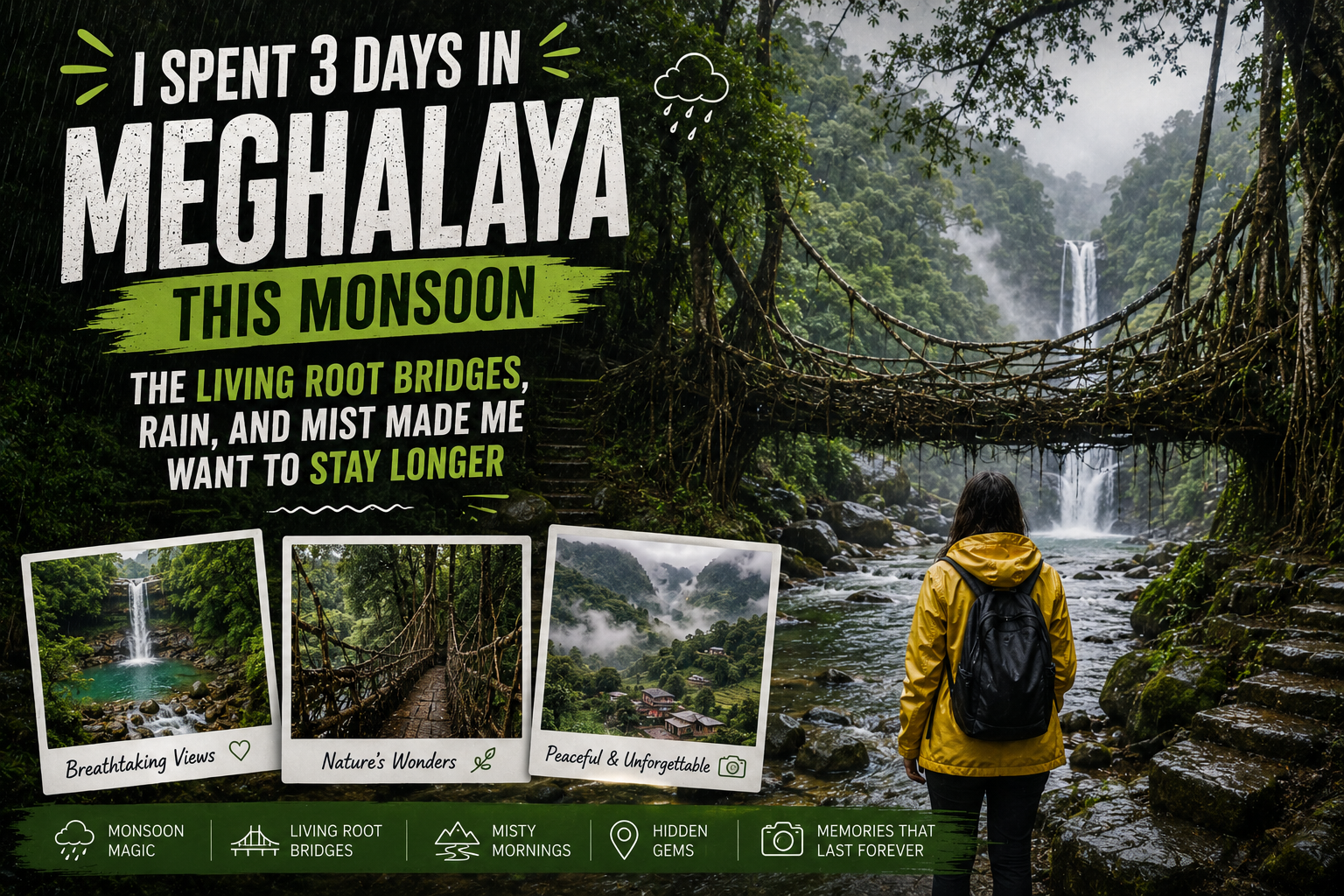
I had been warned twice before I booked the tickets to Meghalaya.
Once by a colleague who had gone to Shillong in July and returned with a cold that lasted three weeks. The second warning came from a travel forum where someone had written, in capital letters: DO NOT GO TO MEGHALAYA IN THE RAINS.
I went anyway.
Partly because I’ve never completely trusted a warning that comes with an exclamation mark, and partly because I wanted to find out what Meghalaya actually looks like when the clouds arrive and the rain refuses to stop.
Three days later, standing somewhere near Nongriat with a leaking golf umbrella, leeches on my socks and not a single completely dry shoe left to my name, I understood the warning.
And ignored it completely anyway.
Meghalaya in monsoon is not the easy version of the state. Roads can become unpredictable, trails turn slippery, waterfalls become enormous, and clouds can erase an entire mountain range within minutes.
But it is also when Meghalaya feels most alive.
The forests become intensely green. Waterfalls explode across cliffs. Rivers swell beneath ancient bridges. Mist moves through villages and hills like it belongs there.
This is what my three days in Meghalaya during the monsoon actually looked like.


Why Visit Meghalaya During the Monsoon?
Before this trip, I assumed the monsoon was simply the season you tolerated if you couldn’t travel at another time.
Meghalaya changed my mind.
The state receives some of the heaviest rainfall in the world, particularly around Sohra, formerly known as Cherrapunji. During the wettest months, rain transforms the landscape rather than simply interrupting it.
Waterfalls that can look modest in drier months become roaring curtains of water. Streams fill rapidly, forests turn almost impossibly green, and the famous clouds of the Khasi Hills become part of the landscape itself.
Of course, there is a trade-off.
Meghalaya monsoon travel requires flexibility.
A clear viewpoint may disappear behind fog. A road can become difficult after heavy rain. Trekking trails become slippery, and some activities may be unavailable because of weather conditions.
If you’re looking for guaranteed sunshine and easy sightseeing, this isn’t the season.
If you want to experience Meghalaya in monsoon at its most dramatic, however, the rain is part of the attraction.
Getting to Meghalaya: The Journey Starts in Shillong
My trip began with a flight to Guwahati.
From there, I travelled by road toward Shillong, climbing gradually out of the Brahmaputra valley and into the Khasi Hills.
The change was almost immediate.
The air became cooler. Pine trees appeared along the road. The landscape grew hillier. And eventually, the clouds stopped being something above me and became something I was literally driving through.
That was my first proper introduction to Meghalaya.
Shillong itself was wet but lively.
Around Police Bazaar, people continued moving through the drizzle beneath umbrellas while shopkeepers sheltered under awnings. Cars crawled through wet streets, tea stalls stayed busy, and the rain seemed to be treated less as an inconvenience and more as a normal part of everyday life.
I stayed at a small homestay where my Khasi hosts provided an enormous dinner and, more importantly, gave me a list of roads I should avoid the following day because of the weather.
That advice turned out to be more useful than anything I had read online.
Travel Tip
If you’re visiting Meghalaya during the rainy season, ask locals about road and trail conditions every morning.
Weather apps can tell you that it will rain.
Local residents can often tell you which road has actually become difficult.
Day 1: Shillong to Sohra — Where the Rain Takes Over
The first full day was dedicated to Sohra, better known to many travellers as Cherrapunji.
The drive from Shillong takes roughly two hours, depending on traffic and road conditions.
Normally, the journey offers spectacular viewpoints across the Khasi Hills and toward the plains of Bangladesh.
I saw almost none of them.
Instead, the road disappeared repeatedly into walls of white mist.
And honestly?
I didn’t mind.
Waterfalls began appearing beside the road. Some were delicate streams sliding down rock faces. Others were powerful torrents crashing through the vegetation.
It felt like the entire landscape was leaking.


Nohkalikai Falls in the Monsoon
My first major stop was Nohkalikai Falls.
I’ve seen photographs of the waterfall before: a dramatic vertical drop surrounded by green cliffs.
The monsoon version was much more aggressive.
Water poured over the cliff with extraordinary force, and the mist around the viewpoint made it difficult to keep a camera lens dry for more than a few seconds.
A handful of other travellers stood nearby doing exactly the same thing — wiping their phones, taking photographs, wiping them again.
Someone told me August would be even wetter.
I decided not to investigate.
Mawsmai Caves
After spending enough time getting soaked at the viewpoint, I headed toward Mawsmai Caves.
The limestone cave system provided something I hadn’t realised I needed:
Shelter.
Inside, the atmosphere was cool and damp. The passages became narrow enough in places that I had to duck, squeeze through gaps and pay attention to where I was putting my feet.
The rocks were slippery from the moisture.
Afterwards, I found a roadside place serving hot food.
A plate of Jadoh and a cup of tea might have been the best meal I’d eaten all day.
Sometimes the best travel experiences aren’t the famous attractions.
Sometimes they’re simply hot food after several hours in the rain.
Day 2: The Nongriat Trek and Meghalaya’s Living Root Bridges
This was the reason I had really come to Meghalaya.
The living root bridges of Meghalaya had been sitting on my travel wish list for years.
Photographs make them look almost magical.
But photographs don’t show the stairs.
To reach the famous Umshiang Double Decker Living Root Bridge near Nongriat, travellers generally begin from Tyrna and descend thousands of steps into the valley.
In the monsoon, those steps become a completely different challenge.


The Nongriat Trek in Monsoon
The concrete steps were wet, mossy and constantly crossed by streams of rainwater.
My guide moved down them as though he were walking across his own backyard.
I moved much more cautiously.
Within the first half hour, I encountered another unavoidable part of monsoon trekking in Meghalaya:
Leeches.
They are small, determined and remarkably good at appearing where you least expect them.
Checking my socks became part of the routine.
Down and down we went through thick forest.
The further we descended, the more intense the greenery became.
The canopy filtered the daylight until everything had a greenish glow.
Streams rushed beside the trail.
Water dripped from leaves.
Every few minutes, the forest seemed to produce another sound — birds, insects, running water or distant thunder.
And then we reached it.
The Double Decker Living Root Bridge
The bridge doesn’t arrive with a dramatic entrance.
You simply round a bend and suddenly find yourself standing in front of something that looks impossible.
Two layers of living tree roots cross the river.
The structures are created from the aerial roots of Ficus elastica, or rubber fig trees. Local communities have traditionally guided and trained the roots across streams and rivers, allowing them to gradually grow into strong natural crossings.
Unlike a conventional wooden bridge, a living root bridge continues to grow.
That idea stayed with me.
This wasn’t a monument that had been built and finished.
It was infrastructure that was still alive.


Standing on the bridge while rain fell around me and water thundered beneath it felt completely different from seeing it on a screen.
The roots were thick, rough and cool beneath my hands.
For a few minutes, I stopped taking photographs.
I just stood there.
Rainbow Falls: The Reward at the End of the Trail
We continued toward Rainbow Falls.
The waterfall drops into a beautiful pool surrounded by enormous rocks.
I had hoped for the rainbow that gives the waterfall its name.
The sun, unfortunately, had other plans.
There was no dramatic rainbow.
But the waterfall itself was spectacular.
The monsoon had filled the streams, and the water rushed through the landscape with an energy that photographs struggle to capture.
A few travellers went into the pool.
I followed.
The water was cold enough to make every tired muscle suddenly noticeable.
After the swim, we began the long climb back.
Those thousands of steps that had looked difficult on the way down seemed significantly more personal on the way up.
But strangely, I didn’t regret a single one.
Day 3: Mawlynnong, Riwai and Dawki
After the Nongriat trek, I deliberately planned a slower third day.
The route took me toward Mawlynnong, one of Meghalaya’s best-known villages, and nearby Riwai.
The landscape remained incredibly green, but the pace was gentler.
Riwai Living Root Bridge
Compared with Nongriat’s Double Decker Root Bridge, the Riwai bridge is considerably easier to reach.
It is a single natural arch formed from intertwined roots crossing a small stream.


The short walk through the forest was almost meditative.
Rain fell gently through the canopy.
Betel nut palms rose around the trail.
The stream beneath the bridge moved quietly.
After the previous day’s trek, it felt almost luxurious.
Mawlynnong Village
Mawlynnong has long been promoted as one of Asia’s cleanest villages.
The reputation is easy to understand once you’re there.
The lanes were swept. Bamboo bins stood around the village. Flowers grew beside homes, adding colour to an otherwise very green and grey day.
I climbed the village’s bamboo viewing structure hoping for a wide panorama.
Once again, the weather had a different idea.
The plains toward Bangladesh disappeared into mist.
Instead of a huge landscape photograph, I got fragments of hills appearing through clouds.
And somehow, that felt more appropriate for Meghalaya.
Dawki and the Umngot River During Monsoon
The final major stop was Dawki, famous for the Umngot River and its remarkably clear water during the drier months.
I’d seen the photographs.
Boats appear to float above the river.
The water can be so transparent that you can see the riverbed below.
The monsoon version is different.
Heavy rainfall changes the river’s appearance, and during my visit the Umngot was much fuller and darker, with a jade-green tone.
It wasn’t the crystal-clear river from the famous photographs.
But it was still beautiful.


And it made me realise something important about travelling during the monsoon:
You aren’t travelling to reproduce somebody else’s photograph.
You’re travelling to see the destination as it exists when you arrive.
Why Meghalaya in Monsoon Was Better Than I Expected
The practical side of this trip was undeniably harder.
Trails were slippery.
My shoes were permanently wet.
Leeches were everywhere.
Road conditions could change.
Clouds frequently blocked viewpoints.
But the rain also created the version of Meghalaya I had secretly hoped to see.
The waterfalls were enormous.
The forests looked saturated with life.
Streams that might otherwise have been quiet were rushing beneath bridges.
And the mist transformed ordinary landscapes into something almost unreal.


There was also something psychologically different about travelling this way.
When the weather makes photography difficult, you stop photographing everything.
When your clothes are wet, you stop worrying about whether they look good.
When the clouds erase the view, you stop waiting for the perfect viewpoint.
You simply experience what’s in front of you.
I remember the sound of rain hitting a tin roof much more clearly than I remember some of the photographs I took.
I remember the smell of wet forest.
I remember the sound of water underneath the root bridge.
And I remember standing in the mist wondering how a landscape could feel simultaneously so close and so hidden.
Is Meghalaya Safe During the Monsoon?
Meghalaya can be visited during the monsoon, but travellers need to take weather conditions seriously.
Heavy rainfall can affect roads, trails, waterfalls and river activities.
The biggest mistake would be treating a monsoon trip exactly like a dry-season itinerary.
Instead:
- Check road conditions before travelling.
- Ask local guides about trekking conditions.
- Avoid hiking during severe weather.
- Don’t approach swollen rivers or waterfalls unnecessarily.
- Keep additional time between destinations.
- Carry waterproof protection for electronics.
- Follow local warnings and closures.
- Avoid forcing your itinerary simply because you have a reservation.
The weather is part of the experience, but it should never be treated casually.
What to Pack for Meghalaya in Monsoon
If you’re planning a Meghalaya monsoon trip, packing correctly matters more than packing heavily.
Essential items:
Waterproof trekking shoes
The Nongriat trail can become extremely slippery.
Rain jacket
An umbrella is useful, but a proper waterproof jacket leaves your hands free while trekking.
Dry bags
Keep your phone, camera, documents and electronics protected.
Extra socks
You will probably need them.
Quick-dry clothing
Avoid carrying cotton-heavy outfits for trekking days.
Leech protection
Leech socks can be useful during wet-season hikes.
Power bank
Don’t assume you’ll always have convenient charging access.
Small first-aid kit
Especially useful for longer hikes.
Water bottle
Stay hydrated even when the weather feels cool.
Best Time to Visit Meghalaya
The best time to visit depends entirely on what you want to experience.
June to September: Monsoon
Best for:
- Huge waterfalls
- Extremely green landscapes
- Mist and clouds
- Living root bridges surrounded by lush vegetation
- Fewer conventional tourist crowds
But expect:
- Heavy rain
- Slippery trails
- Possible road disruptions
- Limited visibility
- Changes to outdoor activities
October to November: Post-Monsoon
This can be an excellent compromise.
The landscape remains green, while conditions generally become more manageable.
December to February: Winter
Expect cooler and considerably drier conditions.
This is better for travellers who want easier road travel, clearer viewpoints and comfortable sightseeing.
A Simple 3-Day Meghalaya Monsoon Itinerary
If you have only three days, here’s a practical structure based on my trip:
| Day | Destination | Highlights |
|---|---|---|
| Day 1 | Shillong → Sohra | Nohkalikai Falls, Mawsmai Caves, waterfalls |
| Day 2 | Tyrna → Nongriat | Double Decker Root Bridge, Rainbow Falls |
| Day 3 | Mawlynnong → Riwai → Dawki | Riwai Root Bridge, Mawlynnong, Umngot River |
Important: During heavy monsoon conditions, don’t treat this as a rigid schedule. Roads and trails can change quickly, so keep some flexibility.
How Much Does a Meghalaya Monsoon Trip Cost?
The cost depends heavily on your accommodation, transport and whether you’re travelling independently or with a private vehicle.
A budget traveller can reduce expenses by:
- Staying in homestays
- Sharing transport
- Eating at local restaurants
- Travelling as a small group
- Using local guides for trekking rather than booking expensive packaged excursions
The Nongriat trek is where it makes sense to prioritise local guidance over saving every rupee.
The knowledge of someone who knows the trail, weather and surrounding villages can be far more valuable than travelling completely independently.
Would I Go Back to Meghalaya During the Monsoon?
Without hesitation.
There is another version of Meghalaya that appears in October and winter travel photographs.
The skies are clearer.
The roads are easier.
The viewpoints actually have views.
I’m sure that version is beautiful.
But the Meghalaya I experienced was wetter, wilder and considerably more atmospheric.
I saw waterfalls at their most powerful.
I walked across bridges that were grown rather than constructed.
I watched entire hills disappear into clouds.
I dealt with leeches.
I ruined a pair of shoes.
I took dozens of photographs that were technically terrible because of the rain.
And somehow, those imperfect photographs are the ones I like most.
Three days wasn’t enough.
If anything, the monsoon convinced me that I should have stayed longer.
Frequently Asked Questions About Meghalaya in Monsoon
Is Meghalaya worth visiting during the monsoon?
Yes, if you enjoy rain, waterfalls, mist and lush landscapes. Meghalaya during the monsoon is more challenging than visiting during the dry season, but the waterfalls and forests can be exceptionally dramatic.
Is July a good time to visit Meghalaya?
July is one of the wettest periods in Meghalaya. It can be rewarding for travellers who specifically want to experience the state’s monsoon landscape, but heavy rainfall can affect roads, trekking and outdoor activities.
Can you visit the living root bridges during monsoon?
Yes, but the trails can become very slippery. The Nongriat trek requires good footwear, reasonable fitness and attention to weather conditions. A local guide is highly recommended.
How many steps are there to the Double Decker Root Bridge?
The route from Tyrna to Nongriat involves thousands of steps, commonly described as around 3,000–3,500 depending on the route and how the count is made. The return journey is physically demanding, particularly during wet weather.
Is Cherrapunji worth visiting during the rainy season?
Absolutely. Sohra, or Cherrapunji, is particularly dramatic during the monsoon because waterfalls and streams become much more powerful. However, heavy cloud can reduce visibility at viewpoints.
What should I pack for a Meghalaya monsoon trip?
Pack waterproof trekking shoes, a rain jacket, quick-drying clothes, extra socks, waterproof bags, leech protection, a power bank and basic first-aid supplies.
Is Dawki worth visiting during monsoon?
Yes, although the Umngot River may not have the exceptionally clear appearance shown in many dry-season photographs. During the monsoon, higher water levels and surrounding greenery create a completely different landscape.
How many days are enough for Meghalaya?
Three days can cover major highlights, but 5–7 days is better if you want to explore Shillong, Sohra, Nongriat, Mawlynnong, Dawki and additional waterfalls without rushing.
Final Verdict: Should You Visit Meghalaya in Monsoon?
If your idea of a perfect holiday involves blue skies, dry hiking trails and predictable road conditions, wait until the monsoon passes.
But if you want to see Meghalaya in monsoon when waterfalls roar, forests glow green and clouds move through the Khasi Hills, don’t let the rain automatically put you off.
Just prepare properly.
Bring waterproof shoes.
Carry a dry bag.
Leave room in your itinerary for delays.
Listen to locals.
And don’t expect the Meghalaya you see in a perfectly edited Instagram photograph.
The real Meghalaya is wetter.
Messier.
Slower.
And, at least for me, considerably more memorable.
Internal Links
- Munnar, India: Why This Lush Hill Station Is Becoming One of India’s Hottest Monsoon Escapes in 2026
- The Rise of Do-Less Travel
- The Hidden Mental Health Benefits of Travel
- The Future of Sustainable Travel: How to Explore Without Leaving a Trace
- Traveling Through the Seasons: Why Every Time of Year Offers a Unique Adventure
- Hidden Gems: Why Offbeat Travel Creates the Best Memories
- Experience-Led Travel 2026: Okinawa, Marrakech, Swiss Alps