
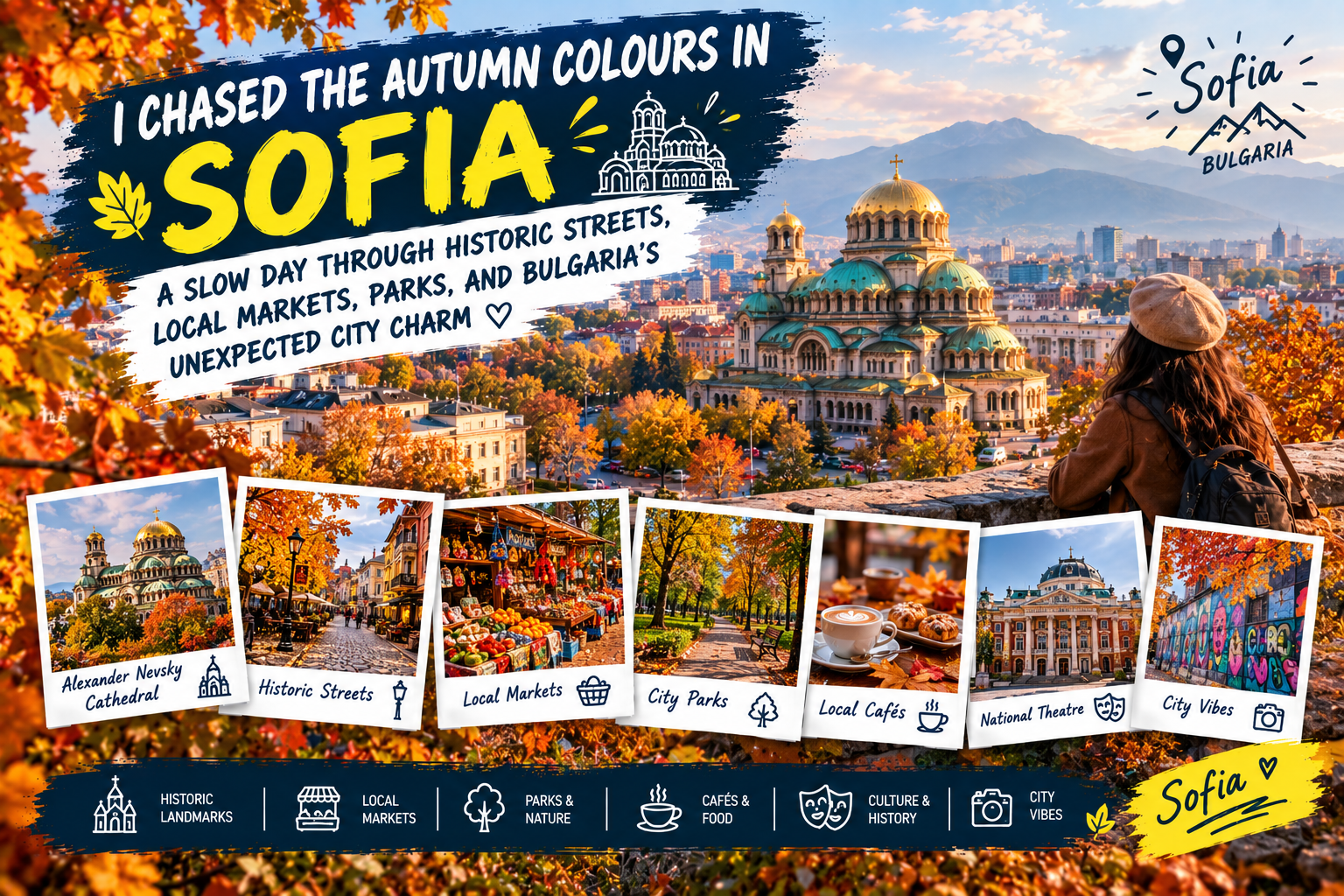
I did not set an alarm in Sofia.
That, more than anything else, tells you what kind of day this was going to be.
Most travellers pass through Bulgaria’s capital on their way somewhere else. Plovdiv’s old town, the beaches around Varna, the mountains above Bansko or the Rila Monastery often become the next destination.
Sofia gets a night or two.
I decided to give it a full, unhurried autumn day.
By evening, I understood why the city had surprised me so much. Nobody had warned me about the particular golden light of October, or how a city of more than a million people could feel almost intimate once I stepped away from the busiest streets.
This is the story of that day.
The churches, the market stalls, the parks turning copper and rust, the yellow cobblestones, the coffee breaks and the quiet streets all became part of a Sofia I hadn’t expected to discover.
Morning in Sofia: Coffee, Cobblestones, and the First Hint of Autumn
Autumn in Sofia doesn’t arrive with a dramatic announcement.
Instead, the colour appears gradually.
One tree turns gold beside a tram line. Another begins losing its leaves inside a quiet courtyard. A row of plane trees creates a canopy above the pavement while the first chilly breeze moves through the streets.
I started near the city centre with a strong Bulgarian coffee from a small stand.
The man behind the counter seemed to know most of the people around him. Regulars ordered without much conversation, while newcomers received a quick curious glance before being handed their cups.
With coffee warming my hands, I began walking.
My route took me toward Sofia’s famous yellow cobblestone streets.
The paving is one of the city’s distinctive details, particularly around some of its most important historic buildings. In the soft October light, fallen leaves scattered across the yellow stones and created a scene that looked almost deliberately arranged.
Nobody had arranged it, of course.
This was simply Sofia on an autumn morning.
Alexander Nevsky Cathedral in the Morning Light
About ten minutes later, the golden domes of Alexander Nevsky Cathedral appeared ahead of me.
The scale of the building immediately changed the mood of the walk.
Alexander Nevsky Cathedral is one of Bulgaria’s most recognisable landmarks and one of the largest Eastern Orthodox cathedrals in the world. Its construction began in the late 19th century, and the cathedral was dedicated to Russian soldiers who died during the Russo-Turkish War of 1877–1878.
I didn’t go inside immediately.
Instead, I sat near the square and watched the morning unfold around the cathedral.
The golden domes caught the sunlight.
Pigeons moved across the pavement.
Visitors stopped to photograph the building before continuing toward the next attraction.
Nearby, an elderly vendor arranged objects for sale while people slowly gathered around the informal market.
There was no reason to rush.
That became the theme of my entire day.
The Antique Market Beside Alexander Nevsky Cathedral
The open-air antique market near Alexander Nevsky Cathedral was one of the first places that made Sofia feel unexpectedly personal.
Folding tables and blankets displayed an assortment of objects that seemed to come from completely different chapters of Bulgarian history.
Old cameras sat beside books.
Medals were displayed near icons.
Porcelain, postcards, coins and Soviet-era memorabilia competed for attention.
I stopped at one table and picked up a small enamel pin.
It wasn’t valuable.
I didn’t need it.
Still, it felt like the kind of tiny object that would bring the morning back to me years later.
The vendors seemed relaxed, and conversations drifted between tables. At one point, two sellers became involved in an animated discussion about football.
I understood almost none of it.
Yet somehow, that made the moment even better.
A national landmark stood only a few steps away, but the atmosphere around the market felt more like a neighbourhood gathering than a major tourist attraction.
That was my first real surprise of the day.
Midday in Sofia: Discovering Ladies Market
By late morning, I had walked toward Zhenski Pazar, better known as Ladies Market.
Located near the central part of Sofia, this historic market has long been associated with everyday shopping rather than polished tourism.
That distinction mattered.
The market felt practical and energetic.
Stalls displayed fruit, vegetables, nuts, spices and other foods. Vendors called out prices while shoppers moved between the rows. Autumn had added its own colours to the scene, with apples, peppers, pumpkins and other seasonal produce appearing across the stalls.
The smell changed every few steps.
One section smelled of roasted peppers.
Another carried the earthy scent of vegetables and herbs.
Somewhere nearby, coffee was being prepared.
I slowed down.
There was something satisfying about watching people shop for ordinary ingredients in a place that visitors might otherwise treat as a sightseeing stop.
Tasting a Bulgarian Autumn
I bought a small bag of walnuts and a piece of sirene cheese.
Then I noticed a jar of rose-petal preserve.
The woman selling it encouraged me to try some.
A mixture of English, gestures and smiles was enough to make the conversation work.
The taste surprised me.
It was floral, slightly sweet and unlike anything I had expected to find in the middle of an everyday city market.
That tiny tasting became one of my favourite memories from Sofia.
Not because it was extraordinary.
Because it wasn’t.
The experience felt spontaneous, local and completely unscripted.
Why Ladies Market Is Worth Visiting Slowly
Tourists can easily walk through a market, take a few photographs and leave.
I nearly did the same.
Instead, I stayed for almost an hour.
That extra time changed the experience.
I noticed the conversations between vendors. Shoppers compared prices. People carried bags of vegetables home. Nothing was arranged for visitors, and that was precisely the appeal.
Ladies Market showed me a side of Sofia, Bulgaria, that grand monuments couldn’t.
The city wasn’t trying to impress me.
It was simply going about its day.
Afternoon in Borisova Garden: Sofia Turns Gold
By early afternoon, I was ready for some space.
Borisova Garden was exactly what I needed.
Often described as Sofia’s oldest and largest park, Borisova Garden stretches through the eastern side of the city and provides a huge green escape from the surrounding streets.
Autumn had transformed it.
Leaves covered the paths in shades of gold, amber, copper and brown. Some trees remained deep green, creating a contrast that made the colours even more striking.
I began walking without choosing a particular destination.
That decision turned out to be the right one.
Walking Through Sofia’s Autumn Colours
Joggers passed me along the paths.
Older residents sat together and talked.
Students occupied benches with books open on their laps, while families pushed strollers through the changing leaves.
Nobody seemed particularly interested in the fact that I was trying to photograph every tree.
They had seen autumn arrive here many times before.
I kept walking.
The paths moved between open lawns and dense trees. A few birds crossed overhead, and the occasional cyclist appeared around a bend.
After the noise of the central market, the quiet felt almost surprising.
Two hours disappeared without me noticing.
That’s when I understood something about Sofia.
Its green spaces aren’t simply places to escape the city.
They are part of the city’s identity.
Late Afternoon at City Garden and the National Theatre
Eventually, I made my way back toward the centre.
My next stop was City Garden, the small public park directly in front of the Ivan Vazov National Theatre.
Compared with Borisova Garden, City Garden is tiny.
Yet its location makes it one of the city’s most sociable public spaces.
People gathered around the fountain.
Students sat on benches.
Couples talked over coffee.
Chess players concentrated over their boards.
The National Theatre stood behind them with its elegant neoclassical facade catching the soft afternoon light.
I bought a small bag of roasted chestnuts from a nearby vendor and found a place to sit.
For a while, I simply watched.
Trams moved through the streets beyond the park.
People crossed between buildings.
The light became warmer.
Nothing spectacular happened.
And somehow, that ordinary scene captured Sofia better than any major landmark I had visited that day.
Evening in Sofia: Vitosha Boulevard at Dusk
As evening approached, I continued toward Vitosha Boulevard.
The atmosphere changed again.
Cafés began filling with people. Street musicians prepared for the evening. Shop windows reflected the fading light, while pedestrians moved along the broad pedestrian street.
In the distance, Vitosha Mountain appeared as a dark silhouette against the sky.
That view reminded me that Sofia is unusual for a European capital.
The city and the mountain are remarkably close to each other.
I found a place to stop for food and ordered banitsa, the flaky Bulgarian pastry I had been curious to try.
A glass of local wine followed.
For the first time all day, I checked the time.
It was much later than I had realised.
A Slow Dinner and a Look Back at the Day
Over dinner, I thought about how little I had actually rushed.
There had been no frantic morning schedule.
No attempt to photograph every attraction.
No checking the clock every thirty minutes.
Instead, the day had unfolded naturally.
Coffee became a walk.
The walk became a cathedral visit.
The cathedral led to the antique market.
A market visit turned into lunch.
Later came the park, the theatre and an evening along Vitosha Boulevard.
Sofia had slowly filled the spaces between those places.
That was what I liked most.
The city didn’t seem to demand constant attention.
It allowed me to notice it at my own pace.
Why Sofia Deserves More Than a Layover
Travellers often treat Sofia as a gateway to the rest of Bulgaria.
It makes sense.
The country has extraordinary destinations, from Plovdiv and the Rila Monastery to the Black Sea coast and the mountains.
Still, spending a full autumn day in Sofia made me question why the city is so often treated as merely a starting point.
The answer isn’t that Sofia has more famous monuments than other European capitals.
It doesn’t need to.
Its charm comes from the combination.
Historic churches stand near ordinary streets.
Markets continue beneath grand landmarks.
Trams move past parks covered in autumn leaves.
Coffee shops sit beside old buildings.
Vitosha Mountain watches over the city from the distance.
Even the busiest parts of Sofia can give way to quiet corners within minutes.
That balance is what stayed with me.
What I Would Do With One Autumn Day in Sofia
If I had only one day in Sofia during autumn, I wouldn’t create an exhausting itinerary.
I’d start with coffee and a slow walk through the historic centre.
Alexander Nevsky Cathedral would be an early stop, followed by time around the antique market.
From there, I’d head toward Ladies Market and spend enough time to actually browse rather than simply pass through.
The afternoon would belong to Borisova Garden.
No strict route.
No target number of photographs.
Just a long walk beneath the changing leaves.
Later, I’d return toward the centre and sit in City Garden near the National Theatre before ending the day on Vitosha Boulevard.
Most importantly, I’d leave some empty space in the schedule.
Sofia is a city that rewards it.
When Is the Best Time to Experience Autumn in Sofia?
October is particularly appealing if you want to experience Sofia surrounded by autumn colours.
The exact timing of peak foliage changes from year to year depending on temperatures and weather, but autumn generally brings cooler days and changing colours across the city’s parks and tree-lined streets.
Morning and late afternoon are especially beautiful.
The light becomes softer, temperatures are comfortable for walking, and the parks take on a warm golden tone.
Pack layers.
Even a sunny autumn afternoon can turn chilly once the sun disappears.
Is Sofia Worth Visiting in Autumn?
Absolutely, especially if your idea of travel involves walking, local food, markets, parks and historic neighbourhoods rather than rushing between attractions.
Autumn gives Sofia a particularly atmospheric character.
The crowds can feel more manageable than during the busiest summer period, while the parks become some of the city’s most beautiful spaces.
More importantly, autumn encourages the kind of slow wandering that suits Sofia surprisingly well.
Final Thoughts: The Sofia I Found by Slowing Down
I arrived in Sofia expecting a stopover.
Instead, I gave it a day.
That decision changed the way I saw the city.
The golden domes of Alexander Nevsky Cathedral were impressive, but I remember the antique market beside it just as clearly.
Ladies Market was interesting, but the woman who handed me a spoonful of rose-petal preserve is what stayed with me.
Borisova Garden was beautiful, yet what I remember most is walking without knowing exactly where I was going.
City Garden was ordinary.
Vitosha Boulevard was lively.
The yellow cobblestones looked almost golden beneath the October light.
Together, those small moments created something much more memorable than a checklist of attractions.
Sofia didn’t need to convince me that it was worth visiting.
It simply asked me to slow down enough to notice.
And by the time I walked back to my accommodation that evening, I no longer thought of Sofia as a city to pass through.
I thought of it as a city I would happily return to.
Internal Links
- Traveling Through the Seasons: Why Every Time of Year Offers a Unique Adventure
- Fallcation 2026: Why September and October Are Becoming the New Travel Season
- The Rise of Do-Less Travel
- Hidden Gems: Why Offbeat Travel Creates the Best Memories
- The Hidden Mental Health Benefits of Travel
- The Joy of Getting Lost: Why Unplanned Travel Adventures Are the Most Rewarding
- The Future of Sustainable Travel: How to Explore Without Leaving a Trace