
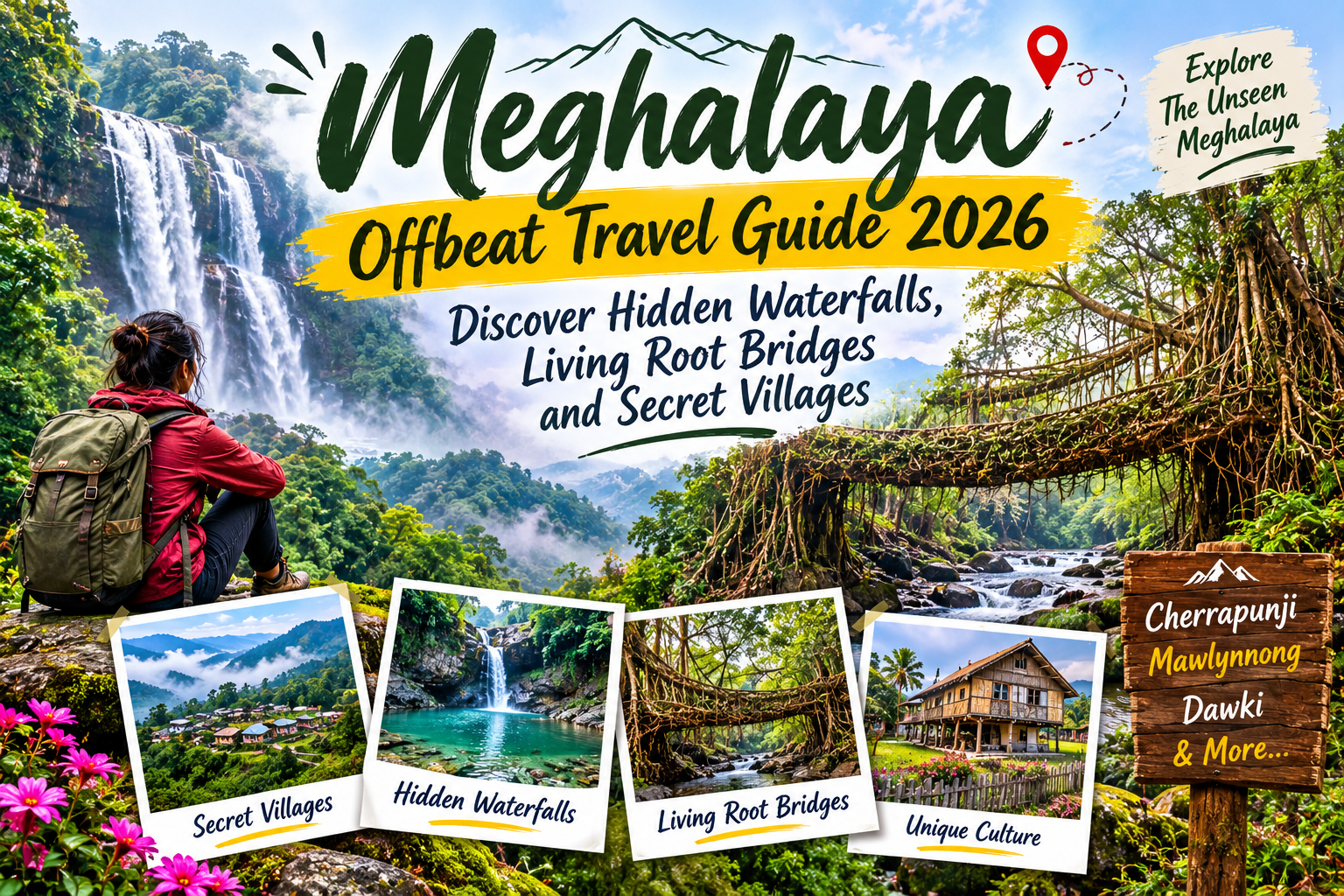
Meghalaya is a destination where nature takes centre stage. Mist-covered mountains, dense forests, sparkling rivers and spectacular waterfalls create landscapes that feel almost magical. Although Shillong, Cherrapunji and Dawki attract thousands of visitors, the real charm of Meghalaya often lies beyond these familiar destinations.
Imagine walking through quiet Khasi villages, crossing bridges made from living tree roots and discovering waterfalls hidden inside forests. Peaceful mornings bring another surprise as clouds drift across the green valleys. Together, these experiences reveal a different side of Northeast India.
This Meghalaya offbeat travel guide takes you beyond the usual tourist circuit. From the peaceful villages of Mawlynnong and Nongriat to the beautiful landscapes around Pynursla, Shnongpdeng and the Jaintia Hills, discover places where nature, culture and adventure come together.
Whether you enjoy hiking, photography, slow travel or exploring destinations away from crowded tourist spots, Meghalaya offers plenty of reasons to plan a memorable journey in 2026.
Why Explore Offbeat Meghalaya in 2026?
Meghalaya is often called the Abode of Clouds. Its landscapes change dramatically with the seasons, creating a beautiful combination of misty hills, green valleys, limestone formations and flowing rivers.
However, the state offers much more than its famous viewpoints. Exploring quieter corners provides opportunities to discover local traditions, natural attractions and peaceful village life.
Here are some reasons to explore offbeat Meghalaya:
- Discover lesser-known waterfalls surrounded by forests.
- Experience traditional Khasi and Jaintia village life.
- Walk across remarkable living root bridges.
- Explore quiet rivers and scenic mountain roads.
- Enjoy nature trails away from busy tourist centres.
- Experience local food, traditions and hospitality.
Moreover, travelling beyond popular attractions creates more opportunities to connect with local communities. Instead of rushing between sightseeing spots, spend time exploring villages, walking through forests and enjoying the peaceful surroundings.
Best Offbeat Places to Visit in Meghalaya
1. Nongriat – The Village of Living Root Bridges
Nongriat is one of Meghalaya’s most extraordinary destinations. Located near Cherrapunji, this peaceful village is famous for its remarkable living root bridges.
Its most popular attraction is the Double Decker Living Root Bridge. Local communities create these impressive structures by guiding the aerial roots of rubber fig trees across streams. Over many years, the roots grow stronger and form natural bridges that can support people crossing them.
Reaching Nongriat requires a challenging trek involving hundreds of steps through forests and villages. Although the journey can be physically demanding, the beautiful surroundings make it worthwhile.
Beyond the famous bridge, visitors can explore nearby waterfalls and natural pools. The village also offers a wonderful opportunity to understand Meghalaya’s traditional relationship with nature.
Best experiences:
- Trek to the Double Decker Living Root Bridge.
- Explore nearby forest trails.
- Visit natural pools and waterfalls.
- Experience the peaceful village atmosphere.
2. Mawlynnong – A Beautiful Village Surrounded by Nature
Mawlynnong is widely recognised for its clean surroundings and community-led approach to waste management. Located in the East Khasi Hills, the village is surrounded by lush greenery, bamboo structures and beautiful countryside.
A walk through Mawlynnong reveals traditional houses, narrow pathways and colourful gardens. Together, these features create a peaceful village atmosphere.
One of its interesting attractions is the Sky View, a bamboo observation structure that provides views towards the Bangladesh plains on clear days.
Additionally, the village is a convenient base for exploring nearby attractions, including the living root bridge at Riwai.
Best experiences:
- Walk through the village lanes.
- Visit the bamboo Sky View.
- Explore the nearby Riwai Living Root Bridge.
- Enjoy local Khasi food.
- Photograph the surrounding countryside.
3. Shnongpdeng – A Peaceful Riverside Escape
Located near Dawki, Shnongpdeng is a beautiful riverside destination known for its clear waters and outdoor activities.
The Umngot River flows through this region, creating an attractive landscape of green hills, rocky riverbanks and transparent water during suitable seasonal conditions.
Unlike busy tourist centres, Shnongpdeng offers opportunities to enjoy the river at a slower pace. Boating, kayaking and other water-based activities are available, depending on weather and local operating conditions.
Furthermore, camping beside the river is another popular experience. Travellers can enjoy the surrounding landscape without following a packed sightseeing schedule.
Best experiences:
- Enjoy boating on the Umngot River.
- Try kayaking and other water activities.
- Spend time beside the river.
- Experience riverside camping.
- Photograph the surrounding hills.
4. Pynursla – Explore Meghalaya’s Quiet Countryside
Pynursla is a scenic region in the East Khasi Hills that offers a quieter alternative to some of Meghalaya’s more popular destinations.
Green hills, small settlements, forests and winding roads define the surrounding countryside. As a result, the region appeals to travellers who enjoy discovering places without following a crowded sightseeing schedule.
The wider Pynursla area also provides access to villages and natural attractions. Take time to explore local markets, interact respectfully with residents and enjoy the changing mountain scenery.
Best experiences:
- Explore traditional Khasi settlements.
- Enjoy scenic countryside drives.
- Discover lesser-known natural viewpoints.
- Experience local food and village culture.
5. Mawphlang – Sacred Forests and Khasi Heritage
Mawphlang is known for its sacred forest, an important part of Khasi cultural and ecological heritage.
The Mawphlang Sacred Grove protects a rich natural environment containing old trees, moss-covered rocks, medicinal plants and diverse vegetation.
Local traditions place strong importance on protecting the forest. Consequently, visitors are expected to follow local rules and avoid removing plants, stones, leaves or other natural materials.
A guided walk through the grove offers an opportunity to understand the relationship between the Khasi community and the surrounding environment. Nature enthusiasts can also learn about local heritage and traditional conservation practices.
Best experiences:
- Take a guided walk through the sacred grove.
- Learn about Khasi traditions.
- Explore the surrounding countryside.
- Discover local heritage and folklore.
6. Jowai – Discover the Beauty of the Jaintia Hills
Jowai is the headquarters of West Jaintia Hills and serves as a gateway to several beautiful attractions in Meghalaya.
The region is known for its rivers, green landscapes, cultural traditions and limestone formations. Compared with some popular Khasi Hills destinations, Jowai offers a different atmosphere and opportunities to explore Jaintia heritage.
Nearby attractions such as Krang Suri Falls make the town a convenient starting point for nature-focused excursions.
Best experiences:
- Explore Jowai town.
- Discover Jaintia culture and traditions.
- Visit nearby waterfalls.
- Enjoy scenic drives through the hills.
- Explore local markets and regional food.
7. Smit – Experience Traditional Khasi Culture
Smit is a traditional Khasi village near Shillong. Its cultural significance is closely connected with the annual Nongkrem Dance Festival.
The village offers an opportunity to understand Khasi traditions, community life and traditional architecture. Visitors interested in cultural tourism can learn more about the region’s heritage here.
During the Nongkrem Dance Festival, traditional performances, colourful clothing and cultural celebrations bring the village to life. Nevertheless, festival dates and visitor arrangements should be checked before planning a trip.
Best experiences:
- Explore the traditional village.
- Learn about Khasi customs.
- Experience the Nongkrem Dance Festival when it takes place.
- Photograph traditional architecture and landscapes.
8. Laitlum Canyons – Dramatic Mountain Views
Laitlum Canyons is one of the most beautiful viewpoints in Meghalaya. Located near Shillong, it offers dramatic views of deep valleys, rolling hills and winding paths.
The name Laitlum is often associated with the idea of the end of hills. Its landscape becomes especially striking when clouds move through the valleys.
Although it is becoming increasingly popular, Laitlum remains a wonderful experience for travellers who enjoy open landscapes and peaceful surroundings.
Best experiences:
- Enjoy panoramic valley views.
- Photograph the changing clouds.
- Explore nearby walking trails.
- Experience a beautiful sunrise or sunset when conditions permit.
Hidden Waterfalls in Meghalaya Worth Exploring
Meghalaya is famous for its waterfalls, and many of its most beautiful cascades are surrounded by dense forests and remote landscapes.
From multi-tiered waterfalls to broad rocky cascades, each location offers a different experience. Here are five waterfalls worth adding to your itinerary.
1. Krang Suri Falls
Located in the Jaintia Hills, Krang Suri Falls is known for its striking blue-green natural pool and beautiful forest surroundings.
The waterfall drops into a clear pool, creating a spectacular setting for photography. Visitors can reach the viewpoint and waterfall area through a walking route.
However, swimming arrangements, safety restrictions and access conditions may change depending on the season. Always follow local instructions before entering the water.
2. Wei Sawdong Falls
Wei Sawdong is a beautiful multi-tiered waterfall near Cherrapunji.
Its distinctive appearance comes from several levels of water flowing into natural pools. From the viewpoint, visitors can enjoy a spectacular perspective of the cascading water.
Reaching the waterfall involves a steep staircase. Therefore, suitable footwear is essential, and visitors should take care while walking.
3. Phe Phe Falls
Phe Phe Falls is a scenic waterfall in the Jaintia Hills region. Surrounded by greenery and rocky landscapes, it is an attractive destination for travellers looking for a nature-focused experience.
The approach may involve walking through uneven terrain. For a safer visit, local guidance can help visitors understand the route and current access conditions.
4. Dainthlen Falls
Dainthlen Falls is located near Cherrapunji and is associated with local Khasi legends.
Unlike narrow forest waterfalls, this attraction flows across a broad rocky landscape. As a result, it offers a different visual experience and excellent photography opportunities.
The location is also an interesting place to learn about the region’s folklore and cultural traditions.
5. Kynrem Falls
Kynrem Falls is among the notable waterfalls of the Cherrapunji region.
Surrounded by green hills, it becomes particularly impressive during the monsoon when water flows strongly over its rocky cliffs.
During the rainy season, the surrounding landscape becomes especially lush. Nevertheless, visitors should check weather conditions before travelling.
Living Root Bridges: Meghalaya’s Natural Wonders
One of the most remarkable attractions in Meghalaya is its living root bridges.
These bridges are created by guiding the aerial roots of rubber fig trees across streams and rivers. Over time, the roots grow, strengthen and form natural structures that can support people.
Unlike conventional bridges made from concrete or steel, living root bridges are living systems that continue to grow. Their construction reflects generations of traditional knowledge and a close relationship with the natural environment.
Famous Living Root Bridges to Explore
Double Decker Living Root Bridge, Nongriat: This is the most famous living root bridge in Meghalaya. Its two levels make it particularly distinctive.
Riwai Living Root Bridge: Located near Mawlynnong, this bridge is easier to access than the Nongriat bridge. Consequently, it is a suitable option for visitors with limited trekking time.
Other village root bridges: Several communities across the Khasi Hills have traditional root bridges. However, their locations and access arrangements should be confirmed locally before visiting.
Together, these bridges represent generations of traditional ecological knowledge. They also demonstrate how communities have adapted to their natural surroundings.
Best Things to Do in Offbeat Meghalaya
Meghalaya is not just about sightseeing. Its landscapes offer opportunities for outdoor experiences, cultural exploration and slow travel.
1. Trek Through Forest Trails
Explore forest paths leading to waterfalls, villages and living root bridges. Some routes are challenging, so choose trails according to your fitness level.
Additionally, hiring a local guide can make remote walks easier to navigate.
2. Enjoy River Adventures
The rivers around Dawki and Shnongpdeng offer opportunities for boating, kayaking and other water activities.
However, always use authorised operators and follow safety instructions. Water conditions can change, particularly during periods of heavy rainfall.
3. Experience Village Life
Spend time in Khasi and Jaintia villages. Learn about traditional homes, local food, community practices and the importance of nature in everyday life.
Moreover, staying in a local homestay can provide a more meaningful cultural experience.
4. Explore Caves
Meghalaya is famous for its limestone caves. Mawsmai Cave is among the accessible options near Cherrapunji, while other cave systems require more planning and appropriate local guidance.
For safety, do not enter restricted or unmarked cave areas without authorised guides.
5. Photograph the Landscapes
From mist-covered valleys to turquoise rivers, Meghalaya offers endless photography opportunities.
Early mornings are particularly beautiful when clouds drift across the hills. Meanwhile, the post-monsoon season can provide excellent conditions for landscape photography.
Khasi and Jaintia Culture: Discover the Local Way of Life
A journey through Meghalaya becomes more meaningful when you understand its local communities.
The Khasi and Jaintia communities have distinctive traditions, languages, food and cultural practices. Many Khasi and Jaintia communities follow matrilineal traditions, where family lineage and inheritance are traced through the female line. However, practices can vary between communities and families.
Local festivals also provide an opportunity to experience Meghalaya’s cultural heritage.
Some important celebrations include:
- Nongkrem Dance Festival: A major Khasi cultural celebration.
- Wangala Festival: A harvest festival associated with the Garo community.
- Behdienkhlam: An important festival celebrated by the Pnar community of the Jaintia Hills.
Festival schedules vary each year. Therefore, check dates and local arrangements before travelling.
Best Time to Visit Meghalaya in 2026
Meghalaya can be visited throughout the year, but the experience changes considerably with the seasons.
March to May: Pleasant Weather and Outdoor Exploration
Spring and early summer offer relatively comfortable conditions for sightseeing and trekking.
This period is suitable for exploring villages, waterfalls and scenic viewpoints. In addition, outdoor activities are generally easier to plan than during periods of heavy monsoon rainfall.
June to September: Monsoon Landscapes
Monsoon transforms Meghalaya into a spectacular green destination.
Waterfalls become powerful, forests appear lush and clouds cover the hills. However, heavy rainfall can affect road conditions, trekking routes and outdoor activities.
For this reason, travellers should monitor weather updates and avoid risky trails during heavy rain.
October to November: Post-Monsoon Beauty
This is an excellent period for exploring Meghalaya.
The landscapes remain green, while rainfall generally decreases. Waterfalls continue to attract visitors, although their flow may vary.
Furthermore, clearer weather can create better conditions for sightseeing and photography.
December to February: Winter Travel
Winter brings cooler temperatures and relatively dry conditions.
It is a good time for village exploration, cultural experiences and scenic drives. On the other hand, some waterfalls may have reduced water flow.
How to Reach Meghalaya
By Air
The nearest major airport for most Meghalaya itineraries is Lokpriya Gopinath Bordoloi International Airport in Guwahati, Assam.
Shillong also has the smaller Shillong Airport, but flight availability is limited. Therefore, check current schedules before planning around it.
By Train
Guwahati Railway Station is the main railway gateway for travellers visiting Meghalaya.
From Guwahati, taxis and other road transport options are available for Shillong and other destinations. You can also arrange onward transport through local travel operators.
By Road
Shillong is approximately 100 kilometres from Guwahati, although travel time depends on traffic and road conditions.
Shared taxis, private cabs and buses operate on routes connecting Guwahati and Shillong.
For exploring offbeat destinations, hiring a local taxi or arranging a private vehicle can make travel more convenient. It also provides greater flexibility when visiting remote villages and waterfalls.
Suggested 5-Day Offbeat Meghalaya Itinerary
A five-day trip can introduce you to Meghalaya’s waterfalls, villages, forests and rivers.
First Day: Guwahati to Shillong
- Arrive in Guwahati.
- Travel to Shillong.
- Explore the local markets.
- Visit nearby viewpoints if time permits.
- Stay overnight in Shillong.
Second Day: Shillong to Mawphlang and Laitlum
- Visit Mawphlang Sacred Grove with a local guide.
- Explore Khasi cultural heritage.
- Travel towards Laitlum Canyons.
- Enjoy the valley views.
- Return to Shillong or stay in the surrounding area.
Third Day: Shillong to Cherrapunji and Nongriat
- Travel towards Cherrapunji.
- Explore Dainthlen Falls or other accessible attractions.
- Begin the trek to Nongriat if you have sufficient time and fitness.
- Stay overnight in or near Nongriat, depending on available accommodation.
Forth Day: Nongriat to Mawlynnong and Shnongpdeng
- Explore the Double Decker Living Root Bridge.
- Return from the trek.
- Travel towards Mawlynnong.
- Visit the Riwai Living Root Bridge.
- Continue towards Shnongpdeng if road and time conditions allow.
Fifth Day: Shnongpdeng and Return
- Enjoy the riverside surroundings.
- Try boating or kayaking if conditions permit.
- Travel back towards Guwahati.
- Depart after allowing sufficient time for the journey.
Important: This itinerary is ambitious, particularly on Days 3 and 4. The Nongriat trek is physically demanding. For a relaxed trip, add at least one extra day and avoid combining long treks with lengthy road journeys.
Where to Stay in Meghalaya
Meghalaya offers different accommodation options, from hotels in Shillong to homestays and guesthouses in smaller villages.
Consider these areas when planning your stay:
- Shillong: Suitable for hotels, restaurants and transport connections.
- Cherrapunji/Sohra: Convenient for waterfalls, caves and trekking routes.
- Nongriat: Basic homestays for travellers exploring the living root bridges.
- Mawlynnong: Village homestays for a peaceful countryside experience.
- Shnongpdeng: Riverside camps and homestays for nature-focused stays.
- Jowai: A convenient base for exploring the Jaintia Hills.
In addition, book accommodation in advance during holidays, festival periods and peak travel seasons.
Meghalaya Travel Budget: How Much Does an Offbeat Trip Cost?
The cost of a Meghalaya trip depends on your travel style, accommodation, transport and activities.
For a five-day trip, consider these broad planning categories:
| Expense | Budget Considerations |
|---|---|
| Accommodation | Hostels, guesthouses, homestays or hotels |
| Transport | Shared taxis, private cabs or rental arrangements |
| Food | Local restaurants, cafés and homestay meals |
| Activities | Trekking, boating, kayaking and guided walks |
| Entry fees | Applicable charges at attractions |
| Additional costs | Local guides, parking and seasonal activities |
Private transport and remote accommodation can increase the overall cost. Therefore, obtain current local quotations before finalising your budget, as prices vary by season and destination.
Essential Travel Tips for Meghalaya
A little preparation can make your trip more comfortable and responsible.
- Carry comfortable trekking shoes: Many waterfalls and root bridges require walking on uneven paths and steep steps.
- Pack rain protection: Weather can change quickly, especially in the hills.
- Carry cash: Some remote villages may have limited digital payment facilities.
- Respect local customs: Ask permission before photographing residents or entering private property.
- Hire local guides: Local guides can help with forest trails, caves and village experiences.
- Avoid littering: Carry your waste back and respect community-managed natural areas.
- Check road conditions: Heavy rain can affect travel between remote destinations.
- Keep extra time: Do not plan tight connections after long treks.
- Follow waterfall safety rules: Rocks can become slippery, and water conditions can change suddenly.
- Support local businesses: Choose community-run homestays, local guides and small restaurants whenever possible.
Responsible Tourism in Meghalaya
Meghalaya’s natural beauty is closely connected to the communities that protect it.
Living root bridges, sacred forests and traditional villages are not simply tourist attractions. Instead, they are part of the region’s cultural and ecological heritage.
Travellers can contribute positively by respecting local traditions, avoiding plastic waste and supporting community-based tourism.
Always follow instructions at sacred forests and village attractions. Similarly, avoid disturbing wildlife, damaging plants or leaving marks on natural structures.
By making responsible choices, visitors can help preserve Meghalaya’s landscapes for future generations.
Frequently Asked Questions About Offbeat Meghalaya
1. What are the best offbeat places to visit in Meghalaya?
Some interesting destinations include Nongriat, Mawlynnong, Shnongpdeng, Pynursla, Mawphlang, Smit and parts of the Jaintia Hills. Together, these places offer a mix of waterfalls, village experiences, forests and scenic landscapes.
2. How many days are enough to explore Meghalaya?
Five to seven days are suitable for exploring several major destinations. However, a longer trip allows you to discover remote villages and waterfalls at a relaxed pace.
3. Is Meghalaya suitable for solo travellers?
Yes, Meghalaya can be explored by solo travellers. Nevertheless, remote treks, caves and unfamiliar trails are best explored with authorised local guides.
4. What is the best time to visit Meghalaya?
October and November are excellent months for sightseeing and outdoor exploration. March to May also offers pleasant conditions. Meanwhile, the monsoon is beautiful but requires extra caution because of heavy rainfall.
5. Is the Double Decker Living Root Bridge difficult to reach?
Yes. Reaching the bridge in Nongriat involves a challenging trek with many steps. Consequently, travellers should have reasonable fitness and allow sufficient time for the return journey.
6. Can Meghalaya be explored without a private car?
Yes. Shared taxis and public transport connect several major towns. However, reaching remote villages and waterfalls can be more convenient with a private vehicle or locally arranged transport.
7. What should I pack for Meghalaya?
Carry comfortable walking shoes, rain protection, quick-drying clothes, a reusable water bottle, basic medicines, cash and a power bank. Additionally, pack a light jacket for cooler evenings.
8. Is Meghalaya safe during the monsoon?
Travel is possible during the monsoon, but heavy rain can cause slippery trails, poor visibility, road disruptions and changing river conditions. Therefore, check local weather and access information before heading out.
Final Thoughts: Discover Meghalaya Beyond the Tourist Trail
Meghalaya is more than a destination filled with waterfalls and beautiful viewpoints. It is a place where nature and community traditions are deeply connected.
From the living root bridges of Nongriat to the peaceful countryside of Pynursla, the rivers of Shnongpdeng and the sacred forests of Mawphlang, every destination offers a different experience.
The best way to explore Meghalaya is to slow down, spend time in its villages and appreciate the landscapes beyond the usual tourist circuit.
So, if you are planning a memorable Northeast India holiday in 2026, let Meghalaya surprise you with its hidden waterfalls, ancient natural bridges and beautiful village experiences.
Internal Links
- I Spent 3 Days in Meghalaya This Monsoon—The Living Root Bridges, Rain, and Mist Made Me Want to Stay Longer
- Shillong Cherry Blossom Festival 2026: Dates, Music, Pink Blooms and a Meghalaya Travel Guide
- I Spent 4 Days in Jorhat During Tea Harvest Season—The Slow Mornings, Tea Gardens, and Hidden Assam Changed My Idea of Travel
- Tawang Festival 2026: Discover Arunachal Pradesh’s Himalayan Culture, Monasteries and Mountain Magic
- The Rise of Do-Less Travel
- The Future of Sustainable Travel: How to Explore Without Leaving a Trace
- Hidden Gems: Why Offbeat Travel Creates the Best Memories
- The Joy of Getting Lost: Why Unplanned Travel Adventures Are the Most Rewarding
Outbound Links
- Meghalaya Tourism – Official Website
- Government of Meghalaya
- East Khasi Hills District Administration
- West Jaintia Hills District Administration
- South Garo Hills District Administration
- Incredible India – Meghalaya
- UNESCO – Living Root Bridges
- National Geographic Travel
- Lonely Planet
- Condé Nast Traveller