
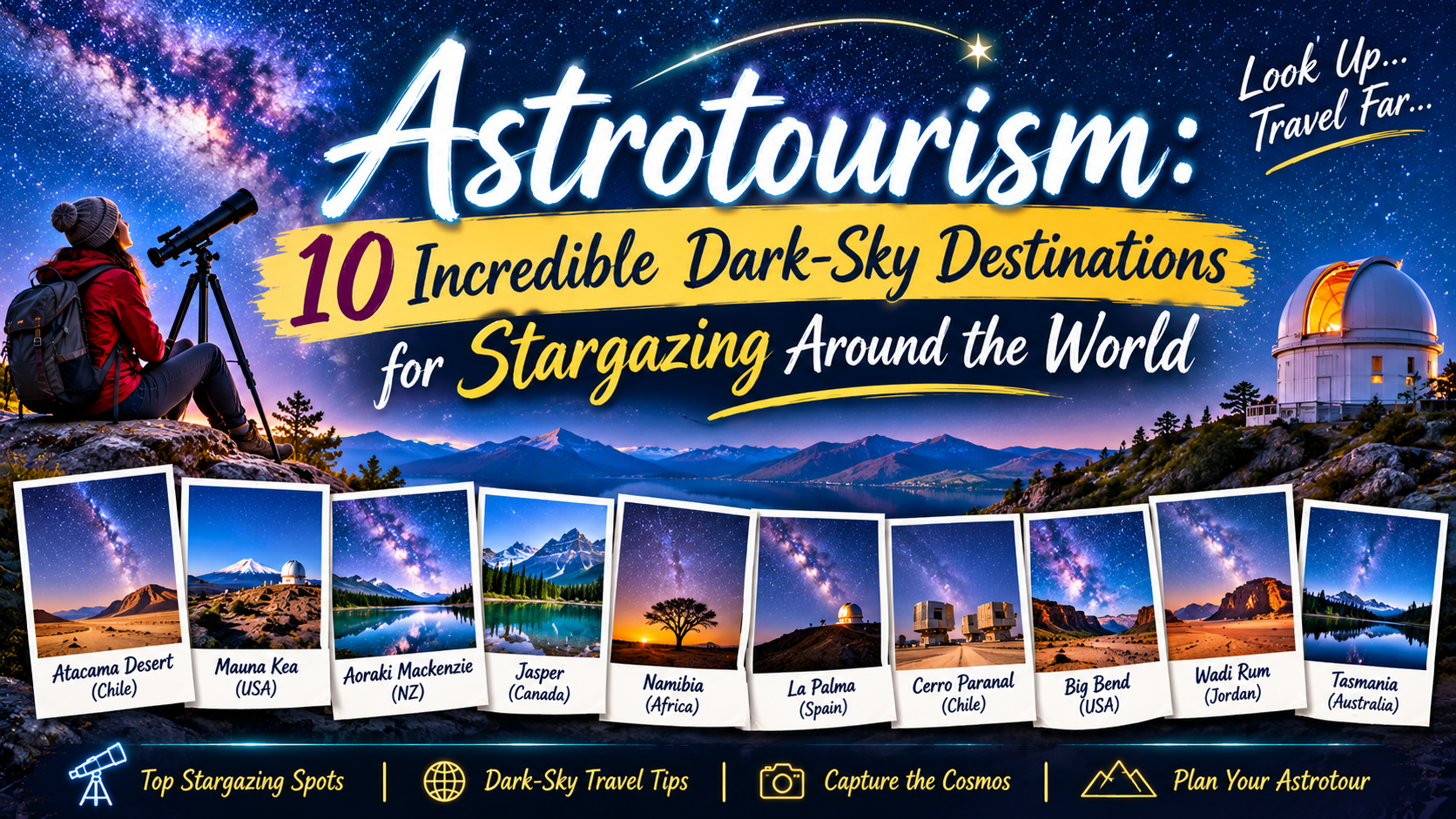
Imagine standing beneath an enormous night sky, far away from city lights – Astrotourism. Thousands of stars stretch across the darkness. The Milky Way appears like a glowing river, while distant planets and constellations become visible to the naked eye. There are no crowded streets, flashing advertisements or traffic sounds—just the quiet beauty of the universe.
This is the magic of astrotourism.
Rather than travelling only for beaches, mountains or famous landmarks, people are increasingly planning journeys around celestial experiences. These include stargazing, astrophotography, meteor showers, planet watching and guided astronomy sessions.
Astrotourism also encourages travellers to explore remote regions, support local communities and understand why protecting natural darkness matters. From the Himalayan village of Hanle to the mountains of New Zealand, here are ten incredible destinations where the night sky becomes the main attraction.
What Is Astrotourism?
Astrotourism is a form of travel focused on observing and experiencing the night sky. It brings together astronomy, nature, adventure and sustainable tourism.
Some travellers visit dark-sky reserves to photograph the Milky Way. Others join guided telescope sessions to observe planets, star clusters and distant galaxies. A few plan entire holidays around meteor showers or astronomical events.
Unlike conventional sightseeing, astrotourism often takes place after sunset. It encourages visitors to slow down, spend time outdoors and appreciate the natural environment.
The experience does not always require expensive equipment or advanced scientific knowledge. Even a clear night away from artificial lights can offer an unforgettable introduction to the universe.
Why Is Astrotourism Becoming Popular in 2026?
Travel preferences are shifting towards experiences that feel meaningful and different from ordinary holidays. Stargazing fits naturally into this movement.
Travel trend reports for 2026 have highlighted dark-sky tourism as an emerging interest. UN Tourism has also published guidance to help destinations develop astrotourism while protecting the night sky and involving local communities.
Several factors are contributing to its growing appeal:
- A break from city life: Remote destinations offer an opportunity to escape artificial lights and crowded urban environments.
- Interest in astronomy: More travellers are discovering constellations, planets, meteor showers and astrophotography.
- Nature-based experiences: Stargazing combines beautifully with camping, mountain travel and wildlife experiences.
- Unique travel memories: Watching the Milky Way or observing Saturn through a telescope can be more memorable than another conventional sightseeing trip.
- Responsible tourism: Dark-sky conservation encourages better lighting practices and greater awareness of environmental protection.
The result is a travel experience that connects people with nature on a much larger scale.
10 Incredible Astrotourism Destinations Around the World
1. Hanle, Ladakh, India
Hanle is one of India’s most remarkable destinations for stargazing. Located in the remote Changthang region of Ladakh, this high-altitude village is surrounded by dramatic mountains, wide-open landscapes and exceptionally dark skies.
The area became home to India’s first Dark Sky Reserve in December 2022. The Hanle Dark Sky Reserve covers a region of approximately 22 kilometres in radius and operates as a science-driven initiative involving the Indian Institute of Astrophysics and local authorities.
Visitors can experience astronomy sessions with trained local Astro-Ambassadors, who use telescopes to introduce travellers to celestial objects. The destination also offers opportunities for astrophotography, especially when the weather and moon conditions are favourable.
Beyond the night sky, Hanle provides a glimpse into the remote landscapes and culture of eastern Ladakh.
Best experiences: Guided stargazing, Milky Way photography, telescope observations and exploring the Changthang landscape.
Travel tip: Hanle sits at a very high altitude. Acclimatise properly in Ladakh before travelling there, and check road conditions, permits and local travel requirements.
2. Aoraki Mackenzie, New Zealand
New Zealand’s South Island offers some of the world’s most spectacular night skies. The Aoraki Mackenzie International Dark Sky Reserve includes Aoraki/Mount Cook National Park and the Mackenzie Basin.
Recognised in 2012, this reserve covers approximately 4,367 square kilometres. Its dark skies are protected through lighting controls designed to reduce light pollution.
Lake Tekapo is one of the region’s most recognisable stargazing locations. The Church of the Good Shepherd, set beside the lake, creates a beautiful foreground for night-sky photography.
Visitors can also explore Mount John Observatory and join organised astronomy experiences. During clear nights, the landscape transforms into a remarkable setting for observing stars and the Milky Way.
Best experiences: Guided astronomy tours, astrophotography, observatory visits and lakeside stargazing.
Travel tip: Plan a stay of at least two nights if possible. Cloud cover can change quickly, and an additional night improves your chances of getting a clear sky.
3. NamibRand Nature Reserve, Namibia
The Namib Desert is famous for its enormous dunes, ancient landscapes and dramatic sunsets. However, its beauty does not disappear after dark.
NamibRand Nature Reserve is one of Africa’s celebrated dark-sky destinations. Its remote location and limited artificial lighting create excellent conditions for observing the night sky.
During a clear evening, the stars appear above the desert like countless points of light. The contrast between the dark landscape and the glowing sky makes the reserve particularly appealing to astrophotographers.
Travellers can combine stargazing with desert lodges, wildlife experiences and guided nature activities. It is also an excellent destination for anyone interested in experiencing the silence of a remote wilderness.
Best experiences: Desert stargazing, night-sky photography, wildlife viewing and nature-based accommodation.
Travel tip: Choose accommodation that offers outdoor stargazing opportunities. Avoid unnecessary lights when stepping outside at night.
4. Alqueva Dark Sky Reserve, Portugal
Portugal’s Alentejo region is known for its open countryside, historic villages, vineyards and peaceful landscapes. It is also home to the Alqueva Dark Sky Reserve.
The area around the Alqueva reservoir offers an appealing combination of rural tourism and astronomy. With relatively low levels of light pollution in suitable locations, the region has become an established destination for observing the night sky.
Visitors can join guided stargazing sessions, learn about constellations and explore astronomical photography. Some experiences combine astronomy with local food, wine-country landscapes and overnight stays in rural accommodation.
The destination is particularly attractive for travellers who want a relaxed holiday rather than a demanding adventure.
Best experiences: Guided astronomy sessions, night-sky photography, countryside stays and lakeside experiences.
Travel tip: Explore accommodation and organised stargazing activities around the reserve before travelling, as experiences may require advance reservations.
5. La Palma, Canary Islands, Spain
La Palma is often associated with volcanic landscapes, walking trails and spectacular ocean views. However, its night sky is equally impressive.
The island’s high-altitude locations and efforts to control light pollution have helped establish its reputation for astronomical observation. The Roque de los Muchachos Observatory is one of its most important scientific landmarks.
Visitors can explore designated viewpoints and participate in guided stargazing activities. On suitable nights, the sky reveals impressive constellations and deep-sky objects.
The island also offers a wonderful combination of daytime and nighttime experiences. Travellers can explore volcanic scenery during the day before spending the evening beneath a star-filled sky.
Best experiences: Astronomy viewpoints, observatory-related experiences, volcanic hiking and astrophotography.
Travel tip: Check access rules before visiting observatory areas. Some scientific facilities have restrictions, and not every site is open for unrestricted tourism.
6. Jasper National Park, Canada
Jasper National Park in Alberta is famous for its mountains, forests, lakes and wildlife. It is also an established destination for dark-sky experiences.
The park’s large wilderness areas provide opportunities to observe the night sky away from the brightest artificial lights. During clear conditions, travellers may spot the Milky Way, constellations and meteor activity.
Jasper also hosts astronomy-focused events and educational experiences at different times of the year. These activities make the destination appealing to beginners as well as experienced sky watchers.
The surrounding landscape adds another dimension to the experience. Imagine watching stars above a mountain lake or photographing the night sky with the silhouettes of the Canadian Rockies in the foreground.
Best experiences: Stargazing, astrophotography, astronomy events and mountain-lake photography.
Travel tip: Winter skies can be beautiful, but temperatures can become extremely cold. Dress in layers and check weather and road conditions before heading out at night.
7. Atacama Desert, Chile
The Atacama Desert is one of the most extraordinary landscapes in South America. Known for its dry climate, high-altitude terrain and clear skies in suitable locations, it has become a major destination for astronomical observation.
The region is home to world-class astronomical facilities, including observatories that study distant galaxies and other celestial objects.
Travellers can experience astronomy through organised tours around San Pedro de Atacama. These often include telescope observations, explanations of constellations and opportunities to photograph the night sky.
During the day, visitors can explore salt flats, colourful lagoons, desert valleys and unusual rock formations. After sunset, the focus shifts from the landscape beneath your feet to the universe above you.
Best experiences: Guided astronomy tours, telescope viewing, desert photography and exploring the Atacama’s natural landscapes.
Travel tip: Choose a night with favourable weather and limited moonlight. Book reputable astronomy tours and follow all safety instructions in remote desert areas.
8. Kerry International Dark Sky Reserve, Ireland
Ireland’s County Kerry is known for its rugged coastline, green landscapes and charming villages. It also offers a remarkable setting for dark-sky tourism.
The Kerry International Dark Sky Reserve lies along the Iveragh Peninsula. Its combination of coastal scenery, mountains and relatively dark skies makes it an appealing destination for night-sky enthusiasts.
Visitors can enjoy stargazing from suitable locations along the peninsula. On clear nights, the landscape provides beautiful opportunities to observe constellations and photograph the Milky Way.
The region is also ideal for combining astronomy with a traditional Irish road trip. Travellers can explore coastal viewpoints, historic sites and small villages before settling down for an evening beneath the stars.
Best experiences: Coastal stargazing, astrophotography, scenic drives and countryside accommodation.
Travel tip: Irish weather can be unpredictable. Keep your itinerary flexible and allow extra nights for better opportunities to observe the sky.
9. Greater Big Bend International Dark Sky Reserve, USA
The vast landscapes of West Texas offer another spectacular setting for astrotourism.
The Greater Big Bend International Dark Sky Reserve covers an enormous region across parts of Texas and Mexico. Its scale and remote surroundings make it particularly important for protecting natural darkness.
Big Bend National Park is a major attraction within this wider region. Travellers can explore desert landscapes, mountains, canyons and hiking trails before experiencing the night sky.
The absence of dense urban development in many areas creates opportunities for impressive stargazing. The region is especially attractive to photographers who want to capture the Milky Way above rugged desert scenery.
Best experiences: Desert stargazing, night photography, camping, hiking and scenic drives.
Travel tip: Remote areas require careful planning. Carry sufficient water, fuel and supplies, and check park alerts before travelling.
10. Exmoor National Park, England
You do not always need to travel to a distant desert or mountain range to experience a beautiful night sky. Exmoor National Park in southwest England is another destination worth considering.
The park is recognised for its dark-sky environment and offers opportunities to enjoy stargazing across open moorlands, valleys and rural landscapes.
Its appeal lies in the combination of accessible countryside and astronomy experiences. Visitors can explore walking trails during the day, discover traditional villages and enjoy peaceful evenings away from bright urban areas.
Exmoor is particularly suitable for travellers who want to include stargazing in a wider countryside holiday.
Best experiences: Rural stargazing, countryside walks, photography and peaceful accommodation.
Travel tip: Check local weather forecasts and choose a location away from direct artificial lighting for the best possible experience.
When Is the Best Time to Go Stargazing?
There is no single season that works for every destination. The ideal time depends on the hemisphere, weather patterns, altitude and the celestial objects you want to observe.
However, a few simple planning principles can make a significant difference.
Choose Nights Around the New Moon
Moonlight can make faint stars and parts of the Milky Way harder to see. A new-moon period is often a good choice for travellers hoping to photograph a darker sky.
Check Local Weather Conditions
Cloud cover can completely change a stargazing experience. Check forecasts before booking and consider staying for more than one night.
Understand Seasonal Differences
The Milky Way’s most visible features change throughout the year. Research the best viewing months for your chosen destination rather than assuming every season offers the same experience.
Look for Meteor Showers
Annual meteor showers can add excitement to an astronomy holiday. The Perseids, Geminids and other recurring showers attract sky watchers around the world.
Their visibility depends on the radiant’s position, moonlight, weather and local conditions. Check an astronomy calendar before planning your trip.
How to Plan an Astrotourism Holiday
A successful stargazing holiday requires slightly different preparation from a conventional sightseeing trip.
1. Select a destination with dark skies
Look for recognised dark-sky parks, reserves or remote locations with low light pollution. Check official destination information before finalising your plans.
2. Check the moon calendar
If your main goal is Milky Way photography or viewing faint stars, consider dates close to the new moon.
3. Stay for multiple nights
One cloudy evening can disrupt your plans. A longer stay gives you more opportunities to experience clear conditions.
4. Book guided experiences
Local astronomy guides can help identify planets, constellations and other celestial objects. They can also explain the science behind what you are seeing.
5. Pack appropriate clothing
Nighttime temperatures can drop considerably, particularly in deserts and high-altitude regions. Carry warm layers, comfortable footwear and weather protection.
6. Respect dark-sky rules
Avoid bright flashlights, unnecessary vehicle headlights and outdoor lighting. Use dim red lights where appropriate, follow local instructions and never disturb wildlife.
What Should You Pack for Stargazing?
You do not need a professional observatory setup to enjoy astrotourism. A few basic items can make your experience more comfortable.
- Warm clothing and an extra jacket.
- Comfortable shoes suitable for uneven terrain.
- A dim red-light torch or headlamp.
- A fully charged phone with an offline star-map application.
- Binoculars for basic celestial observations.
- A camera and tripod if you enjoy astrophotography.
- Water and light snacks.
- Power banks and spare camera batteries.
- A blanket or compact camping chair.
For beginners, binoculars are often a practical starting point. They can reveal more detail in the night sky without requiring complicated equipment.
Why Protecting Dark Skies Matters
Dark skies are not simply a luxury for astronomy enthusiasts. Natural darkness is an important part of the environment.
Excessive artificial lighting can affect wildlife behaviour, disrupt natural cycles and make it harder for people to observe the stars. Birds, insects and other animals can be affected by poorly directed outdoor lighting.
Responsible astrotourism can help raise awareness of these issues. It encourages communities and visitors to adopt better lighting practices while creating opportunities for local guides, accommodation providers and tourism businesses.
The Hanle Dark Sky Reserve in India offers an interesting example of this approach. Its work combines astronomy, light management and community participation.
Travellers can contribute by choosing responsible operators, following local guidelines and avoiding unnecessary light pollution.
Frequently Asked Questions About Astrotourism
1. What is the meaning of astrotourism?
Astrotourism refers to travel focused on astronomy and the night sky. It includes stargazing, telescope experiences, astrophotography, meteor-shower viewing and visits to astronomical observatories.
2. Which is the best place for astrotourism in India?
Hanle in Ladakh is one of India’s leading astrotourism destinations. It is home to the country’s first Dark Sky Reserve and offers guided astronomy experiences through trained local Astro-Ambassadors.
3. Do I need a telescope for stargazing?
No. Many stars and constellations can be observed with the naked eye in locations with low light pollution. Binoculars can help reveal additional details, while telescopes are useful for observing planets and distant celestial objects.
4. What is the best time for stargazing – Astrotourism?
The best time depends on the destination and the celestial event. Clear nights with limited moonlight are generally preferable for observing faint stars and photographing the Milky Way.
5. Is astrotourism suitable for beginners?
Absolutely. Many destinations offer guided sessions where beginners can learn about constellations, planets and basic astronomy. You do not need any previous scientific knowledge.
6. What is a Dark Sky Reserve – Astrotourism?
A Dark Sky Reserve is a designated area where natural darkness is protected through measures such as responsible outdoor lighting, conservation initiatives and public education.
7. Can I enjoy astrotourism without camping?
Yes. Many destinations offer hotels, guesthouses, lodges and guided evening tours. You can enjoy stargazing without spending the night in a tent.
Final Thoughts: Travel Beyond the Earthly Landscape – Astrotourism
Astrotourism reminds us that some of the most extraordinary travel experiences begin after sunset.
From the remote mountains of Hanle to the open landscapes of Namibia and the spectacular skies of New Zealand, these destinations offer a different reason to explore the world.
You might arrive for the mountains, deserts or peaceful countryside. Yet the moment you look up and see the Milky Way stretching across the darkness, the night sky may become the highlight of your entire journey.
Perhaps the next great travel experience is not about discovering another landmark. It is about finding a place where you can finally see the stars.
Internal Links
- Noctourism: Destinations to Explore After Dark
- Readaway Travel: Destinations for Book Lovers and Slow Travel
- The Rise of Do-Less Travel
- Slow Travel Destinations
- Hidden Gems: Offbeat Travel
- Mestia, Georgia: Mountain Town Travel Guide
- 3 Days in Muscat, Oman: Itinerary
- Sikkim Adventure Tourism Fest 2026