
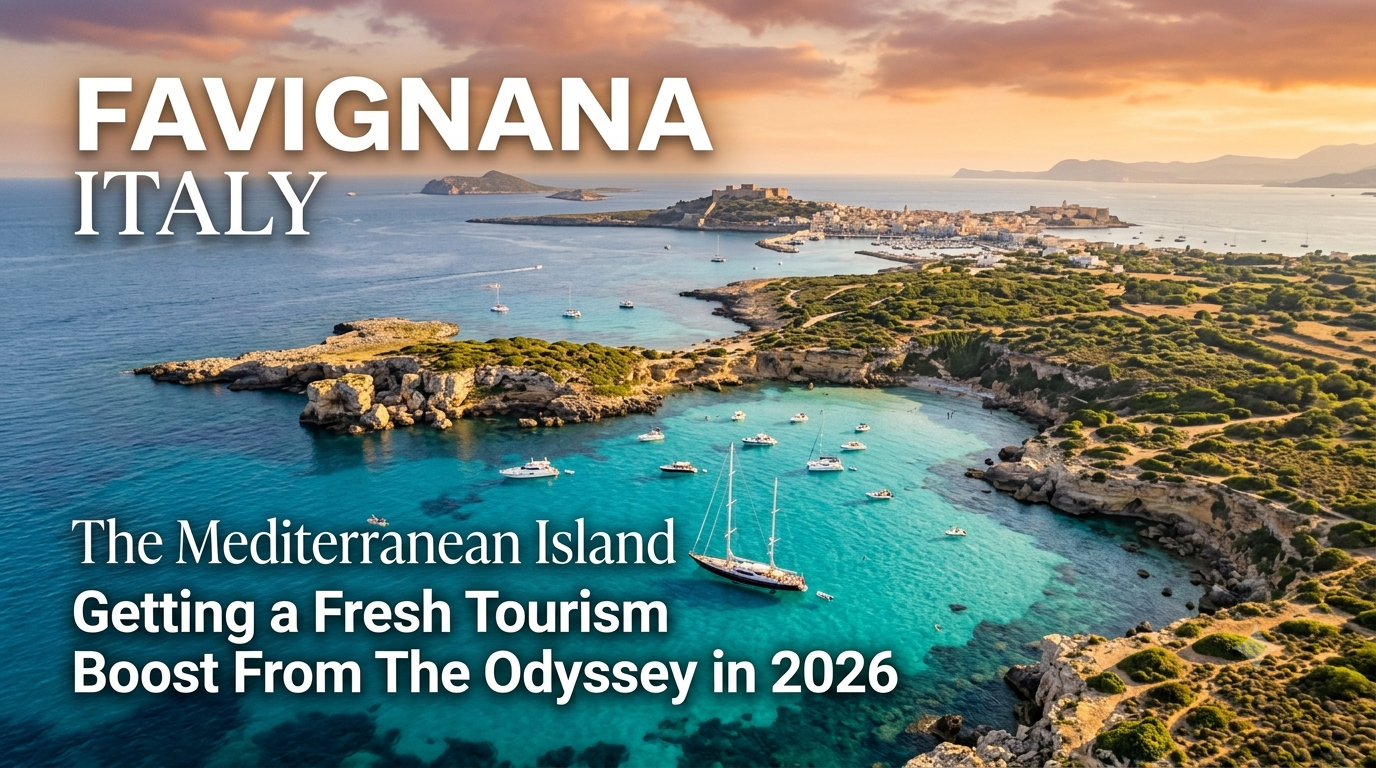
There are Mediterranean islands that have been famous for decades, and then there are places travelers discover just before everyone else does. Favignana belongs firmly in the second category.
Located off the western coast of Sicily, Favignana is the largest of the Egadi Islands and is known for turquoise coves, old tuna-fishing traditions, limestone landscapes, and quiet cycling roads. For years, it attracted mostly Italian holidaymakers and travelers looking for a slower alternative to Sicily’s better-known coastal destinations.
In 2026, however, Favignana has another reason to attract attention: Christopher Nolan’s The Odyssey.
With the island used as a filming location for the highly anticipated Homer-inspired epic, Favignana is gaining a new place on the travel map. The question now is whether the so-called “Nolan effect” will bring a lasting tourism boost without taking away the relaxed character that makes the island special.
How The Odyssey Put Favignana in the Spotlight
Christopher Nolan’s adaptation of Homer’s The Odyssey has turned several Mediterranean locations into potential destinations for film fans, and Favignana is one of the most intriguing.
The island’s rugged coastline and elevated views from Monte Santa Caterina provided the kind of dramatic Mediterranean setting that can easily stand in for the mythical world of Odysseus.
At the summit sits Castello di Santa Caterina, a historic fortress with Arab and Norman influences. Its position high above the island offers sweeping views across the surrounding Mediterranean and the neighboring Egadi Islands.
For Favignana, the connection creates something beyond ordinary movie publicity. Travelers who discover the island through The Odyssey can also experience its beaches, food, cycling routes, fishing heritage, and spectacular coastline.
That combination is what could make the film’s influence particularly valuable to the local tourism industry.
Why the “Nolan Effect” Could Be Significant
Film tourism has already transformed destinations around the world.
From Sicily’s connection with The White Lotus to locations associated with major fantasy franchises, travelers increasingly build trips around places they have seen on screen.
Favignana has a strong advantage: it does not need a movie to create an attraction from scratch.
The island already has:
- Dramatic Mediterranean scenery
- Historic architecture
- Traditional fishing culture
- Limestone caves and quarries
- Crystal-clear swimming coves
- Excellent cycling routes
- Easy access from western Sicily
The film simply gives international travelers another reason to search for it.
For a small island with a population of only a few thousand residents, even a moderate increase in international visitors could have a noticeable effect on accommodation, restaurants, boat tours, bicycle rentals, and local businesses.
Favignana Beyond The Odyssey


The film connection may be the headline in 2026, but Favignana has plenty to offer travelers who have no interest in movie locations.
Cala Rossa
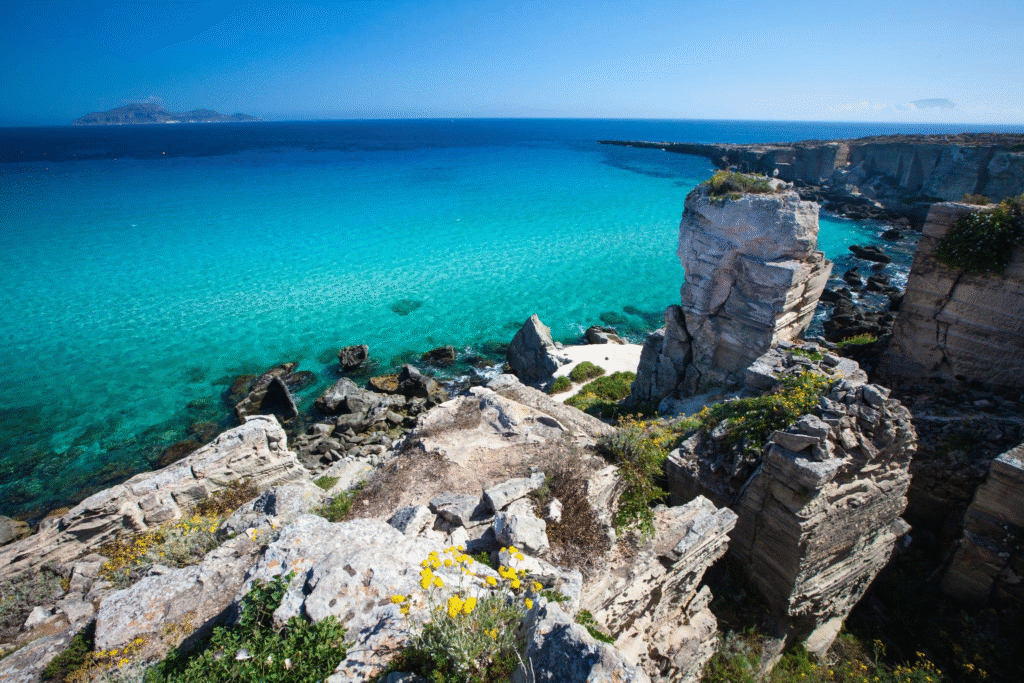
Cala Rossa is probably Favignana’s most recognizable swimming spot.
The cove is surrounded by pale limestone and former quarry walls, while the water shifts between vivid turquoise and deep blue depending on the light and depth.
There is little traditional beach infrastructure here, which is part of the appeal. Visitors generally arrive by bicycle, scooter, boat, or on foot and settle onto the rocks around the cove.
Cala Azzurra
On the southern side of the island, Cala Azzurra offers another beautiful place to swim.
The shallow, exceptionally clear water makes it popular with travelers who want an easier swimming experience than some of the island’s rocky coves provide.
Lido Burrone
For travelers who prefer a more conventional beach day, Lido Burrone is one of Favignana’s better options.
It has sandy stretches and nearby facilities, making it particularly convenient for families and visitors who want to spend several hours by the water.
Explore Favignana by Bicycle
One of the easiest ways to understand Favignana is to slow down.
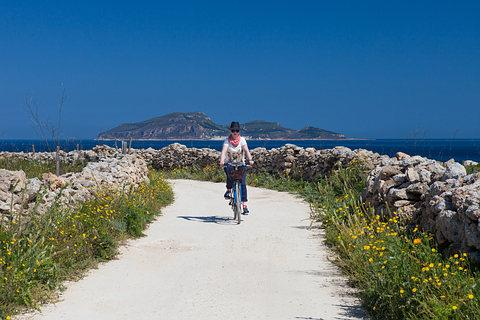
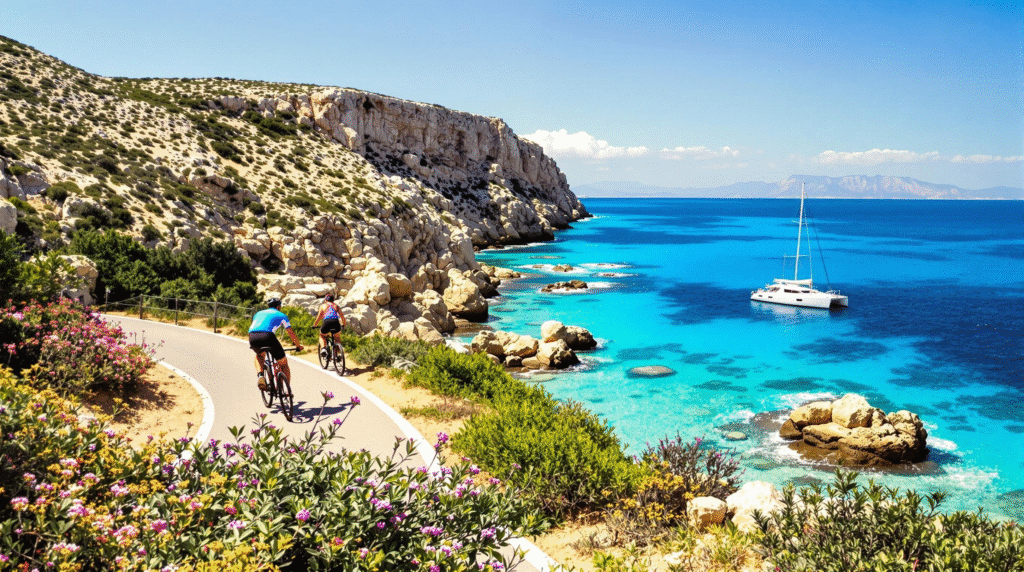
The island is relatively flat, and cycling has long been one of the preferred ways to explore it. Bicycle rental shops around the town and port make it simple to pick up a bike and spend the day moving between beaches, viewpoints, villages, and old quarry landscapes.
There is no need to construct an elaborate itinerary.
Pick a direction, follow the coast, stop whenever the water looks inviting, and continue when you’re ready.
That slower rhythm is one of the qualities Favignana risks losing if tourism grows too quickly.
Castello di Santa Caterina
For the best panoramic views, make the climb toward Castello di Santa Caterina.
The fortress sits on Monte Santa Caterina, the highest point on the island, and its elevated position gives travelers a remarkable view across Favignana and the surrounding sea.
The castle itself has a long and complicated history, with foundations connected to earlier Arab and Norman occupation before later fortifications and its use as a prison.
In 2026, however, its connection with The Odyssey gives the site another layer of interest.
Film fans may arrive looking for traces of the production, while other visitors simply come for the landscape.
The Ex Stabilimento Florio and Favignana’s Tuna Heritage
Favignana’s identity is closely tied to tuna fishing.
Near the port, the Ex Stabilimento Florio provides one of the clearest reminders of how important the industry once was to the island.
The enormous former tuna-processing complex was once at the heart of Favignana’s economy. Today, its industrial architecture and exhibitions provide a fascinating counterpoint to the island’s beaches.
It is worth visiting even if you’re primarily interested in the natural scenery because it explains why Favignana developed the way it did.
Favignana Food: Tuna, Seafood, and Sicilian Flavors
Food is another reason to visit beyond the movie connection.
Favignana’s restaurants naturally lean heavily on seafood, with tuna featuring prominently in local dishes. Expect simple Sicilian cooking rather than elaborate resort cuisine.
Fresh fish, pasta, citrus, olive oil, local vegetables, and traditional Sicilian desserts all have a place on menus around the island.
The best meals are often the simplest ones: fresh seafood, a glass of something cold, and a table overlooking the harbor after a day in the water.
How to Get to Favignana
Favignana is relatively easy to reach from western Sicily.
Most travelers arrive through Trapani, where ferries and hydrofoils connect the mainland with the Egadi Islands.
The fastest services can make the journey to Favignana in roughly half an hour, depending on the service and conditions.
There are also connections from Marsala, making Favignana relatively straightforward to combine with a wider western Sicily itinerary.
For international travelers, the easiest approach is generally to reach western Sicily first and then continue to the island by ferry.
When Is the Best Time to Visit Favignana?
The main summer season runs from roughly June through September.
July and August bring the warmest weather and busiest atmosphere. This is ideal if your priority is swimming, boating, and long days outdoors, but accommodation and ferry demand can be considerably higher.
May, June, September, and early October can offer a more comfortable balance between warm weather and fewer visitors.
For travelers interested in the emerging Odyssey connection, the shoulder seasons may be especially appealing. They allow you to explore the island’s filming-related locations while experiencing a quieter version of Favignana.
Will The Odyssey Change Favignana?
That may be the biggest question facing the island in 2026.
Favignana has many of the ingredients that attract modern travelers: beautiful water, dramatic landscapes, authentic food, a strong local identity, and relatively easy access from a major European destination.
A successful Hollywood film can amplify all of that almost overnight.
The challenge is managing the attention.
Favignana does not have the infrastructure of larger Mediterranean destinations, and its appeal partly comes from its small scale. If visitor numbers rise too quickly during the summer months, the very atmosphere that attracted travelers in the first place could become harder to maintain.
The opportunity, therefore, is not simply to attract more tourists.
It is to spread tourism across a longer season and encourage visitors to stay longer, explore beyond the beaches, and spend money with local businesses.
Is Favignana Worth Visiting in 2026?
Absolutely.
If you’re visiting because of The Odyssey, you’ll discover that the island is much more than a filming location. If you’ve never heard of the film connection, you’ll still find plenty of reasons to come.
Favignana combines some of the best elements of a Mediterranean island escape: clear water, quiet coves, cycling, seafood, history, and a slower pace that is becoming increasingly difficult to find in Europe’s most famous summer destinations.
The Nolan effect may be bringing Favignana a new audience in 2026.
But the island itself is what gives those visitors a reason to stay.
Internal Links
- Island-Hopping Beyond the Crowds: Lesser-Known Archipelagos Worth Discovering
- The Rise of Do-Less Travel
- The Future of Sustainable Travel: How to Explore Without Leaving a Trace
- Experience-Led Travel 2026: Okinawa, Marrakech, Swiss Alps
- Hidden Gems: Why Offbeat Travel Creates the Best Memories
- Forgotten Kingdoms: Ancient Cities Every History Lover Should Visit
- The World’s Most Breathtaking Cliffside Villages You Need to See Once in Your Lifetime