
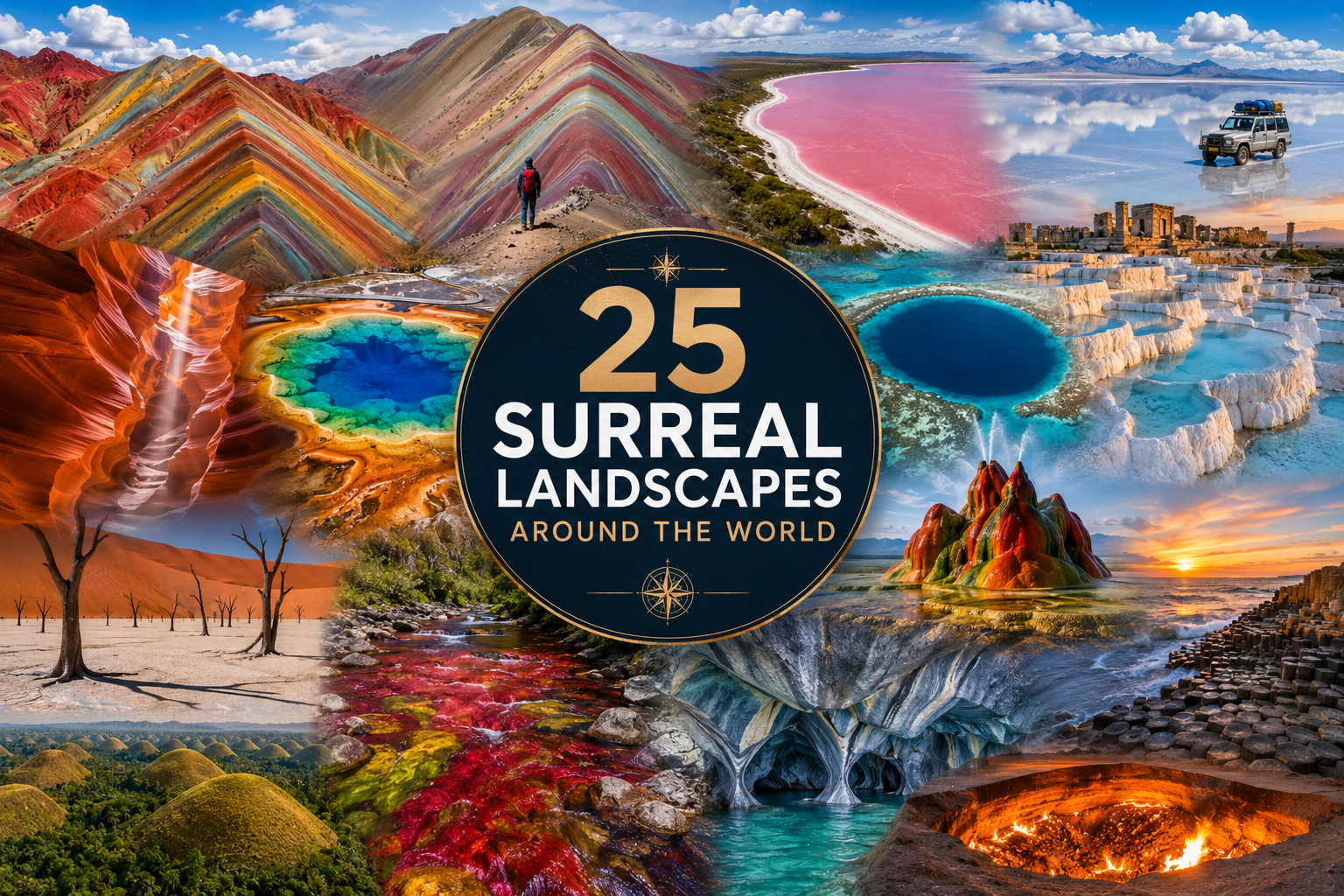
There are places on Earth that seem almost impossible to believe like Unusual natural landscapes. Rainbow-coloured mountains, bright pink lakes, glowing caves, and vast salt flats often look more like scenes from science fiction than real destinations. Yet these incredible places exist because of millions of years of natural processes involving minerals, volcanic activity, erosion, glaciers, and time.
These unusual natural landscapes remind us that nature is the world’s greatest artist. While some have become famous tourist attractions, many remain hidden gems waiting to be explored.
If you’re looking for extraordinary travel destinations, these remarkable landscapes deserve a place on your bucket list.
Why Are Some Unusual Natural Landscapes So Unusual?
Every one of these unusual natural landscapes tells a unique geological story. Their striking colours and unusual formations developed naturally over thousands—or even millions—of years.
Some landscapes are shaped by:
- Volcanic eruptions
- Mineral deposits
- Wind and water erosion
- Salt and algae
- Glacial activity
- Limestone formations
- Extreme weather conditions
These natural forces continue to shape many of these destinations today, making every visit slightly different from the last.
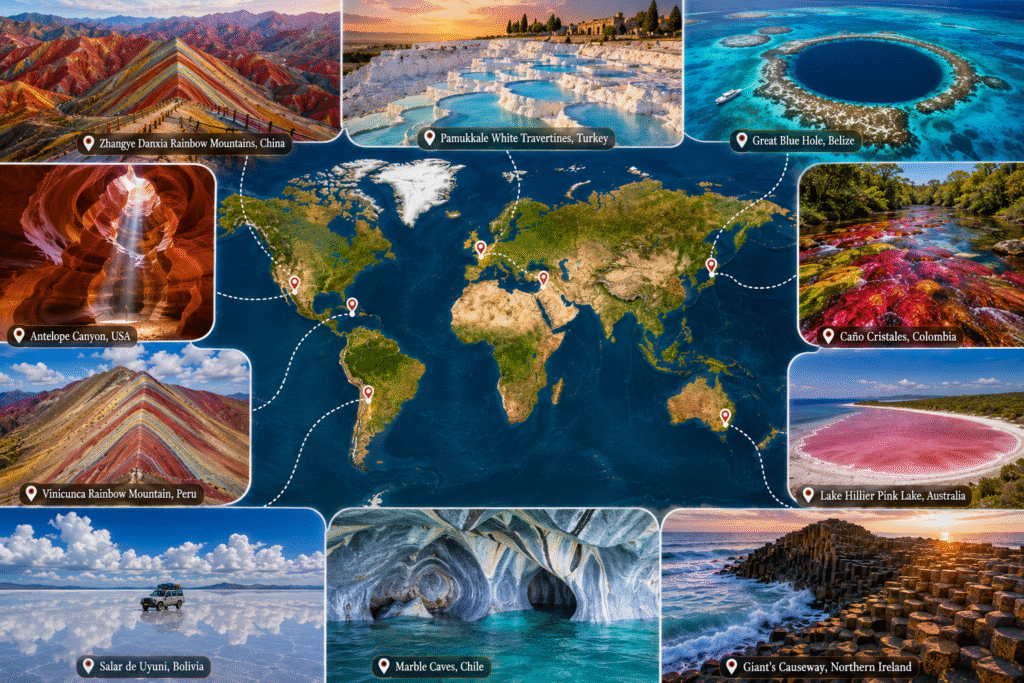
1. Zhangye Danxia Landform, China
China’s Zhangye Danxia Landform is famous for its colourful “Rainbow Mountains.” Layers of sandstone and minerals have created spectacular stripes of red, orange, yellow, green, and blue across the rolling hills.
Millions of years of tectonic movement and erosion gradually exposed these colourful rock layers, creating one of the world’s most photographed unusual natural landscapes.
Raised viewing platforms throughout Zhangye Danxia National Geopark provide incredible panoramic views, especially during sunrise and sunset when the colours appear even more vibrant.
Highlights
- Rainbow-coloured mountains
- UNESCO Global Geopark
- Beautiful sunrise photography
- Easy walking trails
2. Vinicunca (Rainbow Mountain), Peru
Located high in Peru’s Andes, Vinicunca, also known as Rainbow Mountain, has quickly become one of South America’s most famous hiking destinations.
Its striking bands of maroon, gold, lavender, turquoise, and green formed as mineral-rich rock layers became exposed after glaciers melted. Although local communities have known about the mountain for generations, it only gained worldwide attention during the past decade.
Reaching the summit requires determination because the trail climbs above 5,000 metres. However, the breathtaking scenery rewards every step.
Visitor Information
- Altitude: Over 5,000 metres
- Best Time: Dry season (May to September)
- Difficulty: Moderate to challenging
Travel Tip
Spend several days in Cusco before hiking to help your body adjust to the altitude.
3. Lake Hillier, Australia
Australia is home to one of the world’s most fascinating unusual natural landscapes.
Lake Hillier’s bright pink water remains pink throughout the year, even when removed from the lake. Scientists believe the colour results from salt-loving algae and microorganisms living in the highly saline water.
Located on Middle Island in Western Australia, the lake sits beside the deep blue Southern Ocean, creating an extraordinary contrast best appreciated from above.
Why Visit?
- Bright pink lake
- Stunning aerial photography
- Protected nature reserve
- Unique geological phenomenon
Although visitors cannot swim in the lake, scenic flights provide unforgettable views.
4. Lake Retba (Lac Rose), Senegal
Another spectacular pink lake can be found near Dakar in Senegal.
Lake Retba, often called Lac Rose, changes colour depending on the season. During the dry months, high salt levels encourage algae to produce a red pigment, turning the lake brilliant shades of pink.
The lake is also famous for its traditional salt harvesting industry. Local workers carefully collect salt by hand while protecting their skin with shea butter.
Highlights
- Seasonal pink water
- Traditional salt harvesting
- Easy day trip from Dakar
- Unique cultural experience
5. Salar de Uyuni, Bolivia
The world’s largest salt flat is also one of its most extraordinary unusual natural landscapes.
Covering more than 10,000 square kilometres, Salar de Uyuni transforms into a giant natural mirror after rainfall. A thin layer of water perfectly reflects the sky, making visitors appear to walk among the clouds.
During the dry season, the landscape changes completely as the salt surface forms beautiful hexagonal patterns stretching to the horizon.
Best Experiences
- Mirror effect during the rainy season
- Salt hotel stays
- Incredible photography
- Sunrise and sunset tours
Few destinations create such dramatic optical illusions.
6. Pamukkale, Turkey
Pamukkale, meaning “Cotton Castle,” features brilliant white terraces filled with warm mineral-rich water.
These beautiful pools formed over thousands of years as calcium-rich hot springs deposited layers of white travertine. Visitors can walk barefoot across designated sections while enjoying panoramic views of the surrounding countryside.
Above the terraces lies the ancient Roman city of Hierapolis, allowing travellers to combine natural beauty with fascinating history.
Highlights
- White limestone terraces
- Natural thermal pools
- Ancient Roman ruins
- UNESCO World Heritage Site
Pamukkale remains one of Turkey’s most iconic attractions.
7. Great Blue Hole, Belize
Off the coast of Belize lies one of the world’s most famous underwater sinkholes.
The Great Blue Hole formed when ancient limestone caves collapsed after rising sea levels flooded the area thousands of years ago.
Today, divers descend through crystal-clear water to explore giant stalactites that formed long before the cave became submerged.
Why It’s Famous
- World-class scuba diving
- Massive underwater sinkhole
- Crystal-clear Caribbean waters
- Incredible aerial views
Even visitors who don’t dive can admire the perfect circular formation from scenic flights.
8. Caño Cristales, Colombia
Often called the River of Five Colours, Caño Cristales is unlike any other river on Earth.
For a few months each year, an aquatic plant called Macarenia clavigera transforms the river into brilliant shades of red, yellow, green, blue, and black.
The colours only appear under very specific seasonal conditions, making timing essential when planning a visit.
Best Time to Visit
June to November offers the best chance of seeing the river at its most colourful.
9. Fly Geyser, Nevada, USA
Fly Geyser is one of the youngest unusual natural landscapes on this list.
It formed accidentally after a geothermal well was drilled in the 1960s. Over time, mineral-rich water built colourful terraces that now support bright green and red algae.
Although located on private land, guided tours allow visitors to experience this remarkable geothermal feature.
Highlights
- Bright mineral formations
- Geothermal activity
- Colourful algae
- Unique photography opportunities
10. Grand Prismatic Spring, Yellowstone National Park, USA
The largest hot spring in the United States is also one of its most colourful.
Grand Prismatic Spring displays brilliant rings of blue, green, yellow, orange, and red created by heat-loving microorganisms living at different water temperatures.
Visitors can admire the spring from nearby boardwalks or hike to the overlook for spectacular panoramic views.
Why Visit?
- Largest hot spring in the United States
- Incredible rainbow colours
- Easy walking trails
- Yellowstone National Park
The vivid colours make Grand Prismatic Spring one of the world’s most photographed geothermal attractions.
11. Chocolate Hills, Bohol, Philippines
The Chocolate Hills are one of the most recognizable unusual natural landscapes in Southeast Asia. More than 1,200 cone-shaped hills stretch across Bohol Island, creating a landscape unlike anywhere else in the world.
During the rainy season, the hills are covered in lush green grass. As the dry season arrives, the grass turns brown, giving the hills their famous chocolate-like appearance.
Scientists believe these formations developed through the erosion of ancient limestone deposits over millions of years, while local folklore tells the story of two giants whose battle shaped the landscape.
Highlights
- Over 1,200 cone-shaped hills
- UNESCO Global Geopark
- Scenic viewpoints
- Beautiful during both wet and dry seasons
12. Unusual natural landscapes – Wave Rock, Australia
Located in Western Australia, Wave Rock is one of nature’s most impressive geological formations.
Standing about 15 metres high and stretching 110 metres long, the granite rock resembles a giant ocean wave frozen in time. Millions of years of erosion and weathering slowly sculpted this incredible formation.
Mineral-rich rainwater has also created colourful streaks across the rock, adding to its unique appearance.
Why Visit?
- Massive wave-shaped granite formation
- Easy walking trails
- Ancient geological history
- Excellent photography opportunities
13. Unusual Natural Landscapes – Antelope Canyon, Arizona, USA
Few places demonstrate the power of water better than Antelope Canyon.
Located on Navajo Nation land, this spectacular slot canyon formed as flash floods carved smooth curves through soft sandstone over thousands of years. Sunlight filtering through the narrow openings creates beautiful shades of orange, red, pink, and purple.
Visitors must join guided tours, which help protect both the canyon and its cultural significance.
Best Experience
Visit around midday when sunlight beams illuminate the canyon walls for unforgettable photographs.
14. Unusual Natural Landscapes – Danakil Depression, Ethiopia
The Danakil Depression is one of Earth’s most extreme unusual natural landscapes.
Situated below sea level, this remarkable region features colourful sulphur springs, active volcanoes, salt flats, and one of the hottest climates on the planet.
Bright yellow, green, orange, and white mineral deposits create scenery that looks more like another planet than northern Ethiopia.
Visitor Information
- One of the hottest places on Earth
- Active volcanic region
- Colourful geothermal pools
- Guided tours recommended
15. Unusual Natural Landscapes – Painted Desert, Arizona, USA
The Painted Desert stretches across northern Arizona with colourful layers of red, pink, orange, purple, and grey rock.
Millions of years of sediment deposits created these striking bands, while iron and manganese minerals continue to produce their vivid colours.
The landscape changes dramatically throughout the day as sunlight shifts across the hills.
Highlights
- Colourful badlands
- Scenic viewpoints
- Nearby Petrified Forest National Park
- Beautiful sunset photography
16. Unusual natural landscapes – Trolltunga, Norway
Not every unusual natural landscape is colourful. Some impress through their incredible scale.
Trolltunga, meaning “Troll’s Tongue,” is a dramatic rock formation that extends horizontally above Lake Ringedalsvatnet.
The 27-kilometre round-trip hike rewards visitors with one of Norway’s most iconic viewpoints.
Best Time to Visit
June to September offers the safest hiking conditions, although weather can change quickly.
17. Reed Flute Cave, China
Located near Guilin, Reed Flute Cave is famous for its spectacular limestone formations.
Inside, stalactites and stalagmites have formed over hundreds of thousands of years. Modern lighting highlights these natural formations in brilliant shades of blue, purple, green, and red.
Ancient inscriptions dating back more than a thousand years also remain visible inside the cave.
Highlights
- Colourful limestone cave
- Ancient rock formations
- Historic inscriptions
- Family-friendly attraction
18. Deadvlei, Namibia
Deadvlei is one of Africa’s most photographed unusual natural landscapes.
Located inside Namib-Naukluft National Park, the white clay pan contains centuries-old camel thorn trees preserved by the region’s extremely dry climate.
The contrast between the black trees, orange sand dunes, white ground, and deep blue sky creates extraordinary scenery.
Why Visit?
- Ancient dead trees
- Towering sand dunes
- Stunning desert photography
- Sunrise and sunset views
19. Unusual Natural Landscapes – Spotted Lake, Canada
British Columbia’s Spotted Lake is unlike any ordinary lake.
During summer, evaporation leaves behind colourful mineral-rich pools that appear as circular spots across the lake’s surface.
The lake is culturally significant to the Syilx Okanagan Nation, so visitors are encouraged to admire it respectfully from designated viewpoints.
Highlights
- Colourful mineral pools
- Rare geological phenomenon
- Indigenous cultural significance
- Seasonal appearance
20. Unusual Natural Landscapes – Lake Natron, Tanzania
Lake Natron is one of Africa’s most fascinating natural wonders.
Its highly alkaline water often turns brilliant shades of red and orange because of salt-loving microorganisms.
Despite its harsh conditions, the lake serves as one of the world’s most important breeding grounds for lesser flamingos.
Best Experience
Visit during flamingo breeding season for unforgettable wildlife photography.
21. Unusual Natural Landscapes – Marble Caves, Chile
Located on General Carrera Lake in Patagonia, the Marble Caves feature swirling walls carved entirely from solid marble.
Thousands of years of wave action created beautiful tunnels and chambers that reflect the lake’s brilliant blue water.
Small boats and kayaks allow visitors to explore these spectacular formations up close.
22. Unusual Natural Landscapes – Socotra Island, Yemen
Socotra Island is one of the planet’s most unique ecosystems.
Its famous Dragon’s Blood Trees, umbrella-shaped canopies, and rare plant species create landscapes unlike anywhere else on Earth.
Because of its isolation, many of the island’s plants and animals exist nowhere else.
Why Visit – Unusual Natural Landscapes?
- Unique endemic plants
- Alien-like scenery
- UNESCO World Heritage Site
- Incredible biodiversity
23. Darvaza Gas Crater (Door to Hell), Turkmenistan
The Darvaza Gas Crater, often called the “Door to Hell,” has been burning continuously for decades.
A drilling accident created the crater, and natural gas ignited shortly afterward. The flames continue to burn today, creating one of Central Asia’s most unusual attractions.
At night, the glowing crater creates unforgettable desert scenery.
24. Kawah Ijen, Indonesia
Indonesia’s Kawah Ijen is famous for two extraordinary natural features.
The volcano contains the world’s largest highly acidic crater lake and produces the rare blue fire phenomenon, visible only after dark.
Local miners still extract sulphur by hand, making the area both a natural wonder and an important working landscape.
25. Unusual natural landscapes – Giant’s Causeway, Northern Ireland
The Giant’s Causeway is one of Europe’s most famous unusual natural landscapes.
Around 40,000 hexagonal basalt columns formed when volcanic lava cooled and cracked millions of years ago.
Local legend tells a different story, claiming the giant Finn McCool built the stone pathway to reach Scotland.
Highlights
- UNESCO World Heritage Site
- Hexagonal basalt columns
- Coastal walking trails
- Rich folklore
Travel Tips for Visiting Unusual Natural Landscapes
Planning ahead helps you enjoy these remarkable destinations safely and responsibly.
Check Seasonal Conditions visiting Unusual Natural Landscapes
Some landscapes, such as Caño Cristales and Lake Retba, only display their famous colours during specific seasons.
Respect Local Regulations
Many of these fragile environments have strict conservation rules. Always stay on marked trails and follow local guidance.
Pack for the Climate
Weather conditions vary greatly. You may need warm clothing for mountain hikes or lightweight gear for desert adventures.
Support Sustainable Tourism
Choose local guides and eco-friendly accommodations whenever possible to help protect these incredible places.
Final Thoughts on Unusual Natural Landscapes
The world’s most unusual natural landscapes remind us that nature can create extraordinary works of art without human intervention. From rainbow mountains and glowing caves to pink lakes and towering rock formations, each destination tells a story shaped by millions of years of geological change.
Whether you dream of exploring Bolivia’s endless salt flats, hiking Peru’s Rainbow Mountain, or admiring Northern Ireland’s Giant’s Causeway, these breathtaking places prove that our planet still holds countless wonders waiting to be discovered.
Frequently Asked Questions
What is the most unusual natural landscape in the world?
Many travellers consider Salar de Uyuni, Zhangye Danxia, and the Giant’s Causeway among the world’s most unusual natural landscapes because of their extraordinary geological formations.
Why are some lakes pink – Unusual Natural Landscapes?
Pink lakes usually contain salt-loving algae and microorganisms that produce red pigments in highly saline environments.
Which unusual natural landscapes are UNESCO World Heritage Sites – Unusual Natural Landscapes?
Examples include Pamukkale, Giant’s Causeway, Socotra Archipelago, and Yellowstone National Park.
When is the best time to visit Rainbow Mountain in Peru – Unusual Natural Landscapes?
The dry season between May and September generally offers the best hiking conditions and the clearest mountain views.
Internal Links
- Hidden Valleys of the World: Secret Landscapes That Feel Like Another Planet
- Volcanoes, Waterfalls, and Glaciers: The Most Dramatic Landscapes on Earth
- Earth’s Blue Wonders: The Clearest Lakes and Rivers You Have to See to Believe
- Cloud Forests of the World: Mystical Destinations Above the Mist
- Walking Through the Clouds: The World’s Most Spectacular Mountain Trails for Every Explorer
- Best Weekend Getaways
- Experience-Led Travel 2026