
There is something mesmerizing about standing beside water so clear that it almost disappears. Instead of seeing reflections, you can look straight to the bottom, where rocks, fish, and underwater landscapes appear as though they are only a few inches away. These clearest lakes and rivers showcase nature at its purest, attracting travelers, photographers, and outdoor enthusiasts from around the world.
From remote alpine lakes to underground springs and glacier-fed rivers, these destinations are famous for their incredible transparency. Their exceptional clarity comes from unique geological processes that naturally filter the water over thousands of years.
If you’re searching for unforgettable natural wonders, these clearest lakes and rivers deserve a place on your travel bucket list.
Why Are Some Lakes and Rivers So Clear – Clearest Lakes?
Not all freshwater looks the same. The world’s clearest lakes and rivers remain crystal clear because they contain very little sediment, algae, or organic matter.
Several natural factors contribute to exceptional water clarity:
- Underground filtration through limestone or rock.
- Water supplied by glaciers or natural springs.
- Minimal pollution and human activity.
- Protected ecosystems with healthy biodiversity.
- Limited sediment entering the water.
Scientists often measure water clarity using a Secchi disk, a black-and-white disc lowered into the water until it disappears from view. The farther the disc remains visible, the clearer the water.
1. Clearest Lakes: Blue Lake (Rotomairewhenua), New Zealand
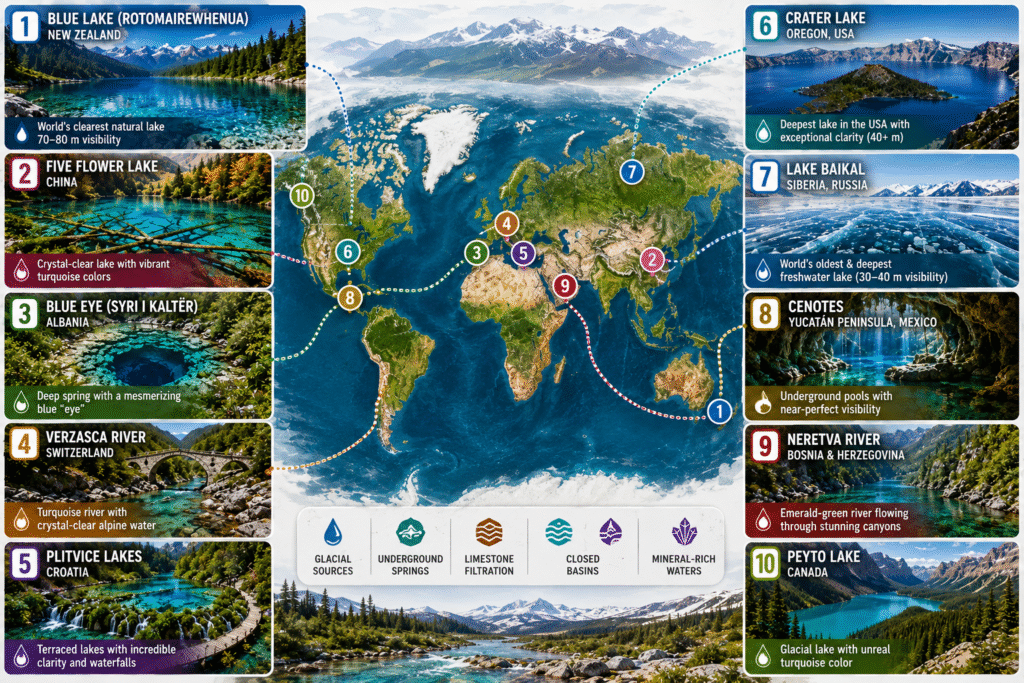
Blue Lake, also known as Rotomairewhenua, is widely recognized as the world’s clearest natural freshwater lake.
Located inside Nelson Lakes National Park, this remarkable lake offers underwater visibility of 70 to 80 metres, making it almost as clear as distilled water. The water travels through underground rock formations that naturally remove nearly every suspended particle before reaching the lake.
Beyond its beauty, Blue Lake holds deep cultural significance for the Ngāti Apa people. To protect both its pristine condition and its sacred status, swimming and entering the water are prohibited.
Why Visit?
- World’s clearest natural freshwater lake
- Incredible blue-violet water
- Remote hiking experience
- Sacred cultural site
Best Time to Visit – Clearest Lakes
Summer offers the most comfortable hiking conditions for reaching Blue Lake, although visitors should always respect local conservation rules.
2. Five Flower Lake, China
Located within Jiuzhaigou Valley National Park, Five Flower Lake is one of China’s most spectacular natural attractions.
Its crystal-clear water reveals ancient tree trunks resting on the lakebed, while mineral deposits create stunning shades of turquoise, emerald, and cobalt blue. During autumn, colorful forests surrounding the lake create breathtaking reflections across the water.
Highlights
- Crystal-clear water
- Colorful mineral-rich lakebed
- Beautiful autumn scenery
- UNESCO-listed national park
This combination of transparency and vibrant colors makes Five Flower Lake one of Asia’s most photographed lakes.
3. Blue Eye (Syri i Kaltër), Albania
The Blue Eye Spring is one of Albania’s most famous natural attractions.
This powerful freshwater spring emerges from deep underground, creating a circular pool that resembles a giant blue eye. Divers have explored more than 50 metres below the surface without reaching the bottom.
The water remains exceptionally clear throughout the year and stays between 10°C and 12°C, making it refreshing even during summer.
Why It’s Special
- Brilliant blue spring
- Exceptional water clarity
- Constant freshwater flow
- Beautiful surrounding forest
Visitors can walk around the spring and admire its remarkable colours, although the cold water keeps most swimmers out for long.
4. Verzasca River, Switzerland’s – Clearest Lakes
Switzerland is home to many beautiful rivers, but few match the beauty of the Verzasca River.
Fed by glacial meltwater from the Alps, the river flows over smooth granite rocks that enhance its famous turquoise colour. Its transparent water attracts swimmers, divers, photographers, and adventure seekers from around the world.
The picturesque stone bridge at Lavertezzo is one of the river’s most photographed landmarks and offers spectacular views of the crystal-clear pools below.
Best Activities
- Swimming
- Photography
- Cliff jumping
- Hiking nearby mountain trails
The Verzasca River perfectly demonstrates why Switzerland is famous for its breathtaking alpine landscapes.
5. Plitvice Lakes, Croatia
Croatia’s Plitvice Lakes National Park is one of Europe’s most beautiful natural destinations.
This UNESCO World Heritage Site features 16 interconnected lakes linked by waterfalls and wooden boardwalks. Mineral-rich limestone naturally filters the water, producing remarkable clarity and constantly changing shades of blue and green.
Walking across the park’s wooden pathways allows visitors to observe fish swimming beneath the surface while enjoying panoramic views of waterfalls and forests.
Highlights
- UNESCO World Heritage Site
- Crystal-clear lakes
- Scenic waterfalls
- Easy walking trails
- Outstanding photography opportunities
The combination of clear water and lush landscapes makes Plitvice one of Europe’s must-visit nature destinations.
6. Crater Lake, Oregon, USA
Crater Lake is one of North America’s most spectacular natural wonders and easily ranks among the world’s clearest lakes and rivers.
Formed after the collapse of Mount Mazama around 7,700 years ago, this volcanic lake is the deepest in the United States. Unlike most lakes, Crater Lake has no rivers flowing into or out of it. Instead, it is filled entirely by rain and snowfall, keeping sediment levels extremely low and the water exceptionally clear.
The lake’s deep sapphire-blue colour is equally impressive. On sunny days, visitors can enjoy panoramic viewpoints, scenic drives, hiking trails, and seasonal boat tours to Wizard Island.
Highlights
- Deepest lake in the United States
- Exceptional water clarity
- Scenic volcanic landscape
- Boat tours during summer
Crater Lake is a perfect destination for photographers, hikers, and nature lovers looking to experience one of America’s most pristine lakes.
7. Lake Baikal, Russia
Lake Baikal is famous for holding more freshwater than any other lake on Earth. It is also the world’s oldest and deepest freshwater lake, making it one of the most remarkable clearest lakes and rivers destinations.
During winter, the lake freezes into transparent sheets of ice, allowing visitors to see deep below the surface. In summer, underwater visibility can reach 30 to 40 metres thanks to tiny organisms that naturally filter the water.
Lake Baikal is also home to unique wildlife, including the rare Baikal seal, which is found nowhere else on Earth.
Best Time to Visit – Clearest Lakes
- Winter for crystal-clear ice.
- Summer for boat trips and hiking.
Its stunning landscapes make Lake Baikal one of Siberia’s greatest natural attractions.
8. Cenotes, Yucatán Peninsula, Mexico
Mexico’s Yucatán Peninsula is famous for its spectacular cenotes, natural sinkholes filled with some of the world’s clearest freshwater.
Rainwater filters through thick limestone before entering these underground pools, removing nearly all sediment. As a result, visibility is often outstanding, making cenotes popular with swimmers, snorkelers, and scuba divers.
Well-known cenotes include:
- Dos Ojos
- Ik Kil
- Angelita
Many cenotes also hold deep historical and cultural significance because the ancient Maya considered them sacred.
Why Visit?
- Incredible underwater visibility
- Snorkelling and scuba diving
- Ancient limestone caves
- Rich Mayan history
These natural pools offer one of Mexico’s most unforgettable travel experiences.
9. Neretva River, Bosnia and Herzegovina
The Neretva River is one of Europe’s hidden gems and deserves recognition among the clearest lakes and rivers.
Flowing through the Dinaric Alps, the river displays brilliant shades of turquoise and emerald green. Its upper stretches remain largely untouched, allowing the water to stay remarkably clean and transparent.
Adventure travelers often visit for rafting, kayaking, hiking, and photography.
Best Activities of Clearest Lakes
- White-water rafting
- Scenic hiking
- Landscape photography
- Nature exploration
Because it receives fewer international visitors, the Neretva River offers a peaceful alternative to many famous European destinations.
10. Peyto Lake, Canada’s – Clearest Lakes
Located in Banff National Park, Peyto Lake is one of Canada’s most photographed natural attractions.
Its striking turquoise colour comes from rock flour, tiny mineral particles carried into the lake by glacial meltwater. These particles reflect sunlight, creating the lake’s famous blue-green appearance.
The viewpoint above Peyto Lake provides one of the most iconic panoramic views in the Canadian Rockies.
Highlights
- Glacier-fed lake
- Incredible turquoise colour
- Easy viewpoint access
- Stunning mountain scenery
Summer offers the brightest colours as glacial melt increases throughout the season.
Travel Tips for Visiting the Clearest Lakes and Rivers
To protect these fragile ecosystems while enjoying your trip, follow these simple travel tips:
Respect Conservation Rules
Many of the world’s clearest lakes and rivers have strict environmental regulations. Follow all local guidelines to help preserve water quality.
Avoid Single-Use Plastics
Carry a reusable water bottle and avoid leaving waste behind.
Stay on Marked Trails
Walking only on designated paths helps protect delicate ecosystems surrounding lakes and rivers.
Visit During the Shoulder Season
Spring and autumn often provide pleasant weather with fewer crowds and better photography opportunities.
Why These Waters Matter – Clearest Lakes
The world’s clearest lakes and rivers are more than beautiful travel destinations. They demonstrate how healthy ecosystems naturally filter water through glaciers, underground springs, volcanic landscapes, and limestone formations.
However, many of these remarkable places face growing threats from pollution, climate change, and increasing tourism. Responsible travel plays an important role in protecting these fragile environments for future generations.
Final Thoughts on Clearest Lakes
The world’s clearest lakes and rivers showcase nature at its purest. Whether you visit New Zealand’s Blue Lake, Croatia’s Plitvice Lakes, Switzerland’s Verzasca River, or Canada’s Peyto Lake, each destination offers unforgettable scenery and extraordinary water clarity.
Every location tells a different geological story while reminding us how precious clean freshwater truly is. By traveling responsibly and respecting conservation efforts, we can help preserve these incredible places for generations to come.
If you’re searching for breathtaking natural beauty, add these clearest lakes and rivers to your travel bucket list.
Frequently Asked Questions
Which is the clearest lake in the world?
Blue Lake (Rotomairewhenua) in New Zealand is widely recognised as the world’s clearest natural freshwater lake, with visibility reaching 70–80 metres.
Why are some lakes and rivers so clear – Clearest Lakes?
The clearest waters contain very little sediment, algae, or organic matter. Underground springs, glaciers, and limestone filtration naturally remove impurities.
Can you swim in Blue Lake, New Zealand’s Clearest Lakes?
No. Swimming and entering the water are prohibited to protect its cultural significance and prevent contamination.
What gives glacier lakes their turquoise colour?
Fine glacial rock particles, known as rock flour, reflect sunlight and create the bright blue-green colour seen in lakes like Peyto Lake.
Internal Links
- Floating Villages Around the World: Communities Living on Water
- Island-Hopping Beyond the Crowds: Lesser-Known Archipelagos Worth Discovering
- Volcanoes, Waterfalls, and Glaciers: The Most Dramatic Landscapes on Earth
- Walking Through the Clouds: The World’s Most Spectacular Mountain Trails for Every Explorer
- Best Weekend Getaways
- Experience-Led Travel 2026
- Packing Smart: Travel Light, Experience More