
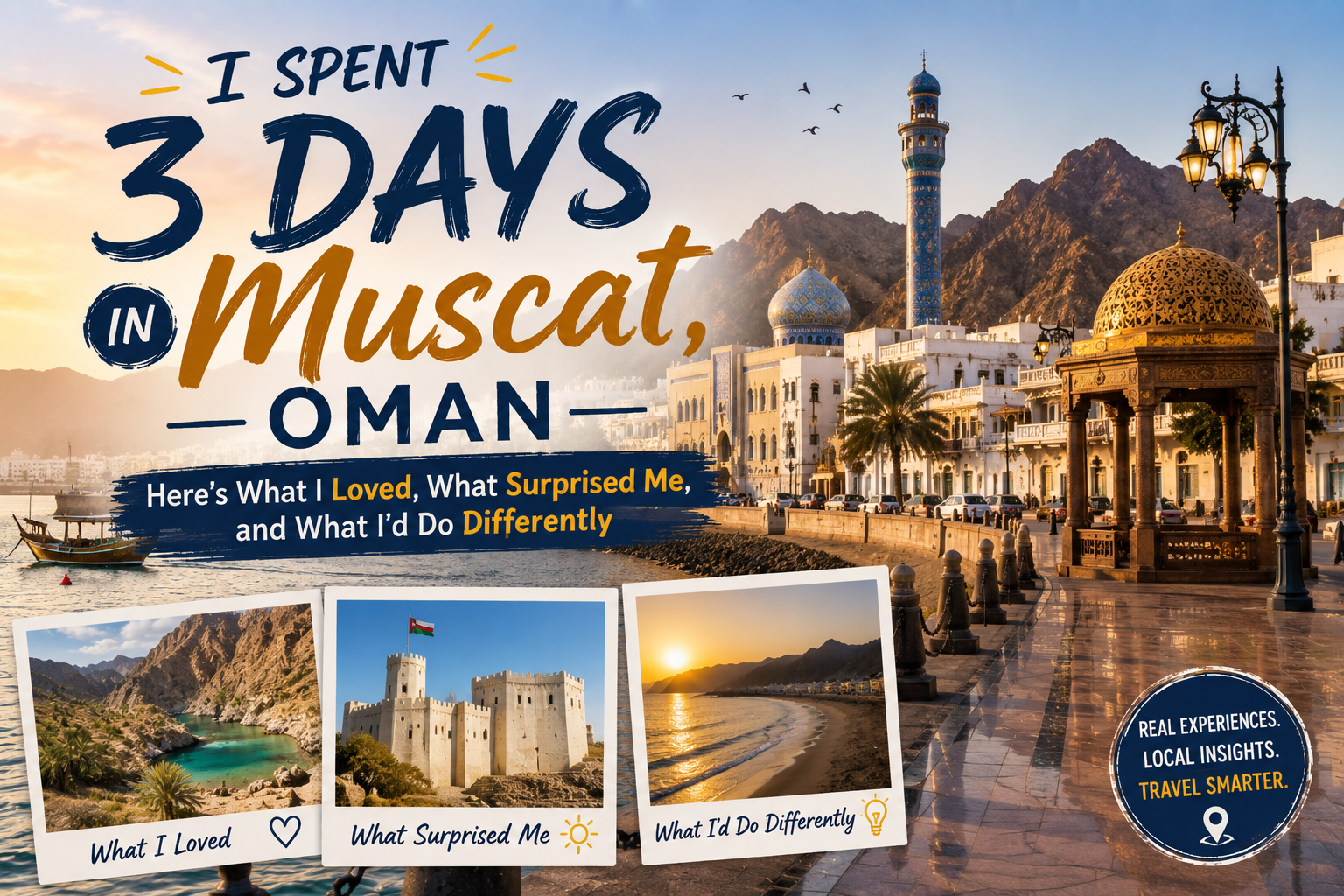
There is a small chance you will arrive in Muscat expecting another flashy Gulf capital and leave wondering why nobody told you about this place sooner.
I almost didn’t book the trip. Every time I mentioned Oman to friends, I got the same blank look, followed by, “Wait, isn’t that near Dubai?” It is close, but Muscat feels completely different. There are no skyscraper-packed horizons competing for attention. Instead, the city stretches quietly between the Gulf of Oman and the rugged Hajar Mountains.
I wanted quiet mornings by the water, dramatic landscapes, traditional markets, and a city that hadn’t been turned into one giant shopping mall. Three days gave me enough time to understand the appeal, although not nearly enough time to see everything.
This is my 3-day Muscat itinerary, including what I loved, what surprised me, what I’d change, and the practical things I’d know before going.
Why Visit Muscat for Three Days?
Muscat works surprisingly well for a long weekend.
The city is spread out along the coastline, so it isn’t a destination where you can simply walk between every major attraction. A rental car makes the trip considerably easier, particularly if you want to include Wadi Shab and Bimmah Sinkhole.
What immediately stood out was the city’s low-rise architecture. Muscat feels spacious and relatively calm, with white and cream-colored buildings backed by rugged mountains.
The first impression is almost the opposite of Dubai: less spectacle, more atmosphere.


Day 1: Sultan Qaboos Grand Mosque, Mutrah Souq & Mutrah Corniche
Morning: Sultan Qaboos Grand Mosque
Start early.
The Sultan Qaboos Grand Mosque is one of Muscat’s essential sights and a good introduction to Omani architecture. The mosque was inaugurated in 2001 and can accommodate around 20,000 worshippers. Its complex features five minarets, a monumental dome and an enormous prayer hall.
For non-Muslim visitors, the official tourism information currently lists visiting hours as Saturday through Thursday, 8:00 a.m. to 11:00 a.m. Modest clothing is required, and women need to cover their heads.


The interior is even more impressive than the exterior. The huge prayer hall, intricate decorative details and enormous Persian carpet make this one of those places where photographs don’t quite communicate the scale.
Travel tip: Bring a scarf and wear trousers or clothing that covers your shoulders and knees. If necessary, appropriate coverings are available at the mosque.
Afternoon: Mutrah Corniche & Mutrah Souq
After the mosque, drive toward Mutrah.
The Mutrah Corniche is one of the best places to experience Muscat at a slower pace. The waterfront curves around the harbor, with traditional boats, low-rise buildings and the mountains creating the backdrop.
Then head into Mutrah Souq.


The souq is a maze of narrow passages filled with frankincense, spices, perfumes, textiles, silver jewelry and souvenirs.
I went in looking for one small bottle of frankincense and came out having spent much longer than planned simply wandering around.
Don’t rush this part. The best experience is often just walking through the market without a shopping list.
Evening: Mutrah Fort at Sunset
Finish the day at Mutrah Fort.
The fort sits above the harbor and provides one of the classic views over Muscat. As the sun begins to disappear, the white buildings, mountains and boats below take on a completely different character.
It’s also a good reminder of what makes Muscat special: the city doesn’t need a skyline full of towers to create an impressive view.
Day 2: Wadi Shab & Bimmah Sinkhole
Day two is the adventure day.
If you only have three days in Muscat, I would make the effort to get outside the city.
Morning: Drive to Wadi Shab
Wadi Shab is roughly a two-hour drive south of Muscat, depending on traffic and your starting point.
The landscape changes dramatically as you leave the city.
Mountains replace buildings, the road becomes quieter and eventually the canyon appears.


Getting into the wadi involves a short boat crossing followed by a hike through the canyon. The trail eventually leads toward turquoise pools surrounded by steep rock walls.
One of the memorable parts is reaching the narrow swimming section toward the interior of the wadi. Depending on conditions and access, visitors can swim through the water toward a cave and waterfall area.
This is the point where I was glad I’d ignored the idea that Wadi Shab would be “just another Instagram location.”
It isn’t.
What to Bring to Wadi Shab
- Water shoes with good grip
- Plenty of drinking water
- Swimwear
- Quick-dry clothing
- Waterproof phone pouch
- Sunscreen
- Small backpack
- Snacks
Important: Conditions and access can change, so check locally before swimming and follow any safety restrictions.
Afternoon: Bimmah Sinkhole
On the return journey, stop at Bimmah Sinkhole.


The limestone crater contains striking blue-green water and is considerably easier to visit than Wadi Shab. You can spend a short time here before continuing toward Muscat.
It’s the kind of stop that works perfectly on a road trip because it doesn’t require an entire day.
Evening: Qurum Beach
Back in Muscat, keep the evening simple.
Head toward Qurum Beach, grab dinner nearby and watch the sunset.
After a full day of hiking and swimming, you probably won’t want another ambitious sightseeing schedule anyway.
Day 3: Old Muscat, Al Alam Palace & Royal Opera House
By the third day, I had learned something important: Muscat is better when you stop trying to see everything.
Morning: Old Muscat
Head toward Old Muscat and explore the area around Al Alam Palace.


The palace itself is the ceremonial residence of the Sultan and isn’t open to visitors, but the exterior is worth seeing.
The historic harbor is framed by Al Jalali Fort and Al Mirani Fort, creating one of Muscat’s most recognizable scenes.
Take your time here. You don’t need hours to see the area, but the early morning is much more comfortable than the middle of the day.
Afternoon: Royal Opera House Muscat
The Royal Opera House Muscat was one of my unexpected highlights.


Even if you aren’t attending a performance, the architecture makes it worth considering as part of your itinerary.
The building combines polished marble, carved wood, elaborate details and landscaped gardens, offering a completely different side of Muscat from the souqs and forts.
Check the current visitor arrangements and performance schedule before going.
Evening: Qurum Beach
For your final evening, don’t schedule another attraction.
Go back to the coast.
Qurum Beach is a good place to slow down and watch local families gather as the temperature drops. Sit by the water, have dinner and let the trip end without another checklist.
That turned out to be one of my favorite parts of the entire visit.
What Surprised Me About Muscat
A few things caught me off guard.
The city is remarkably low-rise
Muscat doesn’t have the overwhelming skyline associated with many Gulf cities. Its architecture and planning give the city a distinctive character.
The mountains are incredibly close
The Hajar Mountains aren’t some distant backdrop. They appear dramatically around parts of the city and become even more impressive once you drive outside Muscat.
The city feels calm
The pace is noticeably different from larger Gulf hubs. The coastline, traditional neighborhoods and spacious roads contribute to that feeling.
The landscape changes quickly
Within a relatively short drive, you can go from an urban coastline to rugged mountains, wadis and sinkholes.
The heat deserves respect
Even outside the peak summer months, midday conditions can make hiking uncomfortable. Plan outdoor activities early and carry enough water.
What I’d Do Differently Next Time
Three days were enough to get a taste of Muscat, but five days would have been better.
I’d add:
- Wadi Bani Khalid
- Wahiba Sands
- More time exploring the Muscat coastline
- A slower morning in Mutrah
- More time in Old Muscat
- A desert overnight stay
I’d also pack proper water shoes.
That sounds like a small detail until you’re walking over wet rocks in a wadi.
And I’d deliberately leave one afternoon completely open. Some of the best moments came when there was nowhere specific I needed to be.
Practical Muscat Travel Tips
Best Time to Visit Muscat
For comfortable sightseeing, October through April is generally the more pleasant period. Summer can become extremely hot, making long outdoor activities considerably harder.
How to Get Around Muscat
For a three-day itinerary that includes Wadi Shab, renting a car is the most convenient option.
Muscat is geographically spread out, and attractions aren’t clustered tightly enough for a short walking-based itinerary.
What to Wear
Muscat is relatively modern, but Oman is culturally conservative. Modest clothing is the safest choice in public spaces, while religious sites have stricter requirements.
At the Grand Mosque, women should cover their heads and visitors should wear clothing covering the shoulders and knees.
Currency
The currency is the Omani Rial (OMR).
Cards are widely useful, but carrying some smaller denominations of cash is convenient for markets, smaller businesses and incidental expenses.
Language
Arabic is the official language, while English is widely used in tourism, hotels, restaurants and other visitor-facing services.
Alcohol
Alcohol is not freely sold in ordinary shops. Licensed hotels and restaurants are the usual places where visitors can legally purchase alcoholic drinks.
What to Pack
For a three-day Muscat trip, I’d prioritize:
- Breathable modest clothing
- Comfortable walking shoes
- Water shoes
- Sunglasses
- Sunscreen
- Reusable water bottle
- Lightweight daypack
- Swimwear
- Waterproof phone pouch
- Scarf for mosque visits
Is Three Days in Muscat Enough?
Yes, but only for an introduction.
Three days lets you experience Muscat’s major cultural sights, explore Mutrah, visit the Grand Mosque, spend a day at Wadi Shab and Bimmah Sinkhole, and still have time for the coastline.
But if you have five days, use them.
Oman gets more interesting the farther you move away from the capital. Desert landscapes, mountain villages, wadis and coastal towns deserve more time than a rushed weekend allows.
Final Thoughts: Would I Go Back to Muscat?
Absolutely.
Three days in Muscat gave me just enough time to fall for the place and not nearly enough time to see it properly.
What stayed with me wasn’t one spectacular attraction. It was the combination of mountains and sea, old markets and modern architecture, quiet roads and dramatic landscapes.
Muscat doesn’t feel like it’s trying to prove anything.
And maybe that’s exactly why it works.
If you’re planning a 3-day Muscat itinerary, don’t treat the city as a quick stop between flights. Give it enough time to breathe, leave some space in your schedule, and make at least one day about getting beyond the city.
You might leave, like I did, already planning the next trip.
Internal Links
- The Rise of Do-Less Travel
- The Future of Sustainable Travel: How to Explore Without Leaving a Trace
- Experience-Led Travel 2026: Okinawa, Marrakech, Swiss Alps
- Island-Hopping Beyond the Crowds: Lesser-Known Archipelagos Worth Discovering
- Forgotten Kingdoms: Ancient Cities Every History Lover Should Visit
- Hidden Gems: Why Offbeat Travel Creates the Best Memories
- The Hidden Mental Health Benefits of Travel