
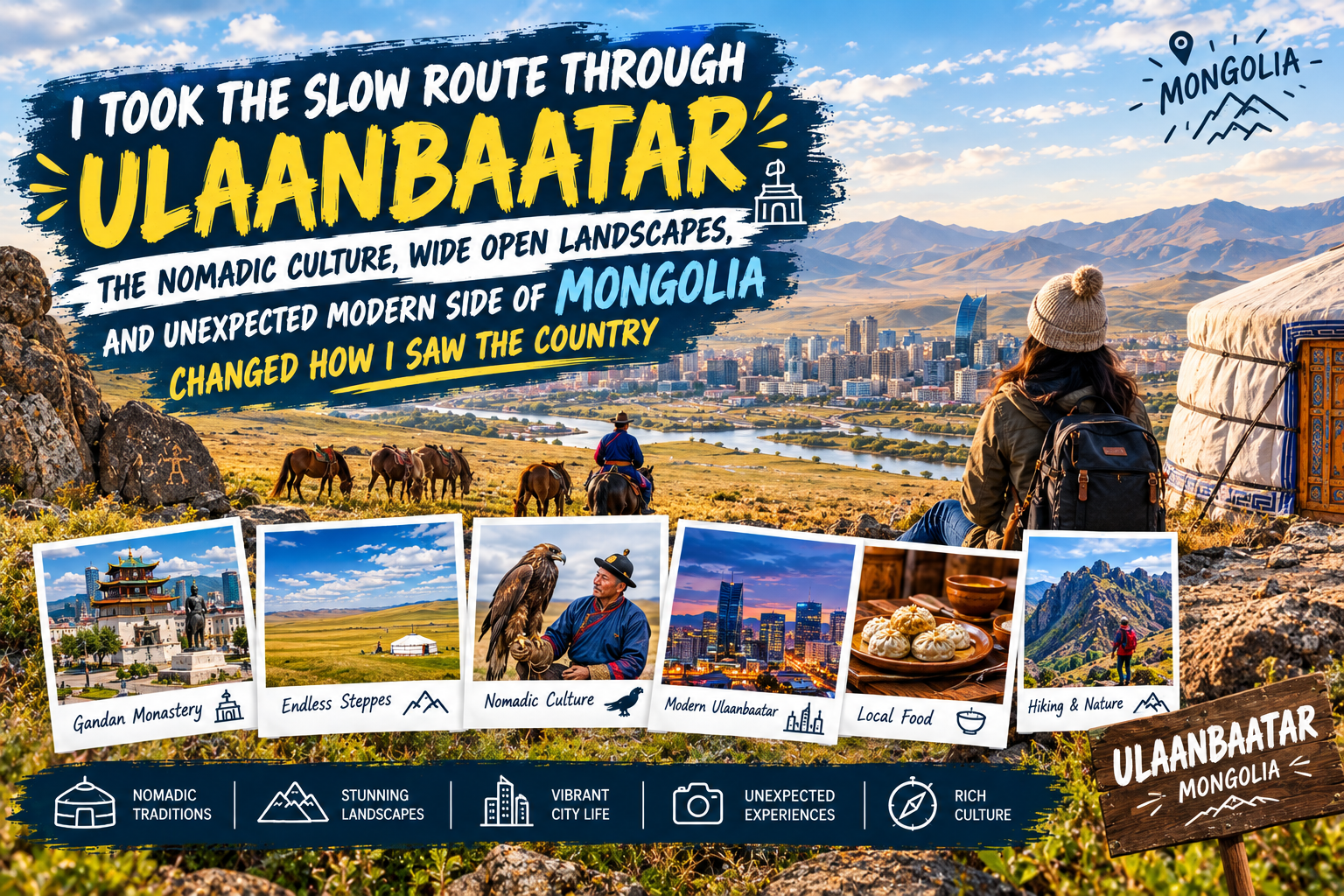
I did not plan to fall in love with Ulaanbaatar.
When I arrived in Mongolia, I saw the capital as a stopover. I thought the real journey would begin once I left the city.
In my mind, Mongolia meant horses, gers and endless grassland. I imagined empty roads running towards distant mountains. Ulaanbaatar was simply the place where my flight landed.
However, the city changed my mind.
Instead of rushing towards the countryside, I slowed down. That decision showed me a side of Mongolia I had not expected.
Ulaanbaatar Is More Than a Gateway to Mongolia
Ulaanbaatar makes a strong first impression.
Mountains surround the city, while different periods of Mongolian history seem to meet in the streets. Soviet-era apartment blocks stand beside modern glass towers. Buddhist monasteries sit near busy roads. Meanwhile, ger districts spread across the surrounding hills.
At first, the city can feel chaotic.
Yet that is also what makes it interesting.
Many travellers use Ulaanbaatar as a starting point for trips into the Mongolian countryside. I had planned to do the same. Instead, I gave myself more time to explore.
The longer I stayed, the more the city started to make sense.
Starting My Days at Sükhbaatar Square
Most mornings began around Sükhbaatar Square, the huge public square in central Ulaanbaatar.
The square briefly carried the name Chinggis Square from 2013 to 2016. Today, however, its official name is Sükhbaatar Square.
An equestrian statue of revolutionary leader Damdin Sükhbaatar stands in the centre.
On the northern side, the Government Palace dominates the view. A large seated statue of Chinggis Khaan stands in front of the building.
The monuments are impressive. Still, everyday life around the square interested me more.
Office workers crossed it in the morning. Families walked around in the afternoon. Later, teenagers gathered near the edges.
Wedding parties also appeared from time to time for photographs.
As a result, the square never felt like a place created only for tourists. It felt like the centre of a living city.
That became my first clue that Ulaanbaatar deserved more time.
Nomadic Culture Is Still Part of the Capital
Before this trip, I assumed I would have to travel deep into the countryside to understand Mongolia’s nomadic culture.
I pictured horse herders living hundreds of kilometres from the capital. I imagined livestock moving across open grassland and families sleeping in isolated gers.
That Mongolia still exists.
However, its nomadic identity does not disappear when you enter Ulaanbaatar.
Instead, traces of it appear everywhere.
You find them in the food. You see them in museums and ger districts. Most importantly, you notice them in the way old traditions continue to adapt to modern life.
Understanding Mongolia at the Chinggis Khaan National Museum
The Chinggis Khaan National Museum helped me understand that connection.
Before visiting, I expected a museum focused mainly on Chinggis Khaan and the Mongol Empire.
It offers much more.
The exhibits explore Mongolia’s early nomadic states, the rise of the Mongol Empire and later periods of the country’s history.
I took my time walking through the galleries.
Because I wasn’t rushing, the story started to connect with what I had already seen outside. Herding, migration and political power had shaped Mongolia for centuries.
Suddenly, the landscapes I wanted to visit were not just beautiful places.
They were part of the country’s story.
Mongolian Food Told Me Another Part of the Story
Food made the connection even clearer.
One of the first dishes I tried was buuz. These steamed dumplings usually contain meat and are common across Mongolia.
Then I tried khuushuur, a fried meat-filled pastry.
Both are simple and filling. More importantly, they fit naturally into Mongolia’s food culture.
Next came something completely different.
Airag is a traditional fermented drink made from mare’s milk. It has a sour taste and a light fermented character.
My first sip surprised me.
I wasn’t sure whether I liked it.
Still, the taste became more interesting once I understood the tradition behind it. Airag has deep links with Mongolia’s pastoral culture. Its traditional production and customs remain an important part of that heritage.
Therefore, drinking it felt less like trying an unusual local drink and more like meeting another piece of Mongolia’s history.
Ulaanbaatar’s Ger Districts Changed My Perspective
The ger districts of Ulaanbaatar showed me another side of the country.
Traditional gers spread across parts of the hills surrounding the city. Yet they do not exist in isolation from modern life.
You may see a ger beside a permanent house. Cars sit outside fences. Satellite dishes appear nearby. Some homes also use modern technology alongside traditional structures.
At first, the combination surprised me.
Then it started to make perfect sense.
Tradition does not have to remain frozen in the past to survive.
Instead, it can change with the people who continue to use it.
Ulaanbaatar makes that process visible.
Leaving Ulaanbaatar for Gorkhi-Terelj National Park
After several days in the city, I headed towards Gorkhi-Terelj National Park.
The change happened quickly.
Buildings became less common. Traffic disappeared. Then rocky hills, pine-covered areas and open grassland began to dominate the view.
Suddenly, the Mongolia I had imagined before the trip appeared in front of me.
I spent one night in a ger camp.
Dinner was simple. Afterwards, the temperature dropped as darkness settled over the landscape.
Then everything became quiet.
It was not ordinary city quiet.
There were no engines, notifications or conversations coming through a wall. Instead, I could hear tiny sounds that I would normally never notice.
That silence stayed with me.
The Mongolian Steppe Changes Your Sense of Distance
Photographs show how beautiful the Mongolian steppe can be.
However, photographs struggle to show its scale.
Cities constantly give your eyes something to focus on. There are buildings, signs, cars and people everywhere.
The steppe is different.
In some places, there seems to be nothing between you and the horizon.
Grass stretches outward. Above it, the sky feels enormous.
As a result, distance begins to feel different.
I finally understood why movement had played such an important role in Mongolia’s history. In a landscape this large, mobility was essential.
Horses were not simply a way to travel. They helped shape work, trade and daily life.
Even a short horseback ride across the grassland gave me a small sense of that relationship.
Modern Ulaanbaatar Was My Biggest Surprise
Before visiting Mongolia, almost every image in my head was rural.
Ulaanbaatar quickly challenged that idea.
Modern cafés appeared throughout the city. Young Mongolians worked on laptops or met friends over coffee. Contemporary restaurants sat close to traditional food shops.
I also found vegetarian options more easily than I expected.
Meanwhile, the streets showed another interesting contrast.
Young people in modern streetwear walked past Buddhist monks. Glass buildings stood near older Soviet architecture. Smartphones and traditional clothing appeared in the same public spaces.
One morning, I watched monks walking around Gandan Monastery.
Later, I sat inside a modern café.
Both experiences felt completely Mongolian.
That was when I realised I had been asking the wrong question.
Mongolia is not choosing between its traditions and modern life.
It is living with both.
Visiting Gandan Monastery
Gandan Monastery gave me another reason to slow down.
The atmosphere changed as soon as I entered the monastery grounds.
People came to pray. Monks moved through the complex. Visitors slowly turned prayer wheels.
Meanwhile, the noise of the city seemed farther away.
I stayed longer than I had planned.
Once again, Ulaanbaatar showed me how many different histories exist within the same city.
Buddhist tradition is one layer. Soviet influence is another. Nomadic heritage remains deeply important. At the same time, rapid modern development continues around all of them.
Sometimes you can see those different Mongolias on the same street.
Hearing Mongolian Throat Singing
One evening, I watched a traditional cultural performance.
The performance included music, contortion and Mongolian throat singing, also known as khöömei.
I had heard recordings before.
Live throat singing was completely different.
A deep tone seemed to fill the room. At the same time, higher sounds appeared above it.
For a moment, it was difficult to believe that one person could produce both.
Afterwards, I walked back into modern Ulaanbaatar.
Cars moved through the streets. Restaurants were busy. People checked their phones while waiting outside cafés.
That contrast explained the city better than any single attraction could.
Why Slow Travel Works So Well in Mongolia
I could have seen Ulaanbaatar in one rushed day.
I could have visited Sükhbaatar Square, walked around Gandan Monastery and spent an hour inside a museum.
Then I could have left for the countryside.
I would have seen the main attractions.
However, I would have missed the connections between them.
Slow travel in Mongolia gave me enough time to notice those connections.
The museum helped me understand what I later saw on the steppe.
The ger districts challenged my assumptions about nomadic culture.
Meanwhile, the cafés and modern streets showed me that Mongolia is changing quickly.
Finally, the countryside helped me understand why space, movement and livestock remain so important to the country’s identity.
How Many Days Do You Need in Ulaanbaatar?
I recommend spending at least two full days in Ulaanbaatar.
Three days is even better if you enjoy museums, food and slower exploration.
If you also want to visit Gorkhi-Terelj National Park, plan for four or five days in total.
A simple itinerary could look like this:
Day 1: Explore Sükhbaatar Square, the Chinggis Khaan National Museum and central Ulaanbaatar.
Day 2: Visit Gandan Monastery, try Mongolian food and explore the city’s modern café scene.
Day 3: Travel towards Gorkhi-Terelj National Park and stay overnight in a ger.
Day 4: Explore the countryside, try horseback riding and return towards Ulaanbaatar.
If you have another day, keep it free.
Mongolia rewards empty space in an itinerary.
Best Time to Visit Ulaanbaatar
For many first-time visitors, June through early September is the easiest period to visit Ulaanbaatar and the surrounding countryside.
Temperatures are generally warmer during summer. In addition, many countryside routes are easier to access.
July is especially important because Mongolia celebrates the Naadam Festival. Traditional wrestling, horse racing and archery form the heart of the festival.
However, summer is also the busiest travel season.
Travelling near the beginning or end of the main season may mean fewer visitors. On the other hand, temperatures can become less predictable.
Therefore, pack layers even if you visit during the warmer months.
What to Eat in Ulaanbaatar
Food should be part of any Ulaanbaatar travel guide.
Start with a few Mongolian classics:
- Buuz: steamed meat-filled dumplings
- Khuushuur: fried meat-filled pastries
- Tsuivan: noodles usually cooked with meat and vegetables
- Suutei tsai: traditional salted milk tea
- Airag: fermented mare’s milk
However, don’t stop with traditional dishes.
Ulaanbaatar also has a growing café and restaurant scene. Exploring both sides of the city’s food culture helped me understand modern Mongolia better.
Practical Tips for Visiting Ulaanbaatar
Give the capital enough time. Spend at least two days in Ulaanbaatar before leaving for the countryside.
Start in the city centre. Sükhbaatar Square and the Chinggis Khaan National Museum provide a useful introduction to Mongolian history.
Visit Gandan Monastery. It offers a different view of Ulaanbaatar and its Buddhist heritage.
Stay in a ger. An overnight trip near Gorkhi-Terelj National Park is an accessible way to experience the countryside.
Prepare for changing temperatures. Weather can shift quickly, especially after sunset.
Plan the Gobi separately. The Gobi Desert and attractions such as the Flaming Cliffs require a much longer journey south. They are not simple day trips from Ulaanbaatar.
Try modern Ulaanbaatar too. Traditional food and historical sites matter, but so do the cafés, restaurants and everyday neighbourhoods.
Is Ulaanbaatar Worth Visiting?
Yes.
Ulaanbaatar is not simply a place to pass through on the way to Mongolia’s famous landscapes.
Instead, the city helps explain those landscapes.
Here, nomadic heritage meets modern urban life. Buddhist monasteries stand beside busy roads. Ger districts climb hills beyond new buildings.
Traditional music still matters. At the same time, modern café culture continues to grow.
The Mongolian steppe may be what first attracts travellers to the country.
For me, however, Ulaanbaatar made the wider journey easier to understand.
Frequently Asked Questions About Ulaanbaatar
Is Ulaanbaatar worth visiting?
Yes. Ulaanbaatar offers museums, Buddhist sites, traditional food and modern city life. More importantly, it provides useful cultural context before you explore the Mongolian countryside.
How many days should I spend in Ulaanbaatar?
Spend at least two full days in Ulaanbaatar. Three days gives you more time to explore without rushing. If you also plan to visit Gorkhi-Terelj National Park, allow four or five days.
What are the best things to do in Ulaanbaatar?
Visit Sükhbaatar Square, the Chinggis Khaan National Museum and Gandan Monastery. You should also try traditional Mongolian food and explore the city’s modern cafés.
Can I visit the Mongolian steppe from Ulaanbaatar?
Yes. Gorkhi-Terelj National Park is one of the easiest countryside destinations to reach from Ulaanbaatar. Visitors can experience open landscapes, ger stays and horseback riding there.
What is a Mongolian ger?
A ger is a traditional circular dwelling used by Mongolian pastoral communities. Its portable structure suits a lifestyle based on movement across large landscapes.
What is airag?
Airag is a traditional fermented drink made from mare’s milk. It has strong links to Mongolia’s pastoral culture and traditions.
What is the best time to visit Mongolia?
June through early September is a popular period for first-time visitors. The weather is generally warmer, while many countryside routes are easier to access. However, the best month depends on the regions you plan to visit.
What Ulaanbaatar Taught Me About Mongolia
Before arriving, I imagined Mongolia as one enormous landscape.
I left with a much more complicated picture.
The grasslands were every bit as impressive as I had expected.
Ulaanbaatar was not.
It surprised me.
I remember the extra afternoon around Sükhbaatar Square. I remember drinking coffee near Gandan Monastery. I remember dumplings, ger districts and the silence outside the city.
Most of all, I remember seeing old and new Mongolia in the same place.
Taking the slow route did not necessarily show me more destinations.
Instead, it made me notice more about the places I had already reached.
Internal Links:
Island Hopping Beyond the Crowds