
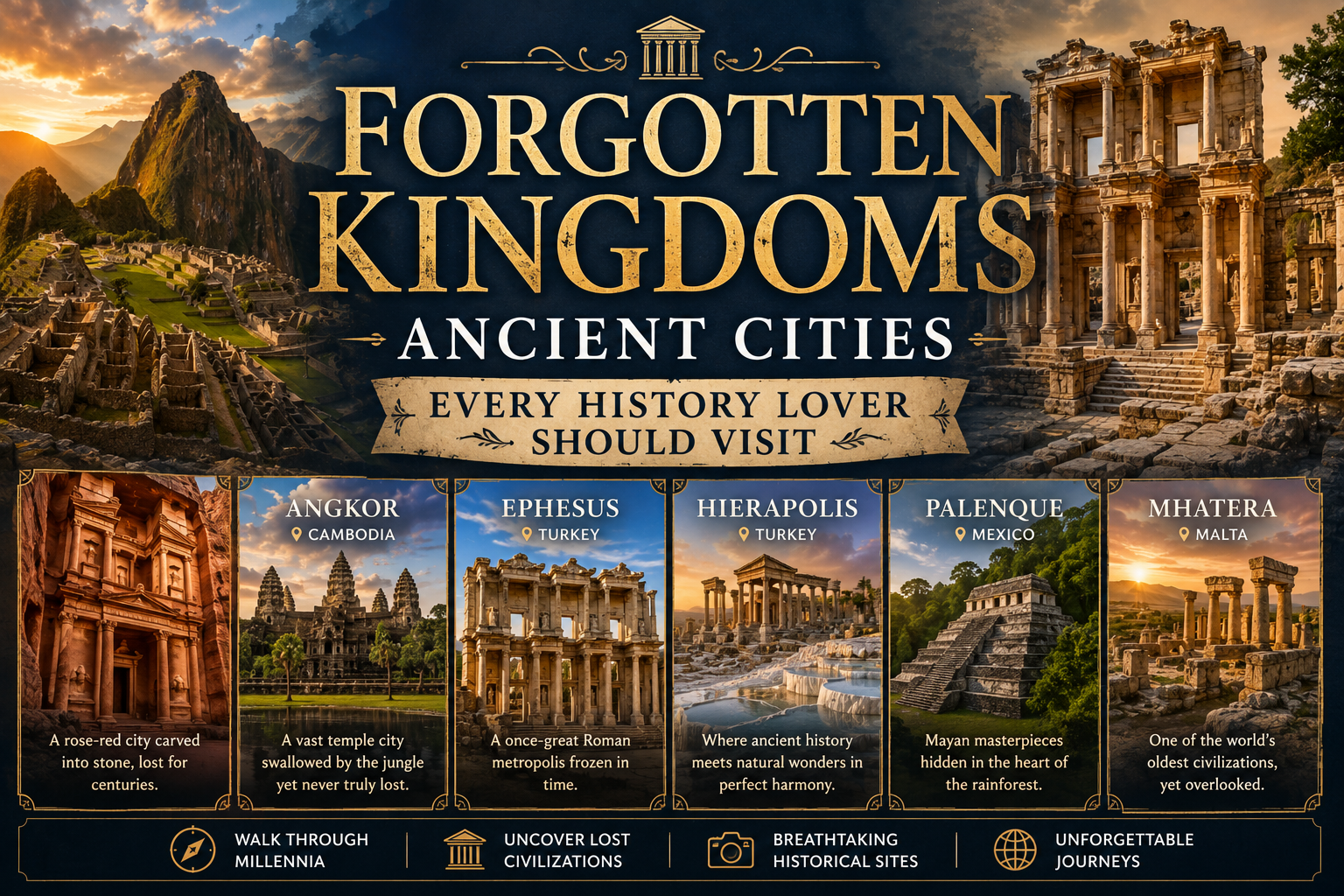
A complete guide to the world’s greatest forgotten kingdoms — including when to go, what to see, and how to plan your trip.
There is a particular kind of quiet that settles over a ruined city. Not silence exactly — the wind still moves through empty doorways, birds still nest in collapsed towers — but a stillness that comes from knowing thousands of people once lived, worked, worshipped, and died on the ground beneath your feet.
That stillness is why travelers keep returning to the world’s forgotten kingdoms, long after the empires that built them have crumbled to dust.
If you’d rather stand inside a thousand-year-old temple than lie on a beach, this guide is for you. Below is a curated list of forgotten kingdoms and lost cities that belong on every history lover’s travel bucket list — along with practical notes on when to go and what to expect once you get there.
Table of Contents
- What Counts as a Forgotten Kingdom?
- 1. Petra, Jordan
- 2. Angkor, Cambodia
- 3. Great Zimbabwe
- 4. Hampi, India
- 5. Persepolis, Iran
- 6. Mohenjo-daro, Pakistan
- 7. Palenque, Mexico
- 8. Pompeii, Italy
- 9. Ephesus, Turkey
- 10. Bagan, Myanmar
- Practical Tips for Visiting Ancient Ruins
- FAQ: Forgotten Kingdoms Travel
What Counts as a Forgotten Kingdom?
Not every ancient ruin qualifies as one of the world’s forgotten kingdoms. The term usually describes a city or civilization that once held real political, economic, or religious power — then slipped out of common memory, sometimes for centuries, before archaeologists or explorers brought it back into the light.
- Petra sat largely unknown to the Western world until 1812.
- Machu Picchu was unfamiliar outside its immediate region until 1911.
- Great Zimbabwe was so unrecognized by colonial administrators that they refused, for decades, to believe Africans had built it themselves.
These aren’t just old buildings. They’re the physical remains of entire societies with their own laws, gods, trade routes, and rivalries. Visiting them is less like sightseeing and more like reading the final chapter of a book whose first three hundred pages have been lost.
1. Petra, Jordan — A Forgotten Kingdom Carved in Stone
Carved directly into sandstone cliffs by the Nabataeans more than two thousand years ago, Petra was once a thriving hub on the ancient incense trade routes linking Arabia, Egypt, and the Mediterranean.
The famous facade of Al-Khazneh, glimpsed at the end of the narrow Siq canyon, is only the beginning. The wider site includes a Roman-style theater, royal tombs, and a monastery reached by more than 800 rock-cut steps.
Why Petra Is One of the World’s Great Forgotten Kingdoms
Petra sat almost entirely unknown to the Western world until 1812, hidden behind desert cliffs that kept its temples and tombs a secret for centuries.
Best Time to Visit Petra
March–May or September–November, when desert temperatures are manageable.
Travel Tips for Petra
Pair your visit with nearby Wadi Rum for red-sand desert camping alongside the ancient ruins.
2. Angkor, Cambodia — Capital of a Forgotten Khmer Empire
At its height in the twelfth century, Angkor may have been the largest pre-industrial city on Earth, home to perhaps a million people. Angkor Wat, the temple most visitors come to see, was originally built as a Hindu temple dedicated to Vishnu before later becoming a Buddhist site.
Beyond Angkor Wat itself, the wider Angkor Archaeological Park holds hundreds of temples, including Ta Prohm, where centuries-old trees have grown directly through the stonework.
Why Angkor Is a Forgotten Kingdom Worth Exploring
The Khmer Empire’s capital was abandoned in the fifteenth century and swallowed by jungle for hundreds of years before French explorers brought it back to global attention.
Best Time to Visit Angkor
November–February, outside monsoon season.
Travel Tips for Angkor
A three-day pass is worth the money — rushing Angkor in a single afternoon means missing most of it.
3. Great Zimbabwe — A Forgotten Kingdom’s Stone City
Built between the eleventh and fifteenth centuries by the ancestors of the Shona people, Great Zimbabwe is the largest ancient stone structure in Sub-Saharan Africa built without mortar. Its granite walls, some over thirty feet high, once enclosed a royal city that controlled gold and ivory trade across the region.
The country of Zimbabwe took its name directly from these ruins after independence.
Why Great Zimbabwe Belongs on Every Forgotten Kingdoms List
Colonial administrators refused for decades to believe Africans had built this vanished kingdom themselves — a stark reminder of how easily history gets erased.
Best Time to Visit Great Zimbabwe
May–October, the dry season.
Travel Tips for Great Zimbabwe
Great Zimbabwe is a strong reminder that sophisticated urban civilizations flourished across Africa long before European contact.
4. Hampi, India — The Vijayanagara Empire’s Forgotten Capital
Once the capital of the Vijayanagara Empire and, by some accounts, the second-largest city in the world during the sixteenth century, Hampi now lies scattered across a boulder-strewn landscape in Karnataka.
The Virupaksha Temple remains an active place of worship, while the Vittala Temple complex — with its stone chariot and musical pillars — hints at just how wealthy this kingdom once was before it fell to a coalition of Deccan sultanates in 1565.
Why Hampi Is a Forgotten Kingdom of Its Own
A capital once home to hundreds of thousands of people fell within a matter of months in 1565, leaving behind one of the most complete ruined cityscapes in South Asia.
Best Time to Visit Hampi
October–February.
Travel Tips for Hampi
Rent a bicycle. Hampi’s ruins spread across several square miles, and a bike covers far more ground than walking alone.
5. Persepolis, Iran — Ceremonial Heart of a Vanished Empire
Founded by Darius the Great around 518 BCE, Persepolis served as the ceremonial capital of the Achaemenid Persian Empire — the largest empire the ancient world had yet seen. Alexander the Great burned it in 330 BCE; whether by accident or deliberate revenge for the Persian sack of Athens remains debated by historians.
What survives — the Gate of All Nations, the Apadana staircase reliefs showing delegations from across the empire bringing tribute — still conveys the scale of Achaemenid ambition.
Why Persepolis Represents a Forgotten Kingdom’s Peak
Persepolis was built purely for ceremony and tribute, not daily governance, which makes its surviving reliefs a rare window into how a vanished empire wanted to be seen.
Best Time to Visit Persepolis
Spring or autumn, avoiding extreme summer heat.
Travel Tips for Persepolis
Check current visa and travel advisories well ahead of booking, as entry requirements for Iran change frequently.
6. Mohenjo-daro, Pakistan — A Lost Civilization Ahead of Its Time
Built around 2500 BCE, Mohenjo-daro was one of the largest settlements of the Indus Valley Civilization — a society with planned streets, covered drainage systems, and standardized brick sizes at a time when much of the world had no cities at all.
No one has fully deciphered the Indus script, so much of what this civilization believed and how it governed itself remains a genuine mystery.
Why Mohenjo-daro Is Among the Most Mysterious Forgotten Kingdoms
This is one of the few forgotten kingdoms whose language we still cannot read, making every visit feel like standing at the edge of an unsolved puzzle.
Best Time to Visit Mohenjo-daro
November–February, avoiding Sindh’s brutal summer heat.
Travel Tips for Mohenjo-daro
Bring a guide who can walk you through the site’s drainage systems and brick-laying techniques — details that are easy to miss without context.
7. Palenque, Mexico — A Forgotten Maya Kingdoms Swallowed by Jungle
Tucked into the Chiapas rainforest, Palenque was a major Maya city-state during the Classic Period, reaching its peak under the ruler K’inich Janaab’ Pakal in the seventh century. His tomb, discovered inside the Temple of the Inscriptions in 1952, remains one of the most significant archaeological finds in the Americas.
Howler monkeys still call through the surrounding jungle canopy, making the walk between temples feel closer to an expedition than a museum tour.
Why Palenque Is a Forgotten Kingdom Reclaimed by Jungle
For centuries the jungle simply grew over Palenque, and much of the site remains unexcavated today, hidden beneath dense Chiapas rainforest.
Best Time to Visit Palenque
November–April, the dry season.
Travel Tips for Palenque
Pair your visit with the waterfalls of Agua Azul, a short drive from the ruins.
8. Pompeii, Italy — A Lost City Frozen in a Single Afternoon
Unlike most forgotten kingdoms on this list, Pompeii was not lost to slow decline but to catastrophe. When Mount Vesuvius erupted in 79 CE, the city was buried under ash so quickly that bakeries still have loaves in their ovens and walls still carry political graffiti scrawled by ordinary Romans.
Few sites anywhere offer this close a look at daily life in the ancient world.
Why Pompeii Is a Uniquely Preserved Forgotten Kingdom
Most forgotten kingdoms fade gradually; Pompeii was sealed in a single afternoon, which is exactly why its details feel so immediate today.
Best Time to Visit Pompeii
April, May, September, or October, avoiding peak summer crowds and heat.
Travel Tips for Pompeii
Pair it with nearby Herculaneum, a smaller and often less crowded site preserved in even finer detail.
9. Ephesus, Turkey — Crossroads of a Forgotten Empire
Once one of the greatest cities of the Roman East and a major center of early Christianity, Ephesus retains one of the best-preserved ancient theaters in the world, along with the facade of the Library of Celsus. The city was also home to the Temple of Artemis, one of the Seven Wonders of the Ancient World, of which only a single reconstructed column now stands.
Why Ephesus Still Matters as a Forgotten Kingdom
Ephesus once rivaled Rome and Alexandria in size and influence, yet today only a single column marks where one of the Seven Wonders of the Ancient World stood.
Best Time to Visit Ephesus
April–June or September–October.
Travel Tips for Ephesus
Base yourself in the nearby town of Şirince, a good spot for wine tasting after a day among the ruins.
10. Bagan, Myanmar — A Forgotten Kingdoms of 2,000 Temples
Between the eleventh and thirteenth centuries, the kings of the Pagan Kingdom built more than 10,000 Buddhist temples, pagodas, and monasteries across the plains of central Myanmar. Roughly 2,200 of these structures still stand today, scattered across a landscape that turns gold at sunrise, when hot-air balloons drift silently over the temple spires.
Why Bagan Is One of Asia’s Great Forgotten Kingdoms
At its peak, the Pagan Kingdom built roughly one temple for every day of the year across nearly three centuries — a scale of devotion few forgotten kingdoms can match.
Best Time to Visit Bagan
October–February, the cooler and drier months.
Travel Tips for Bagan
Check current travel advisories before planning a trip to Myanmar, as conditions in parts of the country can change quickly.
Practical Tips for Visiting Forgotten Kingdoms
Visiting forgotten kingdoms rewards preparation more than almost any other kind of travel. A few things worth sorting out before you go:
Sort Your Documentation Early
Several of these countries require visas arranged well in advance, and rules shift often enough that last-minute research can cost you a trip.
Pack for Extremes
Desert ruins like Petra and Persepolis swing between cold mornings and blistering afternoons; jungle sites like Palenque and Angkor demand rain protection even in the dry season.
Hire a Local Guide Where You Can
Stone does not explain itself. A good guide turns a pile of rubble into a story about the people who lived there.
Slow Down Between Forgotten Kingdoms
Rushing between five sites in three days usually means remembering none of them clearly. Give the big ones — Angkor, Petra, Hampi — at least two full days each.
Frequently Asked Questions About Forgotten Kingdoms
What Is the Oldest Forgotten Kingdoms Open to Travelers?
Mohenjo-daro, dating to around 2500 BCE, is among the oldest major urban sites open to the public, though much of the Indus Valley Civilization’s history is still being pieced together.
Which Forgotten Kingdoms Is Easiest to Reach for a First-Time History Traveler?
Pompeii is one of the most accessible, with direct train connections from Naples and extensive on-site information for visitors who are new to ancient travel.
Are These Forgotten Kingdoms Safe to Visit Today?
Most of the sites on this list — including Petra, Angkor, Hampi, and Pompeii — see millions of visitors a year and have well-established tourist infrastructure. A few, such as Persepolis and Bagan, require a closer look at current travel advisories before booking.
How Much Time Should I Set Aside for a Forgotten Kingdoms Trip?
For a single major site like Angkor or Petra, plan on at least three to four days including travel. A broader trip covering two or three forgotten kingdoms in one region, such as Cambodia and Myanmar together, usually needs two to three weeks to do properly.
Final Thought
Forgotten kingdoms have a way of resetting your sense of time. A century feels short once you have stood inside a temple that has outlasted twenty of them. Whichever of these forgotten kingdoms makes it onto your itinerary first, go slowly, ask questions, and let the place tell you what it has to say. It has been waiting a very long time for someone to listen.
Plan Your Forgotten Kingdoms Trip
Once you’ve picked your forgotten kingdom, the logistics are half the battle. Enigma Jaunt’s customized trip planning service can help build an itinerary around the ruins you actually want to see, while the visa and documentation guides are worth a look before booking anything to a country like Iran or Myanmar. If a guided walk through the ruins sounds better than going it alone, check out guided tours as well.
Before you pack a single bag, it’s worth reading:
- Packing Smart: Essentials Every Traveler Should Carry
- Budget Travel: How to Explore the World Without Overspending (useful if this trip stitches together a few forgotten kingdoms)
- Travel Safety Basics: Staying Aware & Protected in New Environments (especially helpful for first-time travelers to unfamiliar regions)
Internal Links
- Best Weekend Getaways
- Experience-Led Travel 2026
- Best Destination Dupes 2026
- Why More People Are Traveling Solo and Slowing Down
- Packing Smart: Travel Light, Experience More
- AI Travel Assistants: Plan Your Trip Under an Hour
- Coolcations 2026: Why Everyone Is Choosing Cooler Destinations This Summer