
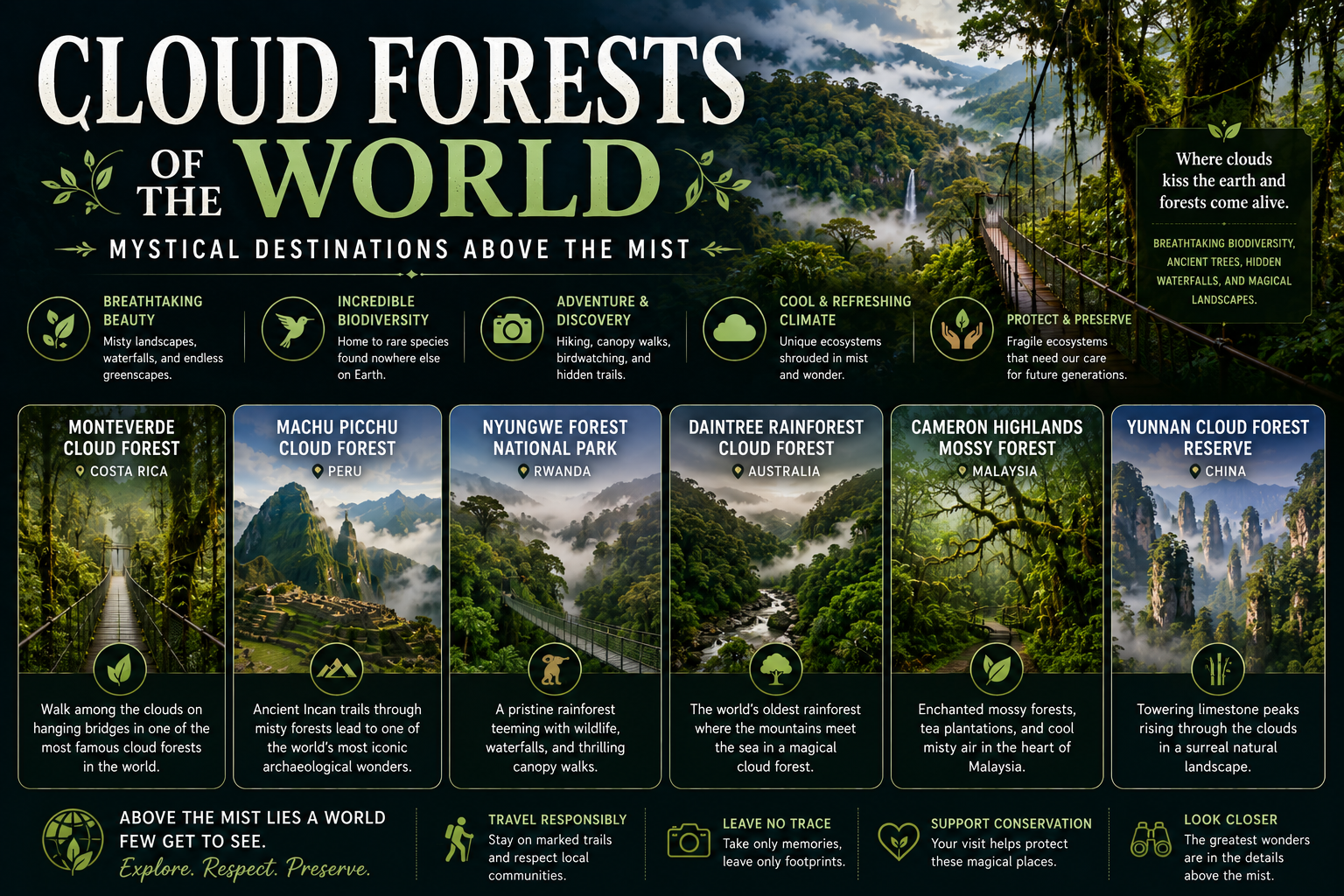
A particular kind of quiet settles over a forest once the cloud forest move in. Sound softens. Colours deepen. A trail that A special kind of silence settles over a forest when clouds roll in. Sounds become softer. Colours grow richer. Trails that looked ordinary suddenly feel magical.
Welcome to the world of cloud forests—one of Earth’s rarest and most fascinating ecosystems. These mist-covered landscapes offer an unforgettable experience for travellers seeking something beyond beaches and cities.
Although cloud forests cover only a small part of the planet, they support an incredible variety of wildlife. Warm, moist air rises along mountain slopes, cools, and forms a blanket of fog. This constant mist feeds the forest, keeping plants, mosses, and trees alive throughout the year.
The result is a breathtaking landscape filled with orchids, ferns, moss-covered trees, bromeliads, and rare wildlife. Every step feels like walking through a living fairy tale.
In this guide, you’ll discover some of the world’s best cloud forest destinations, from Costa Rica and Ecuador to Rwanda and Southeast Asia.
What Is a Cloud Forest?
A cloud forest is a high-altitude rainforest that stays covered in mist for much of the day. Most are found between 1,000 and 3,500 metres above sea level.
Unlike tropical rainforests, these forests receive moisture directly from clouds instead of relying only on rainfall.
Several unique features make cloud forests extraordinary.
- Trees are shorter and covered with moss.
- Orchids and epiphytes grow on tree branches instead of the ground.
- Many plants and animals exist nowhere else on Earth.
- Cool temperatures create ideal conditions for rare wildlife.
Because of their unique biodiversity, conservationists consider cloud forests among the world’s most valuable ecosystems.
1. Monteverde Cloud Forest, Costa Rica
Costa Rica is home to one of the world’s most famous cloud forests—Monteverde.
Located along the Continental Divide, Monteverde receives moisture from both the Pacific Ocean and the Caribbean Sea. This creates misty conditions almost every day.
The Monteverde Cloud Forest Reserve, together with Santa Elena Reserve and the Children’s Eternal Rainforest, protects thousands of hectares of remarkable biodiversity.
Visitors often come hoping to spot the colourful resplendent quetzal. Hanging bridges and canopy walkways provide spectacular views above the forest while allowing travellers to experience life among the treetops.
If you prefer quieter trails, nearby Bajos del Toro offers waterfalls, coffee farms, and fewer crowds.
2. Mindo Cloud Forest, Ecuador
Ecuador contains one of South America’s richest cloud forest regions.
The small town of Mindo sits on the western slopes of the Andes and attracts birdwatchers from around the world.
More than 400 bird species have been recorded here during annual bird counts. Hummingbirds, toucan barbets, and the colourful Andean cock-of-the-rock are among the highlights.
Nearby reserves such as Mashpi, Bellavista, and Tandayapa each offer different elevations. As you move between them, you’ll discover changing wildlife and landscapes.
Visitors can also enjoy zip-lining, waterfall hikes, cable cars, and chocolate farm tours.
3. Nyungwe Cloud Forest, Rwanda
Nyungwe National Park protects one of Africa’s oldest surviving cloud forests.
Located in southwestern Rwanda, this UNESCO World Heritage Site supports exceptional biodiversity.
The park is famous for its primates. Chimpanzees, Angolan colobus monkeys, and eleven other primate species live within its forests.
One of Nyungwe’s biggest attractions is its canopy walkway. Suspended high above the forest floor, it offers breathtaking views across mist-covered valleys.
Hiking trails also lead visitors to waterfalls, orchids, and peaceful forest clearings.
4. Southeast Asia’s Cloud Forests
Several countries in Southeast Asia protect beautiful cloud forests.
Malaysia’s Cameron Highlands is among the region’s best-known destinations. Tea plantations, mossy forests, and cool mountain weather make it popular throughout the year.
The Philippines also contains remarkable mountain forests, especially on Luzon. Indigenous communities have played an important role in protecting many of these habitats.
Compared with Costa Rica or Ecuador, these destinations receive fewer international visitors. They are perfect for travellers looking for peaceful hiking trails and authentic local experiences.
Tips for Visiting Cloud Forests
No matter where you travel, these simple tips will improve your visit.
- Pack waterproof clothing because weather changes quickly.
- Wear hiking shoes with good grip.
- Carry a dry bag to protect cameras and electronics.
- Start your walks early for the best wildlife sightings.
- Book guided tours in advance during peak seasons.
- Walk slowly and quietly to increase your chances of spotting birds and animals.
Why Cloud Forests Matter
Cloud forests provide far more than beautiful scenery.
These unique ecosystems capture moisture from passing clouds and release it into rivers and streams. Millions of people depend on this water for drinking, farming, and daily life.
Unfortunately, climate change, logging, and agriculture continue to threaten these fragile environments. Rising temperatures push the cloud layer higher, reducing the habitat many species need to survive.
Responsible tourism can help protect these forests. Staying in eco-lodges, hiring local guides, and supporting conservation projects all contribute to preserving these extraordinary landscapes.
Final Thoughts
Cloud forests offer one of the most magical travel experiences on Earth.
Whether you’re crossing suspension bridges in Monteverde, photographing hummingbirds in Mindo, tracking chimpanzees in Nyungwe, or exploring the misty trails of the Cameron Highlands, every destination offers something unforgettable.
If you love nature, wildlife, and peaceful mountain landscapes, cloud forests deserve a place on your travel bucket list. These mist-covered ecosystems remind us that some of the world’s greatest adventures still lie hidden above the clouds.
Internal Links
- Experience-Led Travel 2026
- Coolcations 2026: Why Everyone Is Choosing Cooler Destinations This Summer
- Volcanoes, Waterfalls, and Glaciers: The Most Dramatic Landscapes on Earth
- Astro Tourism: The Best Stargazing Destinations Around the World
- Best Weekend Getaways
- Packing Smart: Travel Light, Experience More
- Best Destination Dupes 2026