
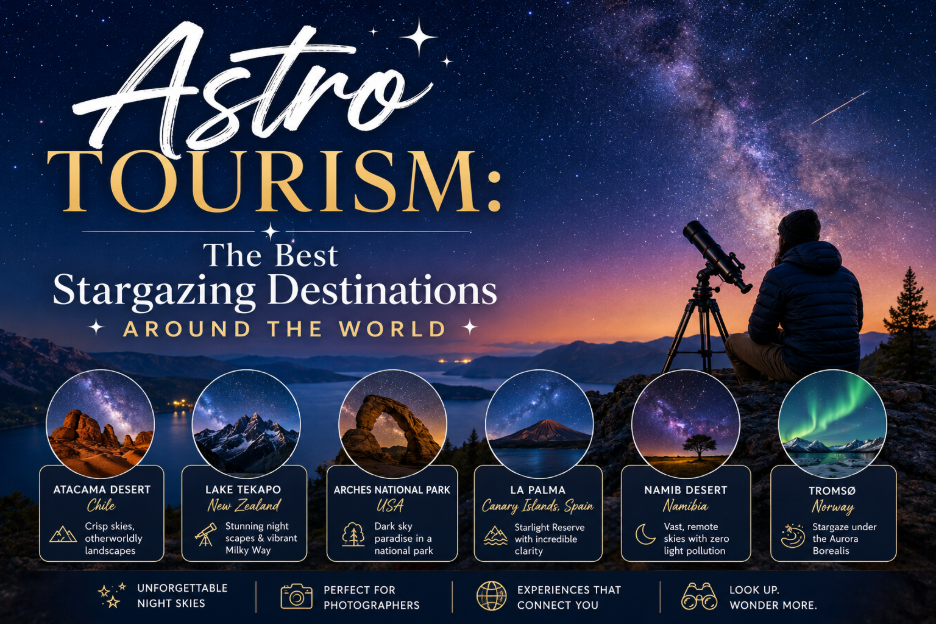
There is a moment, on a clear night far from the nearest streetlamp, when your eyes finally adjust and the sky stops looking like a sky and starts looking like a map of everything. The Milky Way shows up as a pale river instead of a phrase from a poem. A meteor streaks by before you can point at it. Somebody in your group goes quiet.That moment is, more or less, the whole business of astro tourism — and it has quietly become one of the fastest-growing niches in travel.
What Is Astro Tourism?
Astro tourism (sometimes written as astrotourism) means traveling to a place specifically to watch the night sky — stars, planets, meteor showers, the Milky Way, and sometimes the aurora — usually somewhere far enough from city lights that the sky is genuinely dark.
It sits at the crossroads of adventure travel, wellness travel, and old-fashioned wonder.
Unlike a lot of travel trends, this one has a real, measurable driver behind it: light pollution is spreading by roughly 10% a year. That means the number of places left on Earth with a truly dark sky keeps shrinking — and that scarcity is exactly what’s pulling travelers toward dark sky parks, remote deserts, and mountain observatories.
If you’ve ever typed “best places to see the Milky Way” into a search bar at 11 p.m., this guide is for you. Below is a working list of the world’s best stargazing destinations, organized by region, with the Bortle ratings, best travel months, and practical details you need to plan an actual trip — not just admire a photo.
In This Guide
- What makes a sky “dark”?
- North America
- Europe
- Asia & the Himalayas
- Africa
- Oceania & South America
- Trip-planning tips
- FAQ
What Makes a Sky “Dark,” Exactly?
Before the destinations — a quick bit of vocabulary that makes the rest of this guide far more useful.
The Bortle Scale rates night sky darkness from 1 to 9:
- Bortle 9 — city-center sky. You might spot the moon and a couple of planets, nothing more.
- Bortle 1 — as dark as Earth gets. The Milky Way casts a faint shadow, and you can see the zodiacal light, a soft glow caused by sunlight scattering off interplanetary dust.
Most destinations in this guide fall between Bortle 1 and 3.
DarkSky International (formerly the International Dark-Sky Association) is the body that certifies Dark Sky Parks, Reserves, Sanctuaries, and Communities worldwide based on how well they control light pollution. A certification means the lighting policy behind a destination is real — not just a marketing line.
New moon = darkest sky. The new moon phase, when the moon is essentially invisible, gives you the darkest possible viewing conditions. Planning around the lunar calendar matters more than almost anything else you can do.
North America: Deserts, Canyons, and Certified Dark Sky Parks
North America has more certified Dark Sky Places than any other continent, and the American Southwest has become the unofficial headquarters of astro tourism in the West.
- Big Bend, Texas & Mexico — The largest protected Dark Sky Place on the planet: a roughly nine-million-acre stretch of Chihuahuan Desert spanning Big Bend National Park, Big Bend Ranch State Park Complex, and the Black Gap Wildlife Management Area. Dry, still desert air makes for exceptional viewing.
- Cherry Springs State Park, Pennsylvania — Often called the darkest sky east of the Mississippi, a genuine rarity given how much of the eastern U.S. sits under a dome of light pollution. A favorite of astrophotographers nationwide.
- Great Basin National Park, Nevada — High altitude and remote desert combine for some of the clearest, calmest air in the country — ideal for both naked-eye viewing and telescope work.
- Cosmic Campground, New Mexico — Tucked inside the Gila National Forest, this site holds the rarer International Dark Sky Sanctuary designation, reserved for the darkest, most isolated sites of all.
Best time to visit: Late spring through early autumn, when the Milky Way core is visible and roads/campgrounds are fully accessible.
Europe: From English Moors to French Mountaintops
Europe isn’t the first continent people associate with dark skies, but it now has more than 30 designated International Dark Sky Parks, Reserves, and Sanctuaries — several a short drive from major cities.
- Exmoor National Park, England — Europe’s first International Dark Sky Reserve, with good public transport and Bortle Class 3 skies at viewpoints like Webber’s Post.
- Pic du Midi, France — High in the Pyrenees, centered on a working mountaintop observatory open to the public. Anchors France’s first International Dark Sky Reserve.
- Alqueva Dark Sky Reserve, Portugal — In the Alentejo region, one of the earliest Starlight Tourism destinations in the world. Skies reach Bortle Class 1–2, with a dedicated Dark Sky Route connecting viewpoints, telescope rental, and guided tours — a good pick if you want structure over a solo trek.
- Westhavelland Nature Park, Germany — Roughly 90 minutes from Berlin, and Europe’s largest dark sky reserve — proof a great stargazing trip doesn’t require a long-haul flight.
Asia and the Himalayas: India’s New Dark Sky Frontier
For travelers closer to home, India now has a genuine, world-class entry in this conversation.
Hanle Dark Sky Reserve, Ladakh is India’s — and South Asia’s — first officially notified Dark Sky Reserve, established in December 2022 across roughly 1,073 square kilometres of high-altitude desert in the Changthang Wildlife Sanctuary, at an elevation of about 4,500 metres.
- Sits around the Indian Astronomical Observatory, one of the highest astronomical observatories in the world
- Boasts Bortle-1 skies — the darkest rating there is
- Runs on a unique community model: local villagers trained as “astronomy ambassadors” host guided stargazing sessions from homestays, blending science with local sky lore
- Permits: Indian travelers need Ladakh’s environment fee and route permissions; foreign travelers need a Protected Area Permit and generally must travel in a group of at least two, since the area sits in a sensitive border region
- Best time to visit: May through September, when high mountain roads are open and skies stay clear
Hehuan Mountain Dark Sky Park, Taiwan is another regional standout — high elevation combined with easy accessibility for a trip that doesn’t demand a multi-day trek.
Africa: The Darkest Skies Left on Earth
If pure, uninterrupted darkness is the goal, Africa’s deserts are hard to beat.
- NamibRand Nature Reserve, Namibia — Holds Gold Tier International Dark Sky Reserve status, DarkSky International’s highest classification, within one of the least light-polluted regions recorded anywhere on the planet. A genuine bucket-list stop for serious stargazers and astrophotographers.
- Karoo, South Africa — Developed into a full astronomy tourism hub, helped by its proximity to the Southern African Large Telescope, one of the largest single optical telescopes in the world.
Oceania and South America: Southern Hemisphere Skies
The southern hemisphere offers something the north can’t: a different set of constellations, including the Southern Cross and, on the clearest nights, the faint glow of the Magellanic Clouds — two small companion galaxies to our own.
- Aoraki Mackenzie International Dark Sky Reserve, New Zealand — Covers Aoraki/Mount Cook National Park and the Mackenzie Basin. One of the earliest large-scale dark sky reserves in the world; some lodges even have retractable-roof observatories built into wine cellars.
- Atacama Desert, Chile — Frequently ranked among the driest, clearest places on Earth, which is why the world’s most powerful professional telescopes are built there. Travelers get extraordinary naked-eye views of the Milky Way’s galactic core.
Planning Your Stargazing Trip (astro tourism): What Actually Matters
A good astro tourism trip isn’t complicated, but a few details separate a forgettable night under the stars from an unforgettable one.
- Time it around the new moon. A full moon washes out everything but the brightest stars; a new moon gives you the darkest sky the calendar allows.
- Check the Bortle rating before you book. A quick search of any destination’s Bortle class, or a light pollution map, tells you exactly what to expect.
- Pack for cold nights — even in the desert. Desert temperatures fall sharply after dark, and mountain reserves like Hanle sit well above 4,000 metres. Warm layers matter more than most people expect.
- Bring a red-light torch, not a phone flashlight. White light ruins night vision for up to 30 minutes; red light preserves it.
- Give your eyes 20–30 minutes to adjust. Full dark adaptation takes time, and most first-timers give up just before the sky truly opens up.
- Check permits and access rules in advance, particularly for reserves in sensitive or border regions such as Hanle.
- Pack binoculars. A basic pair often shows you more of the Milky Way’s texture than a beginner telescope — and they’re far easier to travel with.
Frequently Asked Questions for Astro Tourism:
What is astro tourism?
Astro tourism is travel undertaken specifically to observe the night sky — stars, the Milky Way, meteor showers, planets, and sometimes the aurora — usually in places certified or known for minimal light pollution.
What is the darkest place in the world to see stars?
Several locations compete for this title, including Namibia’s NamibRand Nature Reserve, Chile’s Atacama Desert, and India’s Hanle Dark Sky Reserve — all of which reach or approach Bortle Class 1, the darkest rating on the scale.
When is the best time of year for stargazing(astro tourism)?
Generally, spring through early autumn in the northern hemisphere offers the longest dark hours with comfortable travel conditions. The Milky Way’s bright galactic core is best viewed roughly March through October. Always plan around a new moon for the darkest possible sky.
Do I need a telescope to enjoy astro tourism?
No. Many of the world’s best dark sky sites are spectacular to the naked eye alone. A pair of binoculars is a worthwhile upgrade, and most certified dark sky parks and reserves also run guided sessions with telescopes provided.
Is Hanle in Ladakh open to all travellers?
Yes — though Indian travelers need Ladakh’s environment fee and relevant route permissions, and foreign travelers require a Protected Area Permit and generally must travel in a group of at least two, since Hanle sits in a sensitive border region.
Internal Links
- Best Weekend Getaways
- Coolcations 2026: Why Everyone Is Choosing Cooler Destinations This Summer
- Best Destination Dupes 2026
- AI Travel Assistants: Plan Your Trip Under an Hour
- Packing Smart: Travel Light, Experience More
- Experience-Led Travel 2026
- Why More People Are Traveling Solo and Slowing Down