
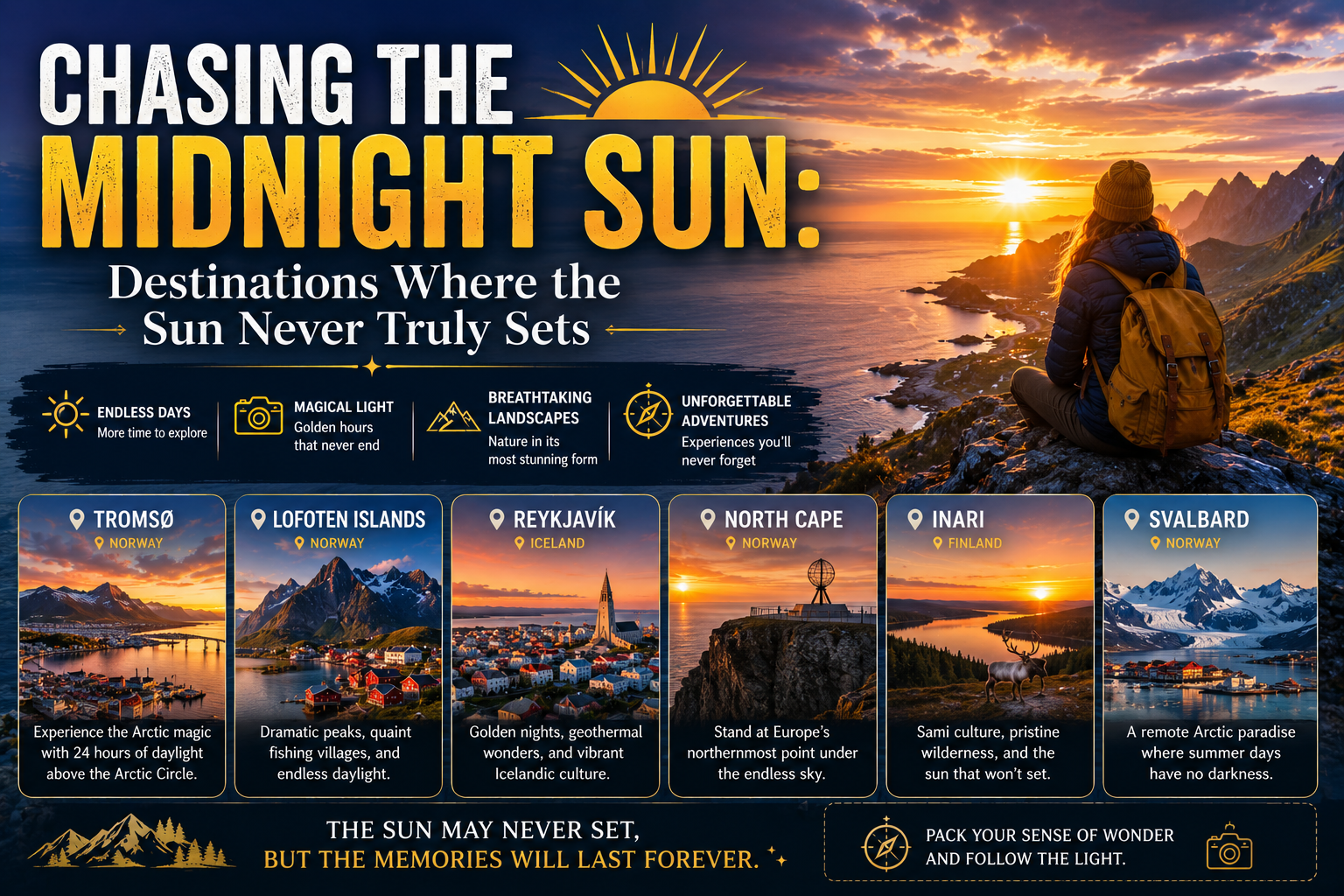
Everything you need to know about chasing the midnight sun — where to go, when to go, and how to plan around nearly 24 hours of daylight.
There is a strange thrill in stepping outside at eleven o’clock at night and finding the sky still bright, the shadows still long, and the world still wide awake. This is the promise of the midnight sun — a natural phenomenon that turns the usual rules of day and night upside down and hands travelers something close to twenty-four hours of golden light.
For a few short weeks each summer, a handful of destinations trade darkness for daylight almost entirely. If you have ever wanted to hike at 2 a.m., photograph a sunset that refuses to finish, or simply sit by a fjord while the sky glows amber past midnight, this midnight sun guide is for you.
Table of Contents
- What Exactly Is the Midnight Sun?
- 1. Norway: The Classic Midnight Sun Destination
- 2. Svalbard: The Ultimate Arctic Extreme
- 3. Iceland: Endless Light Over Fire and Ice
- 4. Greenland: Icebergs Under a Sun That Never Sets
- 5. Sweden and Finnish Lapland: Festivals Under an Endless Sky
- 6. Alaska and Northern Canada: The Midnight Sun Beyond Scandinavia
- When to Go and How to Plan a Midnight Sun Trip
- FAQ: Midnight Sun Travel
What Exactly Is the Midnight Sun?
The midnight sun happens because of the tilt of the Earth’s axis, roughly 23.5 degrees. During the Northern Hemisphere’s summer, the North Pole leans toward the sun, so places above the Arctic Circle — that invisible line at about 66.5°N — receive continuous daylight around the summer solstice.
How Far North Do You Need to Go to See the Midnight Sun?
The rule of thumb is simple: the farther north you travel, the longer the midnight sun lasts.
- Right at the Arctic Circle (66.5°N): one night of it, on the solstice itself
- Around 70°N: the light can stretch on for nearly two months
- As far as 78°N: the sun may not dip below the horizon for four months straight
When Does the Midnight Sun Season Happen?
The phenomenon usually peaks between the summer solstice on June 21st and continues, depending on latitude, into late July or even August. It is one of those rare travel experiences that photographs cannot fully capture — you really have to stand under that endless glow to understand it.
1. Norway: The Classic Midnight Sun Destination
Norway is where most travelers experience the midnight sun for the first time, and it remains one of the most reliable and accessible places to do so.
Lofoten Islands
The Lofoten Islands, scattered off the country’s northwest coast, are often called the most photogenic midnight sun destination on the planet. Jagged mountains rise straight out of the sea, fishing villages sit tucked into narrow coves, and the light lingers over it all in shades of gold and rose long after a normal sunset would have come and gone.
Hammerfest and North Cape
Farther north sits Hammerfest, widely regarded as the world’s northernmost town of its size, which enjoys near-continuous sunshine from May through the end of July. Nearby North Cape, mainland Europe’s northernmost point, gives travelers dozens of days of midnight sun and a dramatic cliffside view over the Barents Sea.
Tromsø
Tromsø offers a livelier base — a proper city with restaurants, museums, and nightlife, minus the total isolation of the far north.
2. Svalbard: The Ultimate Arctic Extreme
If Norway is the gateway, Svalbard is the destination for travelers who want to go all the way. This remote Norwegian archipelago, sitting roughly halfway between the mainland and the North Pole, holds the longest midnight sun of any inhabited place on Earth, with the light lasting close to four months at its longest stretch.
What to Do in Svalbard
Longyearbyen, the main settlement, becomes a base for polar bear country, glacier walks, and boat trips past looming ice cliffs.
Travel Rules to Know Before You Go
Travel here comes with a few unusual rules. Wandering outside town without a guide and a rifle for polar bear protection simply is not allowed, so most outdoor time is organized through guided excursions. It is remote, it is not cheap, and it is unlike anywhere else the midnight sun can be seen.
3. Iceland: Endless Light Over Fire and Ice
Iceland’s capital, Reykjavik, is one of the easiest places to witness the midnight sun without venturing deep into the Arctic. Even though the city itself sits just south of the Arctic Circle, June nights there rarely turn properly dark, and the soft twilight glow lasts until the sun climbs back up again a few hours later.
What to Do in Reykjavik
Travelers can soak in geothermal lagoons, drive the Ring Road past waterfalls and volcanic plains, or simply wander the harbor at midnight while the sky holds onto its color.
Grímsey: A True Midnight Sun Experience
For those chasing a true mid night sun rather than a lingering twilight, the island of Grímsey, which actually crosses the Arctic Circle, offers full round-the-clock daylight in June.
4. Greenland: Icebergs Under a Sun That Never Sets
Greenland offers, without much argument, the most dramatic backdrop for the mid night sun. Ilulissat, home to the UNESCO-listed Icefjord, is the star of the show, with massive icebergs calving into the sea beneath a sky that simply refuses to darken.
Best Time to See the Midnight Sun in Greenland
Midsummer here is short and intense — flowers bloom in a rush, wildlife stirs, and the town’s harbor stays busy well past what would normally be bedtime. In Ilulissat, the mid night sun period generally runs from late May into late July.
Getting to Greenland
Getting around requires a different mindset than most trips. There are no roads connecting Greenland’s towns, so travelers fly, take a boat, or simply do not go. That isolation is part of what makes the destination feel so untouched.
5. Sweden and Finnish Lapland: Festivals Under an Endless Sky
Swedish Lapland leans into the mid night sun with genuine enthusiasm.
Kiruna’s Midsummer Festival
Toward the end of June, the town of Kiruna hosts its annual midsummer festival, and locals celebrate straight through a night that never really arrives.
Finnish Lapland
Across the border, Finnish Lapland offers a similarly magical stretch of endless daylight, paired with reindeer, saunas, and the kind of forest stillness that makes the long light feel almost meditative rather than disorienting.
6. Alaska and Northern Canada: The Midnight Sun Beyond Scandinavia
The mid night sun is not only a European story.
Alaska
In Alaska, towns like Utqiaġvik (Barrow) and Fairbanks see extended daylight through the summer months, and Fairbanks even hosts a midnight baseball game around the solstice, played entirely without stadium lights.
Northern Canada
In northern Canada, communities above the Arctic Circle experience the same round-the-clock daylight, offering a quieter, less crowded alternative to the well-worn Scandinavian trail.
When to Go and How to Plan a Midnight Sun Trip
The peak window for the midnight sun generally runs from the summer solstice in late June through the middle of July, though the exact dates shift depending on how far north a destination sits.
Book Early
Accommodation matters, since this is also peak tourist season across the Arctic.
Pack an Eye Mask
Even seasoned travelers find it strange to sleep when the sky outside looks like late afternoon.
Build in Slower Days
The temptation to stay outside and explore around the clock is real, and jet lag has nothing on midnight-sun lag.
FAQ: Midnight Sun Travel
What Causes the Midnight Sun?
The midnight sun happens because of the roughly 23.5-degree tilt of the Earth’s axis. During the Northern Hemisphere’s summer, the North Pole leans toward the sun, giving places above the Arctic Circle continuous daylight around the solstice.
Where Is the Best Place to See the Midnight Sun?
Norway’s Lofoten Islands are often considered the most photogenic midnight sun destination, while Svalbard offers the longest stretch of continuous daylight of any inhabited place on Earth.
When Is the Midnight Sun Season?
The mid night sun typically peaks between the summer solstice on June 21st and continues into late July or August, depending on how far north you travel.
Can You See the Midnight Sun Without Going Deep Into the Arctic?
Yes. Reykjavik, Iceland sits just south of the Arctic Circle, but June nights there rarely turn properly dark, making it one of the most accessible places to experience the phenomenon.
Final Thoughts
Chasing the mid night sun means chasing something the rest of the world rarely gets to see: a sky that holds onto its light instead of letting it go. Whether it is the fjords of Lofoten, the icebergs of Ilulissat, or the endless golden hour over Reykjavik, these destinations offer a version of summer that feels almost otherworldly. For travelers planning their own route through the land of the mid night sun, the only real difficulty is deciding when, reluctantly, to finally call it a night.
Internal Links
- Coolcations 2026: Why Everyone Is Choosing Cooler Destinations This Summer
- Experience-Led Travel 2026
- Best Weekend Getaways
- Packing Smart: Travel Light, Experience More
- AI Travel Assistants: Plan Your Trip Under an Hour
- Best Destination Dupes 2026
- Why More People Are Traveling Solo and Slowing Down